Low friction on a surface whose behaviour changes with temperature, pressure and motion
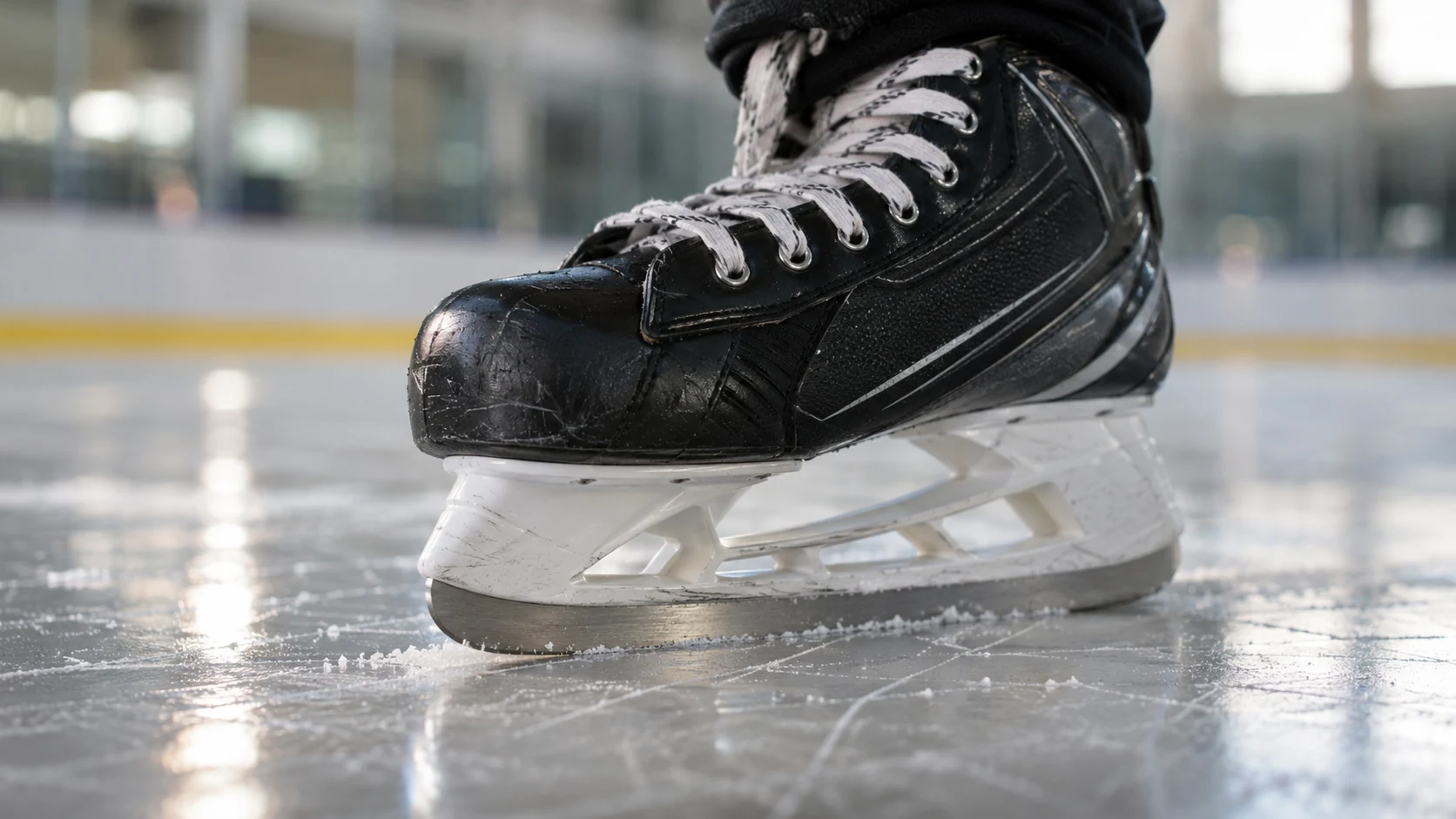
On ordinary ground, a narrow metal blade is an awkward way to travel. On good rink ice, a small push carries a skater several metres. Yet the same blade can bite into the surface for a turn or a stop. Ice has to provide both a low-resistance glide and enough sideways grip to control it.
There is a short textbook answer involving a thin water layer. There is also a more interesting answer: the interface between blade and ice changes as it is loaded, heated, sheared and reshaped. Explaining that interface requires more than one familiar property of water.
Gliding means low friction, not no friction
Friction is the resistance to relative sliding at a contact. A coasting skater still slows, and pushing a blade across ice still requires force. The striking fact is that the resistance can be small enough to make long glides practical.
Research on ice contacts measures this resistance while changing temperature, load, slider shape and speed. Those measurements do not produce a single universal friction value for “ice”. They describe a contact under specified conditions. [1]
That is why a rink can feel different from one session to another without changing into a different substance. Surface condition and the way the blade meets it are part of the physical problem. The word “slippery” summarizes an experience; it does not identify one mechanism.
Why pressure melting is an incomplete explanation
Ordinary ice has an unusual relationship between pressure and melting temperature. That makes it tempting to say a skater’s concentrated weight melts the ice directly under the blade, providing a tiny liquid track.
University of Amsterdam researchers explain why this is insufficient on its own: under common skating conditions, particularly on colder ice, the required pressures do not give a satisfactory general account. Ice can also show low sliding resistance at contacts that the simple pressure-melting story fails to explain. [2]
Pressure still matters. It changes the local contact and can push the blade into the surface. The correction is not “pressure has no effect”; it is “weight melting a water track is not a complete explanation of skating”.
This is separate from the reason ice floats on water. Floating concerns the relative densities of bulk ice and liquid water. Skating concerns what happens at a moving, stressed surface contact.
The outermost molecules behave differently
Water molecules at an ice surface do not have precisely the same surroundings as molecules buried inside the crystal. Research combining friction measurements, spectroscopy and molecular simulations has linked low friction with the mobility of surface molecules.
A 2018 account from the Max Planck Institute for Polymer Research described more mobile surface molecules at warmer temperatures and much greater sliding resistance at extremely low temperatures. In that work, changing molecular mobility tracked the measured change in friction. [3]
This molecular picture is not the same as imagining a visible puddle under every skate. The important changes can occur at a scale far below what an ordinary rink photograph reveals. An illustration showing a thick blue layer should not be mistaken for a measurement of the actual interface.
Sliding can alter the contact it depends on
Moving surfaces dissipate energy through friction. That can heat the local contact and contribute to lubrication. At the same time, the blade presses into and deforms ice, which can add resistance. A changing speed can alter both effects rather than simply making everything easier or harder.
The 2021 experiments reported by Liefferink and colleagues separated temperature-dependent surface friction from the resistance associated with ploughing near the melting point. They showed that pressure, temperature and speed interact, and that slider geometry helps determine how deeply the contact deforms the ice. [1]
A practical way to think about it is a balance sheet. Processes that permit easier shear at the interface reduce resistance; processes that force the blade to displace more ice add resistance. The observed glide is the outcome of that balance, not evidence that every contribution has vanished.
The interfacial layer may not behave like ordinary water
Even where a lubricating layer is measured, calling it simply “water” may hide important mechanical properties. A 2019 experiment used a small bead sliding on ice to probe the layer while measuring friction.
The researchers reported a response with both viscous and elastic characteristics and a viscosity much greater than that of ordinary liquid water under some conditions. This helps explain why a thin interface cannot automatically be treated like a miniature version of water spilled on a kitchen floor. [4]
The scope matters: a bead experiment is not a complete hockey skate carrying a player through a turn. It is a way to isolate and measure part of the contact physics. Its value comes from making a difficult interface accessible to controlled testing.
Newer research is still testing how lubrication develops
A 2025 molecular-simulation study proposed another route to self-lubrication. In the simulated contacts, sliding disrupted crystalline order and produced a liquid-like interface without requiring ordinary thermodynamic melting as the dominant process. The authors called this cold, displacement-driven amorphization. [5]
This should be reported as a result from molecular simulations, not as a declaration that heating never matters on a rink. Different studies examine different materials, temperatures, speeds and scales. A proposed mechanism has to be connected carefully to the conditions of a real blade.
The continuing research is part of the explanation, not an embarrassment to be edited out. Low friction is easy to experience. Establishing what produces it at a hidden, moving interface is a much harder experimental task.
| Factor | Why it matters | Oversimplification to avoid |
|---|---|---|
| Temperature | Affects surface mobility and ice hardness. | Colder ice is always faster. |
| Local pressure | Changes molecular motion and penetration of the surface. | More pressure only creates more lubrication. |
| Sliding speed | Changes heating, shear and deformation conditions. | One friction value applies at every speed. |
| Blade finish and geometry | Determine where and how the load is carried. | A skate is just an infinitely thin line. |
| Ice preparation | Changes the surface presented to the blade. | All ice at the same temperature is identical. |
Why a skate can glide forward and grip sideways
Blade orientation changes how it interacts with ice. A smooth running surface can slide with relatively low resistance, while an edge pressed into the ice can resist sideways movement. Grip involves deformation and contact forces as well as the properties that permit gliding.
The Amsterdam researchers connect conventional skate design with this balance: smooth surfaces help keep resistance low, while edges provide higher-pressure contacts when grip is needed. [2]
Think about the difference between coasting and deliberately setting an edge. The skater has not changed the chemical identity of the blade or the rink. The contact geometry and loading have changed. That is enough to make “slippery ice” support a controlled turn rather than uncontrolled motion.
Rink water and preparation also enter the picture
A 2026 study examined how dissolved solids in rink-making water affected ice hardness and skate-to-ice friction in its test conditions. The measured differences show why even the water used to build a rink can be relevant to performance. [6]
The result is not a universal recipe for every rink. It is another controlled comparison, adding water quality to the variables that can influence an engineered ice surface. A precise temperature alone does not describe every feature of the finished ice.
Likewise, a commonly discussed favourable temperature near minus seven degrees Celsius comes from particular experiments and speed-skating practice. It should not be turned into a universal target for figure skating, hockey, recreational rinks and every blade design. [3]
How to interpret what you feel on the ice
If one session feels slower than another, the sensation alone cannot identify a cause. A rougher surface, a different blade condition, softer ice or a change in technique can alter the experience. Several may change together.
A useful observation separates them. Note whether the difference appears during a straight glide or mainly when setting an edge. Ask whether it follows a particular pair of skates or a particular part of the rink. These are clues for comparison, not a substitute for measurements or coaching.
Questions readers ask
Do skates glide with zero friction?
No. Resistance is low under suitable conditions, but it remains present and causes a coasting skater to lose speed.
Does body weight simply melt the ice?
That familiar explanation is incomplete. Temperature, surface mobility, deformation and sliding processes all need consideration.
Is there a visible water layer under the blade?
The relevant interface can be extremely thin and mechanically complex. An ordinary photograph does not reveal its structure.
Why do edges help a skater stop?
An edge changes local pressure and deformation, allowing the blade to resist sideways motion rather than merely glide along the surface.
Have scientists completely settled the mechanism?
No single simple account covers every contact condition. Experiments and simulations continue to test how the competing contributions work.
A glide is a changing interface
The ice is doing more than supporting a narrow blade. Its surface molecules move, its structure can deform, and the contact changes while the skater travels. That changing interface explains why skating can be easy to enjoy and surprisingly difficult to reduce to one sentence.
Continue exploring
Sources and further reading
- Liefferink et al., Physical Review X (2021) — Friction on Ice: How Temperature, Pressure, and Speed Control the Slipperiness of Ice
- University of Amsterdam (2021) — Why can we skate on ice?
- Max Planck Institute for Polymer Research (2018) — The Slipperiness of Ice Explained
- Canale et al., Physical Review X (2019) — Nanorheology of Interfacial Water during Ice Gliding
- Atila, Sukhomlinov and Müser, Physical Review Letters (2025) — Cold Self-Lubrication of Sliding Ice
- Sports Engineering (2026) — Effect of water quality on ice hardness and skate-to-ice friction in ice rinks
Keep exploring.
One remarkable idea at a time—nature, science, history and beyond.
Last updated November 6, 2026.

Barnakle Editorial Team
Barnakle Editorial Team is the collective byline used for Barnakle’s editorial articles. The contributor profile explains the team identity and links to the publication’s editorial policies.
More from the editorial team →