A spinning wing changes its own orientation as it flies
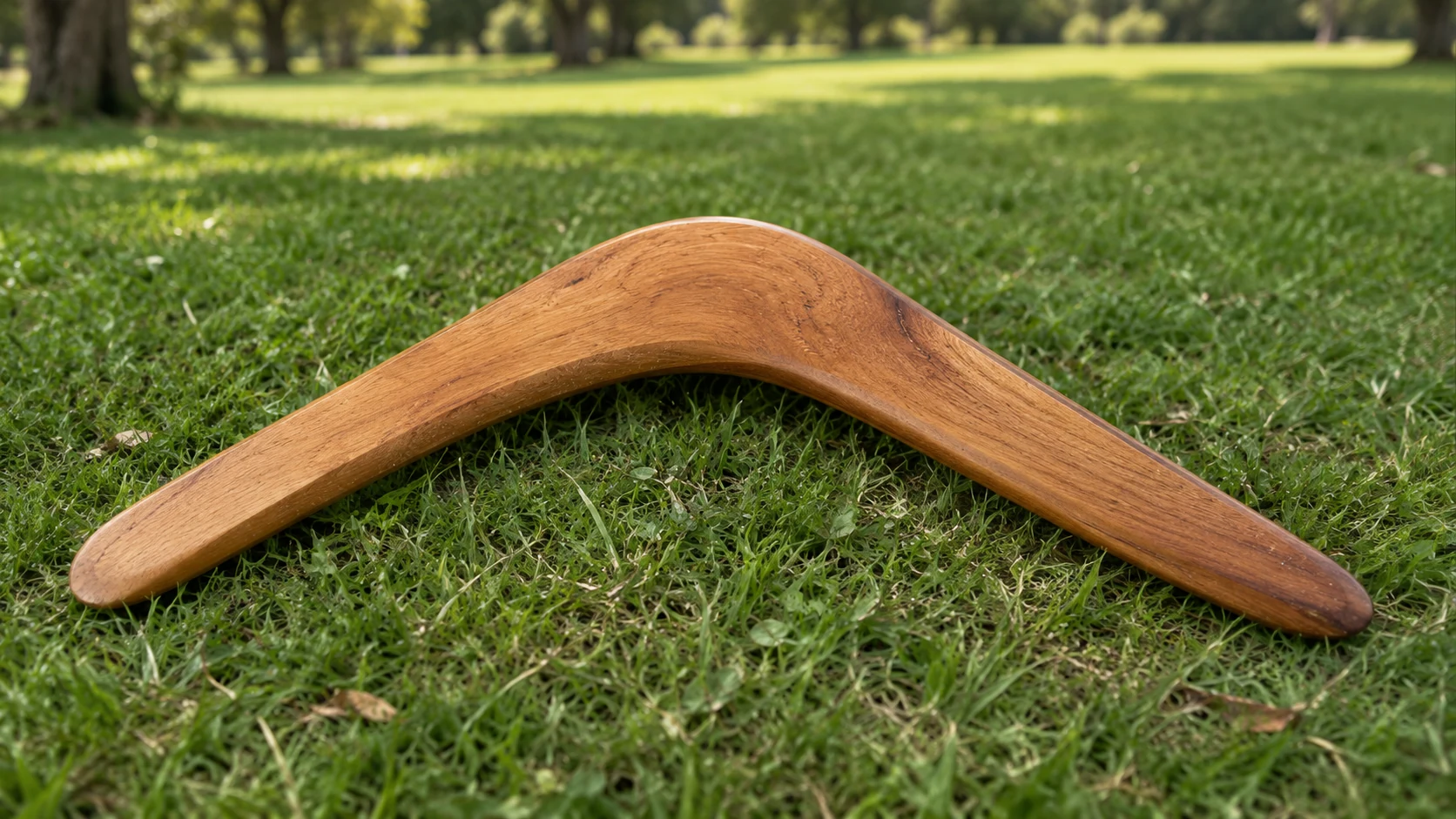
A returning boomerang does not travel outward, stop and somehow decide to reverse. It follows a curved route through the air. The mystery becomes easier when you separate three things happening together: forward motion, rotation and a changing orientation.
That explanation also needs a qualification at the start. Not every object called a boomerang is designed to return.
Not all boomerangs come back
The National Museum of Australia explains that most Australian boomerangs are of non-returning varieties. Boomerangs have different forms and uses across Aboriginal cultures; the familiar returning shape is not a universal description of every community’s technology. [1]
For the flight question here, “boomerang” means a design intended to return under suitable conditions. A non-returning tool is not a failed returning toy. It may be doing exactly what it was made to do.
This distinction prevents a common mistake in demonstrations: judging every curved throwing object by whether it circles back. The intended function matters before any aerodynamic explanation begins.
The arms are wings, not merely a bent stick
A returning boomerang’s arms have shaped surfaces that interact with airflow. The Australian Museum emphasizes the cross-sectional shape of the arms as well as the conspicuous curve. The useful analogy is a wing moving through air, rather than a flat piece of wood whose outline alone guarantees a return. [2]
For a familiar two-arm design, spinning moves those wing-like surfaces through the air repeatedly. Forward motion adds another contribution to their airspeed. The object is therefore both travelling along a path and sweeping its arms around a centre of rotation.
Lift is named relative to the airflow and the lifting surface. It is not always a force pointing straight up towards the sky. A tilted or nearly upright spinning object can direct an important part of its aerodynamic force sideways.
For the broader wing story, read how airplanes stay in the air. The boomerang adds a complication that a fixed aircraft wing does not have: its different portions continually exchange positions as it rotates.
Why the advancing side sees different airflow
At a given instant, rotation carries one side in the same general direction as the boomerang’s forward travel. On the opposite side, rotation acts against that forward component. The airspeed experienced by the wing sections is consequently unequal.
The Australian Museum’s flight explanation uses the upper and lower arms of a typical near-vertical throw to illustrate this difference. The two kinds of motion combine on the advancing side and oppose one another on the retreating side. [3]
The words “advancing” and “retreating” describe positions within the rotation. They do not permanently label one wooden arm as the fast one. After part of a revolution, a particular arm occupies a different position and encounters different relative airflow.
Imagine putting a small imaginary marker on one tip and following it in slow motion. The marker moves around the spinning centre while that centre itself travels through the air. Its motion is not the same as the motion of the centre alone.
Unequal lift produces a turning influence
Different aerodynamic forces acting at different positions can produce a torque: a turning influence on the rotating object. Because the boomerang is already spinning, the result is not adequately described as one arm simply being pushed straight over.
Georgia State University’s HyperPhysics explanation connects the asymmetric lift to a torque that changes the spin axis. This gyroscopic precession is central to the returning trajectory. The aerodynamic forces and the object’s rotation have to be considered together. [4]
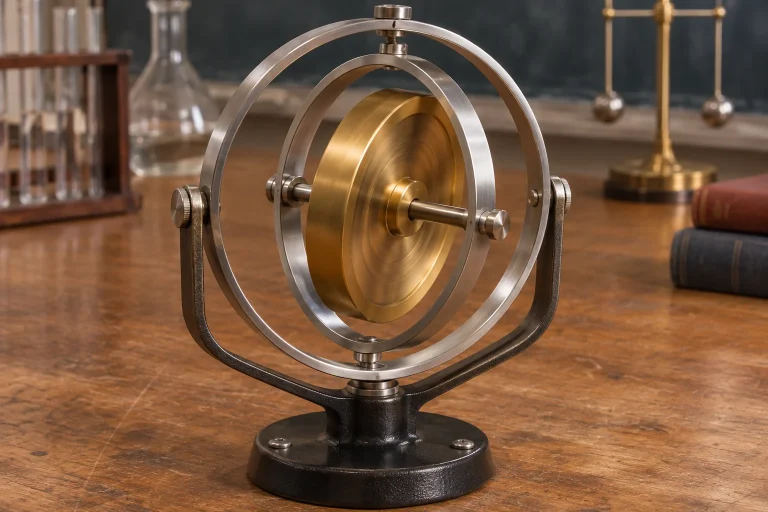
Angular momentum is useful here because it has a direction associated with the spin axis. A torque can change that direction. As the orientation changes, so does the direction of the aerodynamic force, allowing the overall path to bend.
“It spins” is therefore an incomplete answer. Spin changes how the object responds, but the surrounding air supplies the aerodynamic forces involved in turning its flight.
Why the return is a curve rather than a reversal
NASA’s four-wing paper-boomerang activity links returning flight to lift, torque and gyroscopic precession. Its model changes orientation during the flight, illustrating that the object is not confined to one fixed attitude from release to landing. [5]
A useful mental picture is a path being steered continuously by forces whose direction is changing. The boomerang does not need a separate “go home” force that switches on at the farthest point.
This also explains why a video viewed from one angle can be confusing. A spinning object’s orientation and its direction of travel are different quantities. Seeing it tilt does not mean it has stopped moving forward along its current curved route.
| Motion | What changes? | What it helps explain |
|---|---|---|
| Translation | The position of the whole object | Why it moves away from the launch point |
| Spin | The positions of the arms around the centre | Why the arms repeatedly sweep through air |
| Precession and other orientation changes | The direction of the spin axis and lifting surfaces | Why aerodynamic forces can keep bending the path |
A real flight is more complicated than a perfect circle
Detailed research models include aerodynamic forces, moments and the motion of the whole body. John Vassberg’s flight-dynamics study combines aerodynamic modelling with gyroscopic behaviour and examines a traditional V-shaped design as a case study. The paper treats orientation and stability as part of the problem, rather than assuming the object must follow a geometric circle. [6]
The simple explanation is valuable because it identifies the ingredients. It is not a calculator that predicts an exact landing point from a photograph.
For example, two objects with similar outlines may differ in cross-section, mass distribution and other design features. Calling both “V-shaped” discards information that matters to their flight. A neat silhouette is not a full aerodynamic specification.
Drag changes both travel and spin
Air resistance affects the boomerang’s forward motion and rotation. In a 2020 study, researchers modelled drag force and drag torque and compared simulated flight with measurements from a tracked boomerang. Their measured path had a teardrop-like shape, and the paper reported remaining differences between simulation and measurement. [7]
That comparison is a good reminder of what a model is for. It can test whether proposed forces account for observed behaviour without implying that every detail is settled or that every throw will be identical.
A returning flight also spends energy. The spin and forward motion supplied at launch do not continue unchanged forever. The object eventually descends; its return is not a source of perpetual motion.
Does the boomerang need exactly two arms?
No. NASA’s educational model has four wings, which makes a useful counterexample to the idea that the familiar elbow-shaped outline is the only possible returning form. The important issue is how a design’s lifting surfaces and rotating motion work together. [5]
That does not make the traditional two-arm design irrelevant. It means the visual feature most easily recognized by a human is only one part of the engineering.
The Australian Museum’s discussion of boomerang flight likewise emphasizes thinness, surface area and wing-like properties. An account focused only on “a curved stick” leaves out the surfaces that generate aerodynamic forces. [8]
Frequently asked questions
Will any curved stick return?
No. Returning flight depends on a suitable aerodynamic design and motion. A curved outline alone does not establish the required wing surfaces, balance or flight behaviour. [2]
Does it aim for the person who threw it?
No. It follows a trajectory determined by the object, its motion and its interaction with the air. “Returns to the thrower” describes a successful outcome near the starting area, not a homing ability.
Why does spinning matter?
Spin moves the arms through the air and gives the object angular momentum. Aerodynamic torque then changes the direction of that angular momentum, contributing to the curved flight. Spin and airflow play different, connected roles. [4]
Is a returning boomerang guaranteed to come back?
No. A design intended to return still depends on suitable launch and flight conditions. The distinction between a returning design and a successful return is as important as the distinction between a wing and a complete flight.
Keep exploring
Sources and further reading
Research and institutional references checked on November 7, 2026. Journal abstracts and public research summaries are distinguished from full-text papers in the references where applicable.
- National Museum of Australia — Earliest evidence of the boomerang in Australia
- Australian Museum — The Boomerang is Curved to Fly
- Australian Museum — The returning Boomerang: how it flies
- Georgia State University, HyperPhysics — Boomerang
- NASA Glenn Research Center — Four Wing Paper Boomerang
- Vassberg (2012) — Boomerang Flight Dynamics, AIAA research paper
- Gudem et al., AIAA (2020) — Flight Dynamics of Boomerangs: Impact of Drag Force and Drag Torque (author-hosted PDF)
- Australian Museum — Why a Boomerang flies
Keep exploring.
One remarkable idea at a time—nature, science, history and beyond.
Last updated November 8, 2026.

Barnakle Editorial Team
Barnakle Editorial Team is the collective byline used for Barnakle’s editorial articles. The contributor profile explains the team identity and links to the publication’s editorial policies.
More from the editorial team →