Some of the ocean's most productive regions are supplied by water rising from below. Upwelling carries subsurface water towards the surface, often delivering nutrients that support phytoplankton growth in the sunlit layer.
The process links winds and ocean circulation with food webs. It does not mean every patch of cold surface water will produce the same ecological response.
Surface water must be replaced
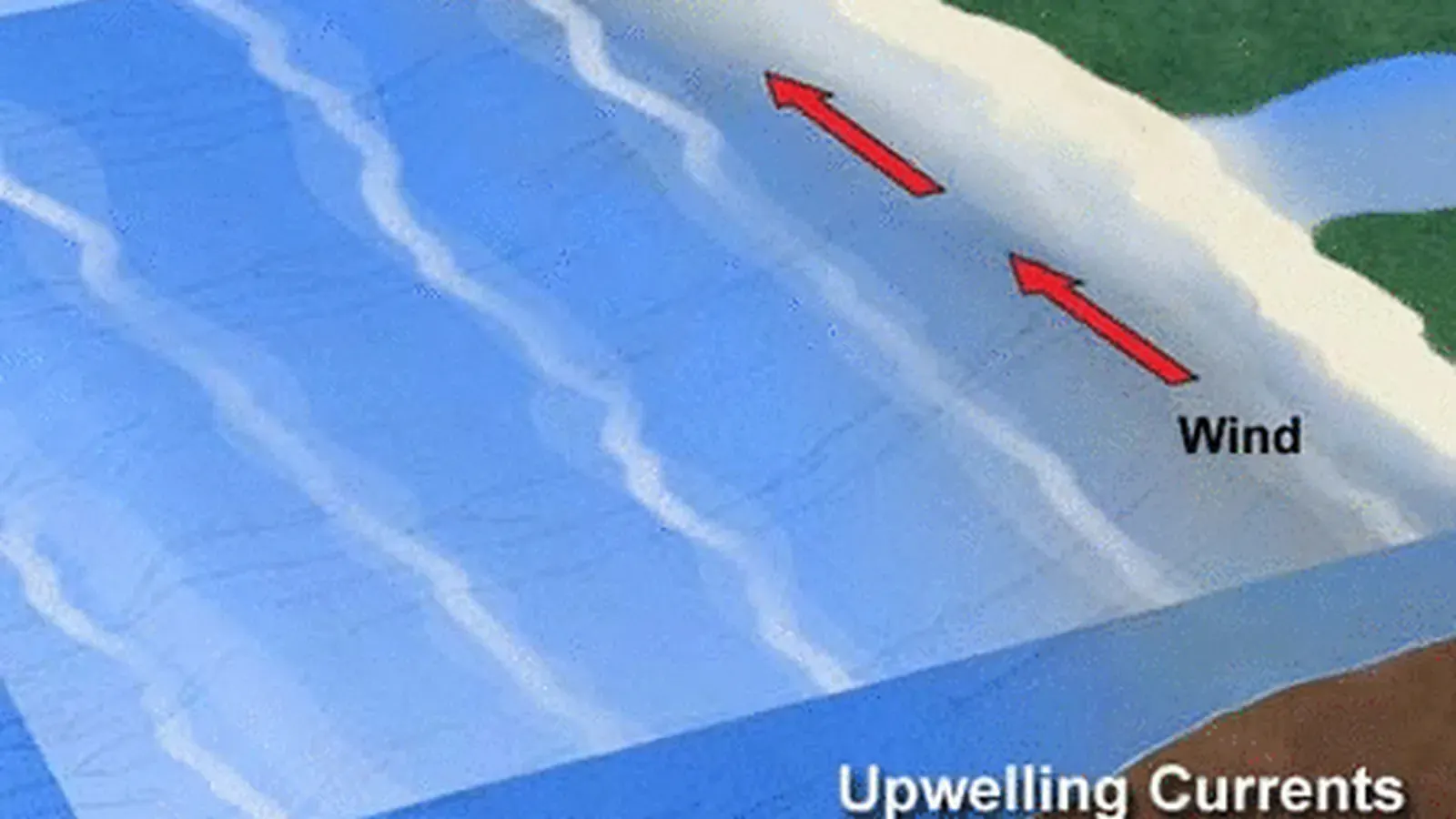
In an idealised coastal setting, winds drive a net movement of surface water away from the shore. Water from below then rises to replace it. Earth's rotation contributes to the relationship between the wind and the net transport.
The direction depends on the hemisphere and coastline. NOAA's explanation of coastal upwelling therefore focuses on how water is displaced rather than saying wind always pushes it directly offshore wherever it blows.
Nutrients have accumulated below
Nutrients released as sinking organic material decomposes can be present in subsurface water. When that water reaches a region with sufficient light, phytoplankton can use the renewed supply.
This helps explain why upwelling can support rich food webs even though the process itself is a movement of water, not the creation of new nutrients. The physical circulation makes an existing resource available in a different place.
Productivity works through a food web
Phytoplankton growth can support zooplankton, forage fish and larger consumers. NOAA Fisheries describes this connection in the California Current, where seasonal upwelling affects a wider ecosystem.
The response is not instantaneous at every level. Grazing, transport and the life cycles of consumers influence how a nutrient input becomes food for fish, seabirds or marine mammals. Timing can matter as much as the total amount of upward water movement.
The water can bring difficult conditions too
Subsurface water may have low oxygen as well as high nutrient concentrations. Bringing it onto a continental shelf can therefore create environmental pressures alongside the productivity benefit.
Decomposition of newly produced organic matter can also consume oxygen. The outcome depends on circulation, ventilation and the local balance of production and respiration. “Nutrient-rich” should not be treated as a synonym for ideal habitat for every organism.
Scientists measure more than temperature
Cold surface water can be one sign of upwelling, but researchers also use winds, currents, nutrient measurements and biological observations. NOAA's upwelling indicators distinguish water transport from the nutrient supply associated with that transport.
Satellite observations help describe surface patterns over large areas, while in-water measurements provide information about the water column. Together they connect the forcing with the ecological response.
A productive system can still change
Seasonal variability, unusual winds and broader ocean conditions can alter both the source water and its delivery. Understanding upwelling therefore requires following a changing chain: water movement, nutrient availability, primary production and the organisms that depend on it. The chain explains the richness of many coastal seas without implying a fixed annual supply.
Explore a related question
How Kelp Forests Reshape Coastal Ecosystems
Sources and further reading
Keep exploring.
One remarkable idea at a time—nature, science, history and beyond.
Last updated October 27, 2026.

Barnakle Editorial Team
Barnakle Editorial Team is the collective byline used for Barnakle’s editorial articles. The contributor profile explains the team identity and links to the publication’s editorial policies.
More from the editorial team →