Road loops, cameras and radar send presence information to a controller that safely chooses when phases may change
You arrive at a red light, stop over a rectangular cut in the pavement and wait. The rectangle may contain an inductive loop, but it is not usually weighing your car. It detects an electrical change. That detection then becomes a request to a controller, which has other vehicles, pedestrians and timing constraints to consider before a green light can appear.
A road loop senses a changed electrical circuit
Installers cut a rectangular or circular pattern into the road, place insulated wire in the slot and connect it to detector electronics. Alternating current creates an electromagnetic field around the loop.
Conductive metal in a vehicle supports eddy currents and alters the coil’s effective inductance and loss. Electronics detect the change relative to a tuned baseline and report presence or passage to the controller.
Size, number of turns, placement and detector tuning influence which vehicles are seen. Motorcycles and bicycles contain less metal and can be missed when a loop is poorly positioned, damaged or configured.
The loop and its electronics form a sensing system with a baseline electrical behaviour. Conductive parts of a vehicle alter that behaviour when they enter the field. Detection therefore depends on vehicle geometry, position and detector setup as well as on the presence of metal. A heavy object is not automatically a stronger or more useful target simply because it is heavy.
Sources: [1]
Other detectors observe traffic from above
Video systems analyse selected zones in an image and infer occupancy or motion from changing pixels and learned features. Lighting, shadows, snow, lens contamination and occlusion can reduce reliability.
Microwave sensors transmit radio energy and analyse echoes to detect presence, range or motion. Overhead installation avoids cutting pavement, though alignment and scene geometry still matter.
Cameras, radar and magnetic sensors infer presence in different ways. None supplies an infallible description of the whole intersection. A camera can be affected by occlusion and weather; a radar installation has its own coverage and configuration limits. Choosing a detector means matching its strengths to the site and maintaining that match.
Sources: [1]
Detection requests a movement; it does not command green
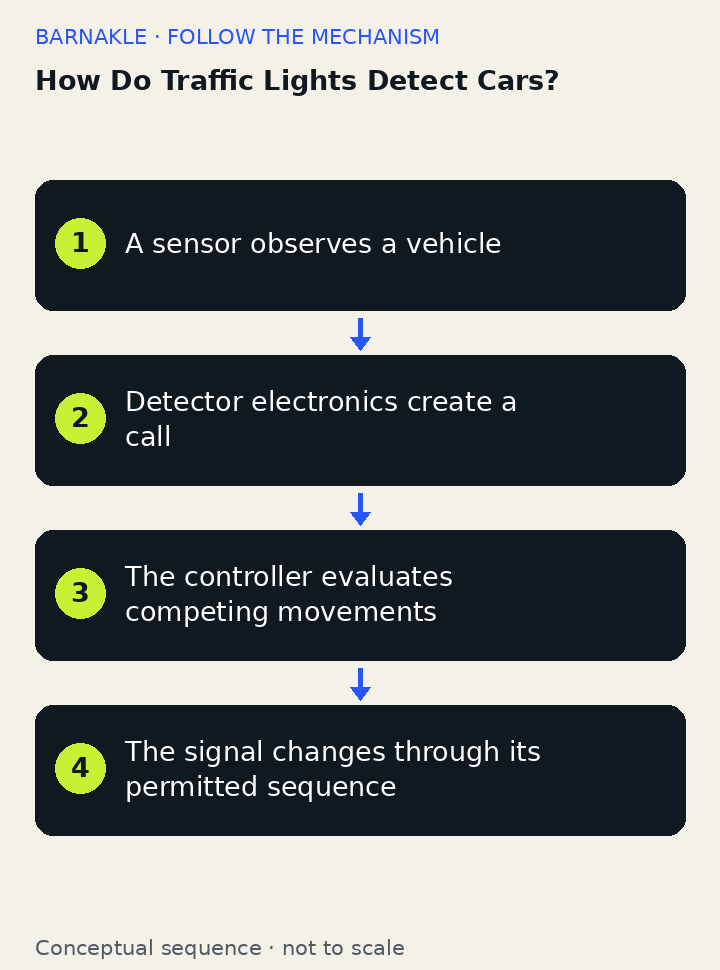
Detection sets or extends a request for a movement. The controller considers minimum green time, gap timing, pedestrian clearance and competing calls before deciding whether the current phase should continue or terminate.
Yellow warns that right of way is ending, and an all-red interval can allow the intersection to clear. Conflict monitoring prevents incompatible green indications even if a detector or software request is wrong.
Signals along a major road can follow a shared cycle and offset to create progression. A side-street vehicle may be detected immediately but wait until its movement fits the coordinated and safe phase sequence.
A controller must decide between competing requests within a permitted sequence. A vehicle can be detected correctly yet wait while another movement receives its minimum service or pedestrians complete a crossing interval. Coordination along a corridor adds another constraint. Waiting alone is therefore insufficient evidence that a sensor failed to see a vehicle.
Sources: [3]
A working signal depends on context and maintenance
Broken loop wires, shifted cameras, communications faults and stuck calls can create unusual operation. Controllers record status, and agencies use inspection and fallback timing to keep the junction functioning.
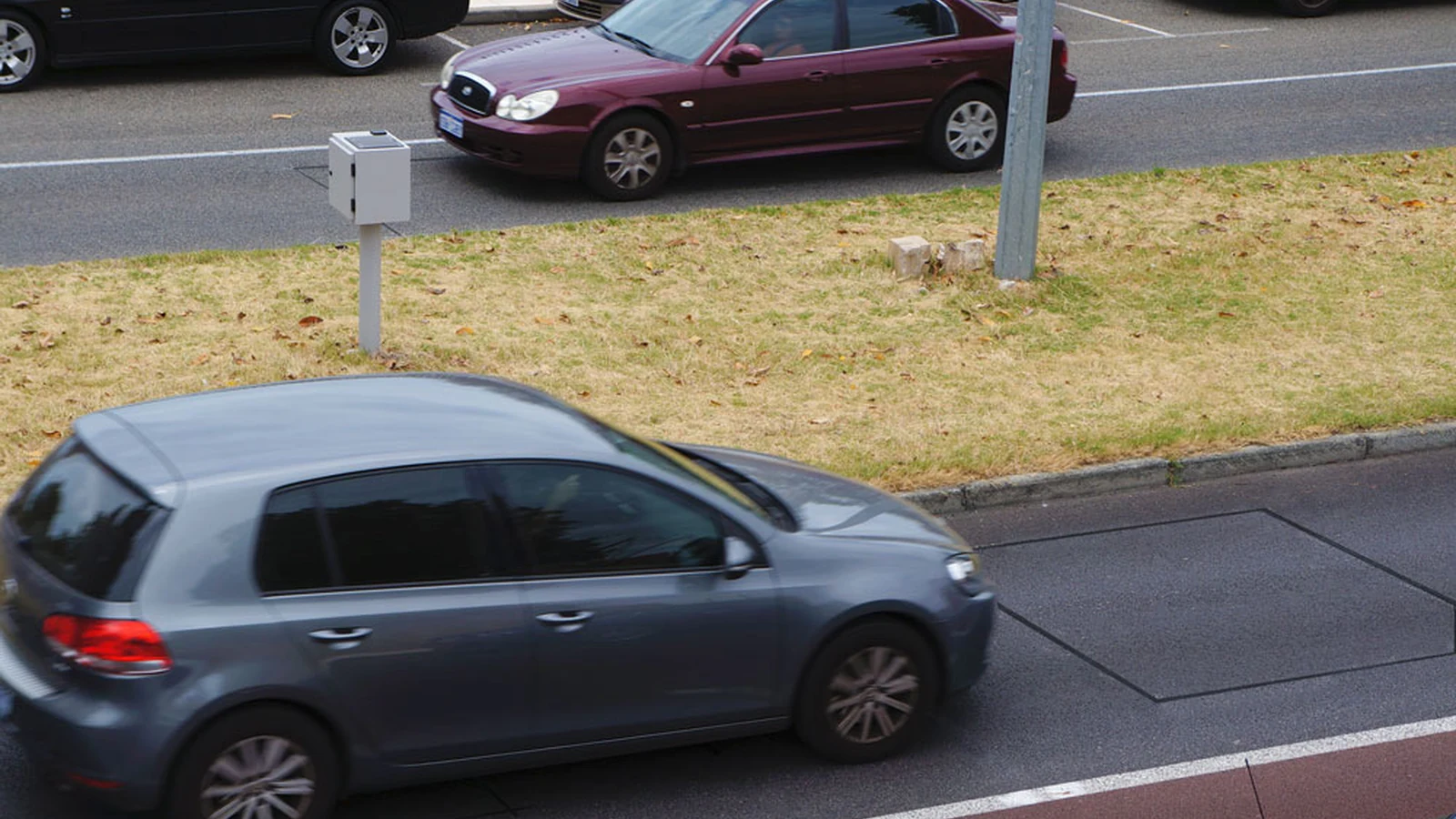
Headlight-flashing stories mix up ordinary traffic detection with specialized authorized priority or preemption systems. They are different technologies and functions. Similarly, a camera-shaped unit near a signal does not, by its shape alone, establish that it records identifying footage for enforcement. The installed equipment and agency's use determine what it does.
Sources: [2]
Why two detected cars cannot both get green
Two cars can trigger detectors at the same moment on conflicting approaches. A sound system must not give both an incompatible green. It records their requests and serves them within the control plan. This simple conflict explains why 'the sensor saw me' and 'the light changed immediately' should never be treated as equivalent events.
Detector, controller and signal display
| Term or component | What it means here |
|---|---|
| Detector | Reports presence, passage or another measured traffic state. |
| Controller | Decides when requested movements can be served. |
| Signal display | Communicates the permitted movement to road users. |
Headlight flashes do not command an ordinary signal
Flashing headlights does not reliably force an ordinary traffic light to change. Some emergency vehicles use authorized optical, radio or GPS-based priority systems, but those are not the same as general vehicle detection. A camera-shaped detector also does not necessarily record identifying video; its function depends on the installed system.
How detector performance is checked
Transportation engineers perform detector counts, compare them with verified observations, measure missed and false calls, and evaluate delay and queue length under different timing plans. Federal guidance and the Manual on Uniform Traffic Control Devices establish operational and display requirements, while local agencies adapt settings to the intersection.
Traffic-signal detection questions
Why did the light skip my lane?
The detector may not have registered the vehicle, the call may have arrived late, or the controller may still be serving required clearance and coordinated phases.
Are all signal cameras enforcement cameras?
No. A camera may serve vehicle detection rather than enforcement. Its appearance alone does not establish whether identifying footage is recorded; the installed system and the responsible agency determine its function.
What happens when a detector fails?
Controllers can use a constant call, fixed timing or another fallback, and maintenance personnel investigate the fault.
Detection supplies a request, not an instant green
Traffic detection joins a physical measurement to a public control decision. The loop, camera or radar supplies information; the controller organizes service around it. Recognizing that division makes the wait at a red light easier to interpret without relying on weight myths, headlight tricks or assumptions about every camera on a pole.
Continue exploring
Sources and further reading
Keep exploring.
One remarkable idea at a time—nature, science, history and beyond.
Last updated November 6, 2026.

Barnakle Editorial Team
Barnakle Editorial Team is the collective byline used for Barnakle’s editorial articles. The contributor profile explains the team identity and links to the publication’s editorial policies.
More from the editorial team →