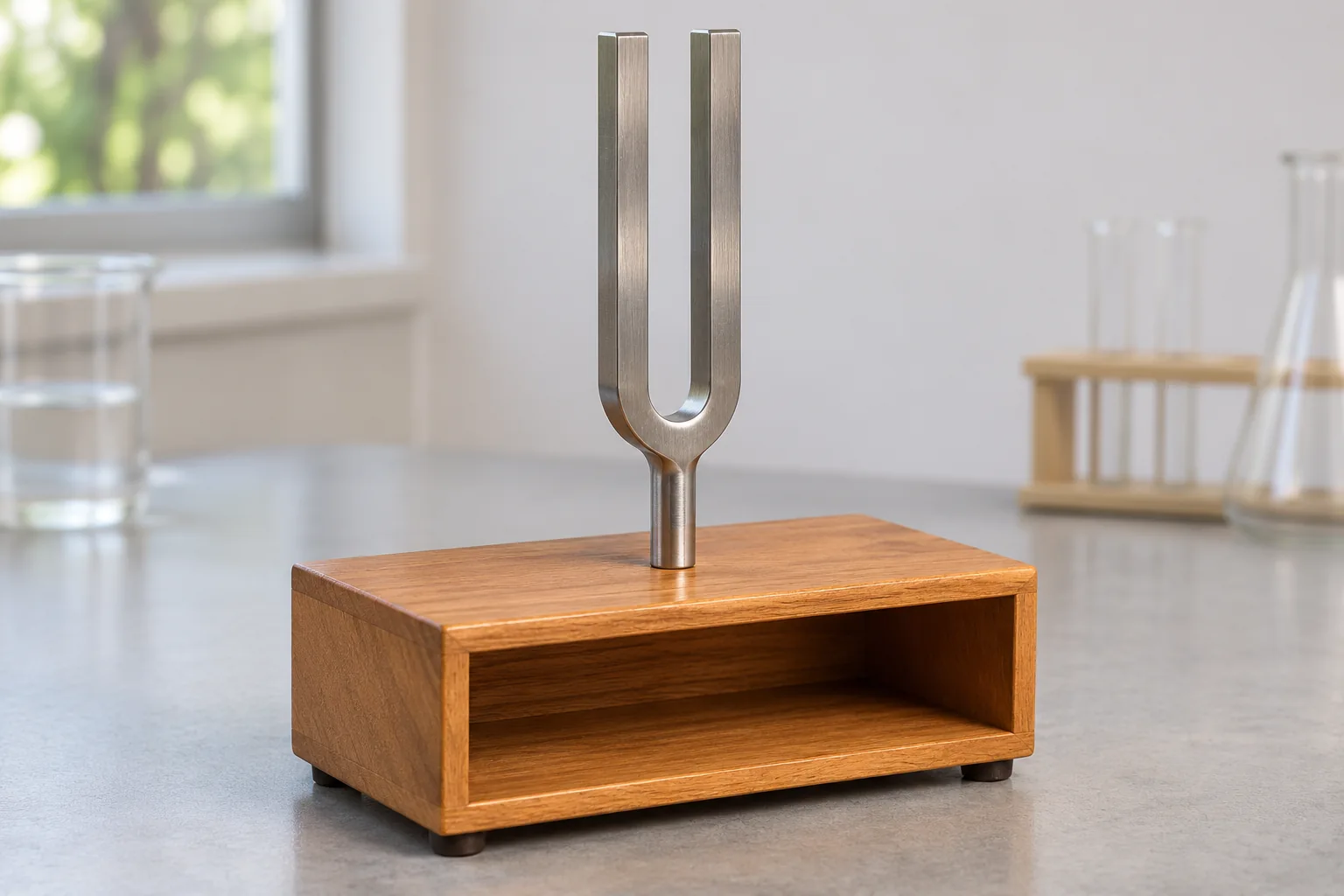
A tuning fork produces a clear note because its two prongs vibrate strongly in a particular bending pattern after a strike. The prongs alternately move toward and away from one another. Their repeating motion disturbs the surrounding air, creating sound at a frequency largely set by the fork’s dimensions and material. Other vibrations may occur, especially after a hard strike, but the familiar sustained tone is dominated by the intended fundamental mode. [1, 2]
The result seems simple: tap a piece of metal and hear a note. The interesting part is that the tap contains a broad, brief disturbance, while the fork’s continuing response is much more selective. That makes a tuning fork a useful way to separate three ideas that are often confused: pitch, loudness and resonance.
What actually moves in a tuning fork?
Each prong, or tine, bends along its length. In the familiar mode, the ends move outward together and then inward together, forming a mirror-image pattern. Metal elasticity supplies a restoring force, and the moving mass carries the tines past their resting positions before the next reversal. [1]
The displacement is usually too small and too rapid to see clearly with unaided eyes. Penn State’s vibration demonstrations use modeling and high-speed footage to make the motion apparent. The seemingly motionless object in a person’s hand can therefore be changing shape hundreds of times each second. [1]
The stem is useful as a handle because it moves much less than the tine tips in the main mode, but it is not perfectly motionless. Small stem motion can transfer vibration into a table or soundboard. Holding a tine directly instead would interfere with the part of the fork that needs to bend freely. [1, 2]
Why does one fork produce one recognizable pitch?
A structure has preferred patterns of vibration, called modes. For a conventional fork, the intended tone corresponds to a particular mode with a particular natural frequency. The impact briefly supplies energy; the fork’s mechanical properties determine the subsequent ringing. A harder blow does not choose an entirely new fundamental frequency in the way selecting another key on a piano does. [2, 4]
Longer tines generally give lower frequencies when material and cross-sectional shape are otherwise comparable. Thickness, shape and material properties also matter, so length alone cannot predict the pitch of arbitrary forks. COMSOL’s own model documentation explicitly includes tine dimensions and material in calculating the fundamental frequency. [4]
Manufacturers tune the geometry to obtain the intended reference note. Historical adjustable forks used small movable masses on the tines, illustrating another way to alter the vibration. The Smithsonian’s collection documents forks as both musical reference tools and scientific instruments. [3]
Frequency, pitch and loudness are different
Frequency is the number of repeated cycles per second, measured in hertz. Pitch is the auditory impression closely associated with that rate. A 440-hertz reference completes 440 cycles each second; one cycle lasts about 0.00227 seconds, calculated as 1 divided by 440. This arithmetic describes the period of a hypothetical ideal 440-hertz oscillation, not a measurement of the fork pictured here.
Loudness depends on the sound reaching the listener and the hearing response. A larger vibration amplitude usually creates a stronger sound, but amplitude and frequency are separate quantities. As a fork rings down, its movement becomes smaller: the note fades without needing to slide steadily down a musical scale. The Open University uses this decaying vibration to explain why a real ringing signal is not a perfectly unchanged repeating waveform. [8]
Think of drawing two waves with the same spacing between peaks but different heights. The spacing represents the same cycle rate; the heights represent different amplitudes. That distinction is why “strike it harder” and “use a higher-pitched fork” are different instructions.
Is a tuning fork a perfectly pure sound?
Not under every condition. A light strike can produce a sound dominated by a single frequency, but a harder impact can excite additional modes and create an initial metallic clang. A fork is a real elastic object with more possible motions than the one usually emphasized in a classroom. [2, 6]
The higher modes should not all be called harmonics. Harmonics occur at whole-number multiples of a fundamental; a conventional fork’s prominent higher bending mode is not simply the next whole-number multiple. The Acoustical Society of America account explains this distinction and also describes additional sound components that can arise at large vibration amplitudes. [2]
“A clear reference note” is therefore a useful practical description. “An object physically incapable of producing any other frequency” would be incorrect. Harvard’s demonstrations similarly note that a frequency analyzer can reveal components associated with a strong strike or with the resonance box. [6]
Why does a box make the note louder?
A bare fork moves relatively little air. When coupled to a suitable resonance box, it can transfer energy to a system that radiates sound more effectively. The box and the air associated with it respond to the driving vibration, making the note easier to hear across a room. [2, 6]
The extra sound is not free energy. It comes from energy initially supplied by the strike and subsequently transferred out of the vibrating system. A louder sound can accompany faster energy loss. A resonator changes how the vibration couples to its surroundings; it does not create an inexhaustible supply of motion.
Air columns offer another example. OpenStax describes a tuning fork held near a tube whose length can be changed by adding water. At certain lengths the air column responds strongly, because a resonant frequency matches the driving sound. The pipe’s length is changing; the fork has not suddenly acquired a different note at every water level. [7]
How can one fork make another vibrate?
Two suitably matched forks can demonstrate sympathetic resonance. Sound from the first provides a repeating pressure disturbance that drives the second. When that disturbance matches a responsive mode, repeated small transfers of energy can build a noticeable vibration. The University of Toronto demonstrates this response using a nearby lightweight ball to reveal movement. [5]
The sound need not come from another fork. The same teaching demonstration uses a speaker whose frequency is swept until the fork responds. This makes the principle especially clear: resonance depends on a relationship between a driving frequency and the object’s response, rather than on two objects having the same name. [5]
Why do nearly matched notes pulse?
Two sounds with slightly different frequencies can produce beats: the combined sound grows louder and softer as the waves alternately reinforce and oppose one another. For simple steady tones, the beat rate is the absolute difference between their frequencies. [7]
For example, hypothetical tones of 440 and 442 hertz produce two beats per second. That does not mean either fork is moving just twice per second. The slow pulse is an interference pattern laid over much faster oscillations. Reducing that pulse can help compare a musical note with a reference.
Related principles appear in how an acoustic piano makes sound and why we hear echoes. They connect vibrating sources to the paths sound takes through its surroundings.
Questions about tuning forks
Does hitting a fork harder make its note higher?
It mainly increases amplitude and can excite extra modes. The intended reference frequency is chiefly determined by the fork itself. [4, 6]
Does a fork need electricity?
An ordinary hand-struck fork does not. The initial mechanical impact supplies the energy that later leaves as sound and other losses.
Why does the note eventually stop?
Energy continually leaves the vibration through sound radiation, transfer into supports and internal losses. Its amplitude therefore decreases unless a continuing drive replaces that energy. [7, 8]
What makes the device useful?
It turns an easily supplied mechanical impulse into a recognizable reference frequency. The two-pronged shape is a carefully constrained oscillator, even when the finished object looks remarkably plain.
Sources and further reading
Sources checked November 14, 2026. Publication records, summaries and abstracts are identified below where used; those labels do not imply a full-text review of restricted papers.
- Penn State, Daniel A. Russell — Vibrational Modes of a Tuning Fork
- Russell (2020), Acoustical Society of America — The Tuning Fork: An Amazing Acoustics Apparatus
- Smithsonian National Museum of American History — Tuning Forks
- COMSOL model documentation — Tuning Fork
- University of Toronto Physics — Resonance (Tuning Forks), teaching demonstration
- Harvard Natural Sciences Lecture Demonstrations — Tuning Forks
- OpenStax, Rice University — Sound Interference and Resonance
- Open University — Sound for music technology: Period
Keep exploring.
One remarkable idea at a time—nature, science, history and beyond.
Last updated November 16, 2026.

Barnakle Editorial Team
Barnakle Editorial Team is the collective byline used for Barnakle’s editorial articles. The contributor profile explains the team identity and links to the publication’s editorial policies.
More from the editorial team →