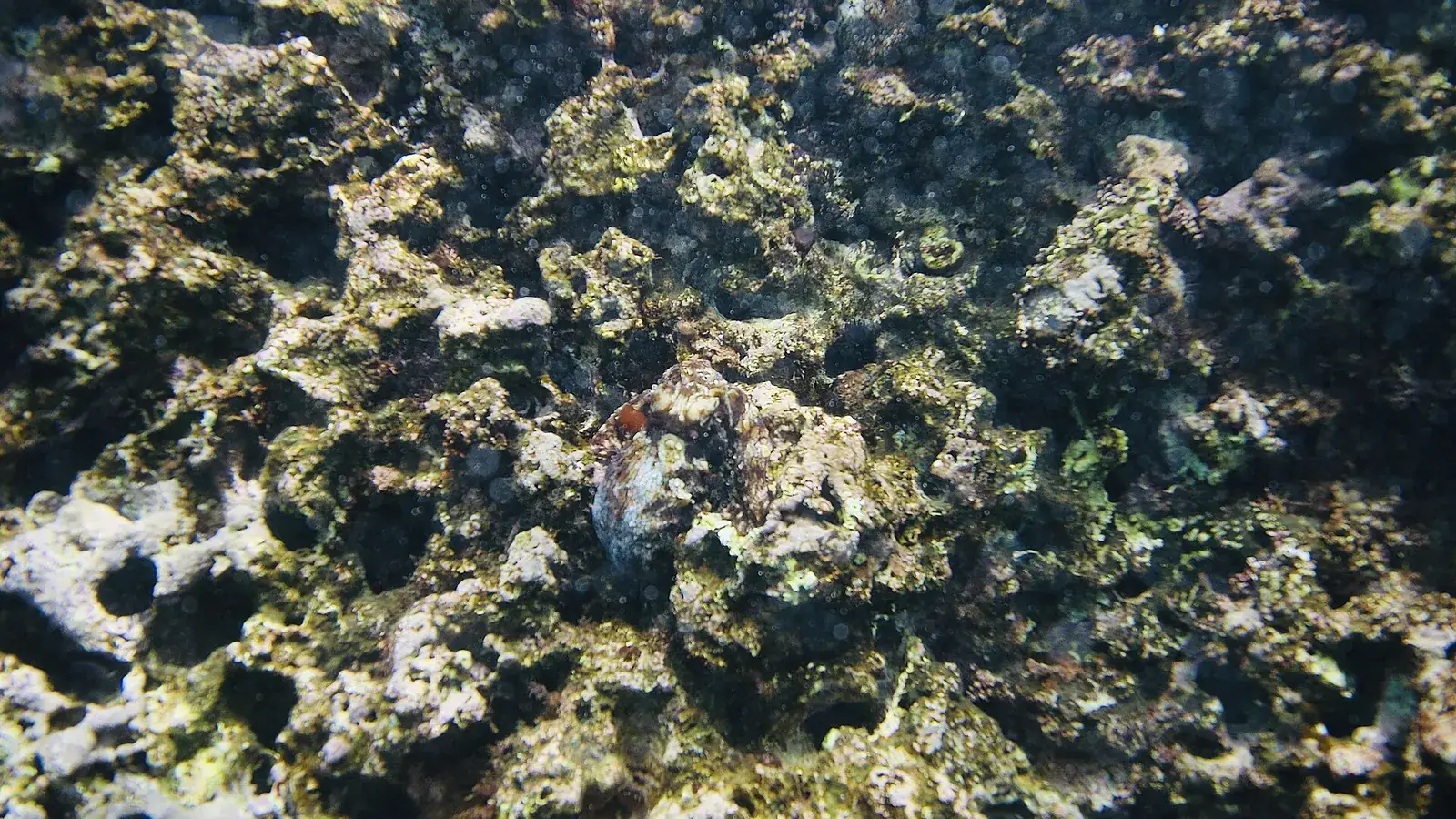
An octopus can change its visible pattern and alter the outline of its skin in a short time. These transformations involve different structures working together: pigment-bearing organs change the displayed colour pattern, reflective tissues affect light, and muscular projections change surface texture.
The result can resemble a background without requiring the animal to reproduce every detail like a photographic screen.
Muscles expand the visible pigment
A chromatophore is a small pigment organ with muscles arranged around a pigment-containing sac. When those muscles contract, the sac spreads out and presents a larger coloured area. Relaxation reduces the visible area.
Neural control coordinates many organs into changing patterns. The colour change therefore does not depend on transporting pigment slowly across the entire body each time the animal meets a new background.
Reflection adds another optical layer
Cephalopod skin can include structures that reflect light rather than simply absorb selected wavelengths. Iridophores and leucophores contribute different optical effects in different animals and body regions.
The Smithsonian's cephalopod account distinguishes these reflective tissues from chromatophores. They help explain why appearance can depend on the lighting and viewing angle as well as on the animal's pigment pattern. Not every species uses identical structures in identical ways.
Texture comes from papillae
Octopuses and cuttlefish can raise or flatten projections called papillae. Changing those structures produces bumps and more complex outlines, helping the animal resemble uneven surroundings such as rock or algae.
Research comparing papilla morphology shows that these are controlled tissue structures rather than permanently rough skin. Their form and complexity vary. A mechanism demonstrated in cuttlefish is informative for comparison, but should not automatically be assigned in every detail to all octopuses.
Camouflage coordinates several choices
An effective appearance combines pattern, contrast, posture and sometimes texture. The animal's visual surroundings help guide that response. A large patch, fine mottling and a disrupted outline can serve different backgrounds.
“Matching the background” is consequently a shorthand for several possible strategies. Camouflage can make an outline harder to detect without making the body identical in colour to every object behind it.
What observations do not establish
A spectacular video shows an appearance change, but it does not by itself reveal every sensory cue or neural computation that produced it. Researchers use controlled backgrounds, recordings and anatomical studies to separate those questions.
Nor is colour change always concealment. Cephalopods can use visible displays in other contexts, and the function of a particular pattern requires behavioural evidence. The underlying biology is more versatile than a simple on/off invisibility trick: an animal controls optical and mechanical features of its own surface to change how another observer might detect it.
Explore a related question
How Do Chameleons Change Colour?
Sources and further reading
Keep exploring.
We’ll email you when the first edition is ready.
Last updated October 27, 2026.

Barnakle Editorial Team
Barnakle Editorial Team is the collective byline used for Barnakle’s editorial articles. The contributor profile explains the team identity and links to the publication’s editorial policies.
More from the editorial team →