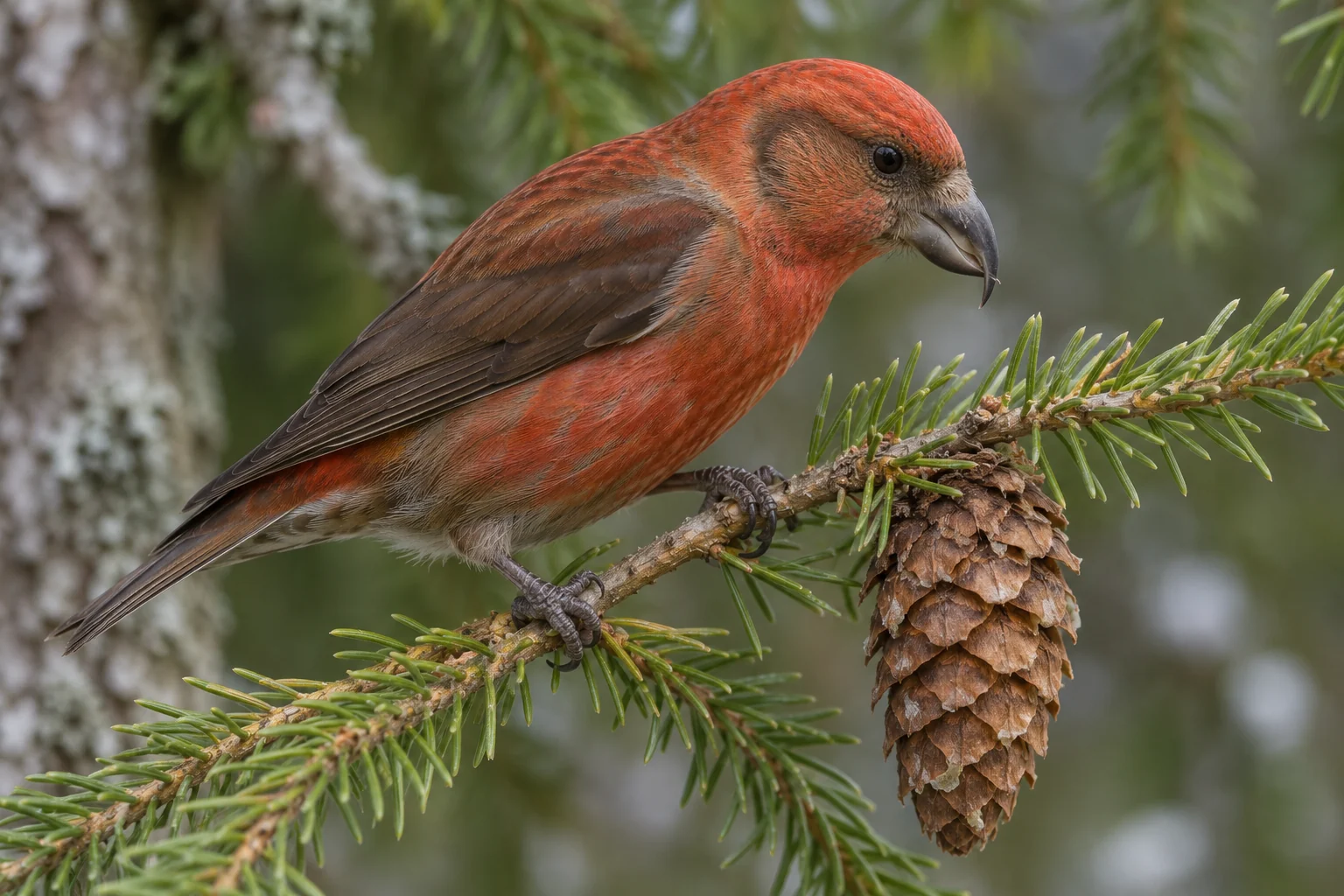
Watch a red crossbill feeding and the moment worth catching comes just before it eats. A seed is still under a woody cone scale. The bird turns its head, slips its bill into the seam and makes a gap just wide enough to reach inside. Then its tongue does something the beak could never manage on its own. It draws the seed out of its hiding place.[1, 2]
On a finch at a feeder, you’d expect the upper and lower halves of the bill to meet neatly at the tip. A crossbill’s curve past each other. It makes more sense to look at that bill from the cone’s point of view. Two pointed jaws approaching a narrow seam from slightly different angles can gain purchase on the edges. The bird can lever one scale away from the next and eat from a cone whose seeds are still out of reach of many other birds.[1, 2]
The seed has two kinds of packaging
A conifer seed tucked inside a cone poses two problems. First comes the scale, a woody cover that the bird has to get past. Then comes the seed’s own outer coat. A bill that cracks an exposed seed perfectly well might leave its owner hungry in a tree loaded with closed cones. You could pour the contents of those cones into a feeder and change which birds can get a meal without changing the food itself.[1, 3]
The crossbill starts with the seam. With its bill partly open, it gets a tip under the scale. A sideways movement of the lower jaw and sometimes a twist of the head help lever the scale aside. It takes a surprisingly small opening to succeed. The tongue ends in a scoop that can reach through the gap, retrieve the seed and draw it back to the bill. The bird husks the seed and eats the kernel. The bulk of the cone stays where it was.[1, 2]
A left-handed cone worker?
The lower tip can curve to the left or to the right. The Cornell Lab has footage of a white-winged crossbill, a relative of the red crossbill, working a cone it has carried to a perch. Its foot does much of the positioning. It holds the cone on the side toward which the lower tip points, rotates it and brings successive scales against the useful edge of its bill. In slow motion the meal looks almost tidy.[2]
That is a reason to watch the feet as well as the head. Each seed is small, and turning a cone a fraction after a successful bite can set up the next one. Take a still photograph midway through the movement and it could look as if the bird were cutting a woody scale in two. Follow several bites in succession and you can see the same cone turning beneath it. The job is to reach a series of pockets around a central support.[2]
What happens when the cone opens?
Ecologist Craig Benkman tested a wonderfully specific question. How much does the crossing itself matter once the bird already knows how to feed? He compared the performance of two experienced red crossbills whose crossed tips had been temporarily shortened with their earlier performance and with that of two other birds. The test included different kinds of conifer cones. He recorded the time it took to obtain a seed, a measure that picks up difficulty even when a bird eventually succeeds.[3]
The difference was striking on closed cones. The birds with shortened tips struggled to get seeds that the other birds could reach. Yet when Benkman offered a dry, open white pine cone still holding seeds, prying times were much closer. The result rests on a small experiment, but its pattern is revealing. If the tips simply made every part of eating faster, the advantage should have persisted after the scales spread. The condition of the cone mattered. Open a cone for the bird in advance and you have quietly removed the hardest part of the test. That detail is easy to miss if you judge the shape of a bill by watching what the bird does with seeds lying loose on a tray.[3]
A forest full of trees can run short of food
Consider two neighbouring stands of conifers. One has a heavy crop of cones whose seeds are still present and accessible. Another can look just as green while offering a fraction of the food. A crossbill flock can leave plenty of trees standing behind it and still have a good reason to move. Birders sometimes see unusually large movements, called irruptions, outside the areas where they expect these birds. Which trees recently produced cones helps explain that shifting map.[4, 5]
Even within red crossbills, birds with different bill sizes favour different cones. Cornell describes a small-billed form that often feeds in western hemlocks, whose cones are tiny, and a much larger-billed southwestern form associated with pines. A bigger jaw would be of little advantage if a smaller one can work a particular cone more quickly. Listen as well as look when a flock goes overhead. Differences in flight calls help birders distinguish types that would be difficult to sort out by eye.[4]
Finding a family in winter
The crop can affect when a pair raises young, too. North American red crossbills often nest in late summer or toward the end of winter when suitable seeds are available. At a time of year when other songbirds have yet to start looking for nest sites, a pair may already have the food supply it needs. The adults can bring conifer seeds to their young. A productive stand can therefore do more than feed the flock passing through today.[4, 5]
If you spot crossbills in a conifer, pick one bird and stay with it for a few seconds. See whether it is working an attached cone or holding a loose one. Watch for the turn of its head after contact and for the moment it moves on to another scale. Those tiny choices reveal something a guidebook photograph of the crossed tips can’t quite show. This finch earns its living by getting to the seed a little earlier in the life of the cone.[1, 2, 3]
Related reading
Sources
- COSEWIC — Red crossbill foraging and nutrition
- Cornell Lab Bird Academy — A white-winged crossbill works a cone, with video
- Craig Benkman, Ibis — Experimental test of the advantage of crossed mandibles
- Cornell Lab of Ornithology — Red crossbill life history
- National Park Service — Red crossbills in Rocky Mountain National Park
Keep exploring.
One remarkable idea at a time—nature, science, history and beyond.
Last updated November 25, 2026.

Barnakle Editorial Team
Barnakle Editorial Team is the collective byline used for Barnakle’s editorial articles. The contributor profile explains the team identity and links to the publication’s editorial policies.
More from the editorial team →