A resting posture shaped by anatomy, gravity and heat exchange
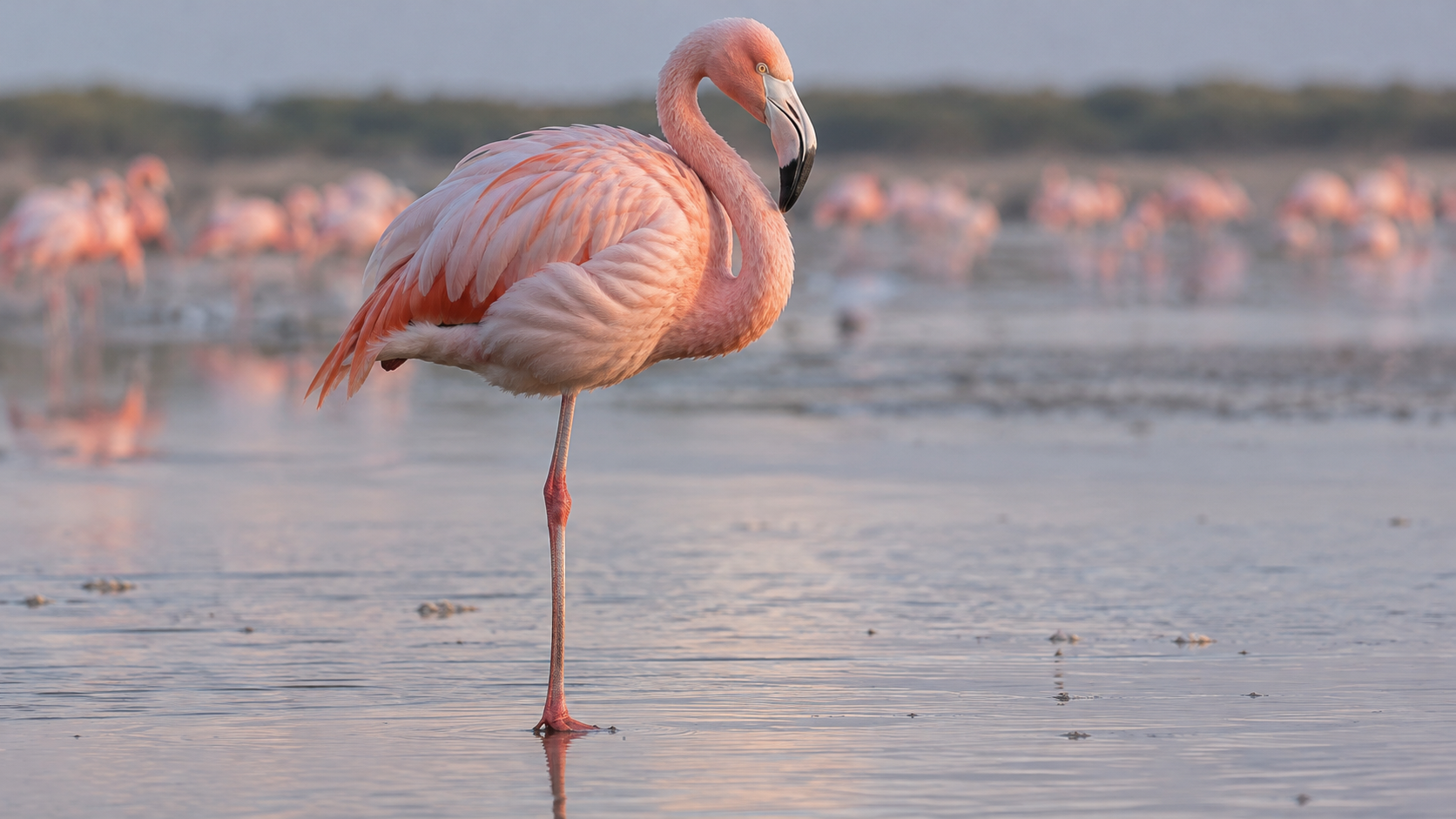
A flamingo seems to choose the difficult option. Beside the water, it lifts one long leg, folds it beneath its feathers and settles into a posture that would soon have a person wobbling. Some birds even close their eyes. The apparent balancing act is less like a human fitness challenge than it looks.
There are two questions hidden in the familiar “why”. How can the bird hold that position? And what benefit makes the position worth using? Mechanical support, muscular effort and heat exchange belong in the explanation, but an answer to one question is not automatically an answer to all three. The research becomes clearer when those pieces are kept separate.
Follow the mechanism
- Anatomy sets the available joint positions.
- Placing the foot beneath the body can engage passive support.
- Quiet standing can require little active force.
- Tucking the other leg changes its exposure to heat loss.
The visible joint is not the knee
The bend halfway down a flamingo’s exposed leg is commonly mistaken for a backwards knee. It is an ankle region. The knee and the short upper leg lie much closer to the body, partly hidden beneath feathers. That changes how the whole limb should be imagined: the exposed length is not simply a stretched version of a human thigh and shin.
The distinction matters mechanically. A resting bird arranges several joints, bones and supporting tissues into a particular configuration. Looking only at the visible bend misses the upper structures carrying its weight. A photograph can show the outline of the pose without revealing the forces acting around those hidden joints.
This is also why copying the outline with your own body is an unreliable test. Humans and flamingos distribute mass differently and have different limb proportions. A person tiring on one foot has learned something about human balance, not measured the energy cost of the bird’s posture.
Sources: [2]
What the passive-support experiment demonstrated
In a 2017 study, Young-Hui Chang and Lena Ting examined whether a flamingo’s limb could support its body without active muscle contraction. They manipulated two flamingo cadavers and found a one-legged configuration that supported the body passively. In the tested arrangement, placing the foot inward beneath the body helped engage the support; changing the posture could make it unstable.
A cadaver cannot make ongoing muscular balance corrections. The result therefore establishes something a video of a living bird cannot: suitable anatomy and posture can carry body weight without active muscle force. The authors described a gravity-engaged support arrangement rather than a simple latch clicking shut.
Its scope is important. Two specimens are not a population survey, and passive support in an experimentally arranged limb does not tell us exactly how much energy every living flamingo spends. The experiment identifies a mechanical possibility. It does not prove that all muscles switch off whenever a bird lifts a foot.
Sources: [1]
Supporting weight and maintaining balance are different jobs
Imagine a chair standing securely on a floor. Its structure carries a load without a motor continually pushing upward. Now imagine the same chair tilted onto one leg: even if the wood can carry the weight, preventing a fall becomes a separate problem. The analogy is deliberately incomplete, but it separates load support from balance.
A flamingo has to keep the combined effects of its body position, foot contact and movement compatible with standing. A passive support arrangement can reduce one demand without eliminating every adjustment. Wind, grooming, calling and repositioning can change the forces. Quiet rest is not mechanically identical to an alert bird twisting its neck.
The 2017 researchers also used a force plate with living flamingos. Quiet, eyes-closed standing showed less sway than more active behaviour. Those measurements are consistent with an economical posture, but they are not direct recordings of every muscle or measurements of whole-body metabolic rate. “Little active force can be needed” is more defensible than “standing on one leg uses no energy”.
Sources: [1]
Why tucking a leg can help with warmth
A long, unfeathered leg exposes tissue to its surroundings. Folding one into the feathered body changes that exposed area. The thermal effect depends on conditions: water contact, air movement and the temperature difference between the bird and its environment all matter.
Research on captive Caribbean flamingos reported that a greater proportion rested on one leg at lower temperatures. This supports a role for temperature in posture choice. It does not mean a cold day is required; flamingos also stand on one leg in warm settings.
The Smithsonian’s flamingo account identifies reduced heat loss as a benefit of the tucked posture. San Diego Zoo’s account is more cautious about the overall explanation. Both can fit a picture in which conserving warmth is useful without being the single cause of every instance. A posture can offer more than one advantage, and the advantage that matters most may change with the setting.
| Claim | What the evidence can support | What it does not establish |
|---|---|---|
| Passive weight support | A suitable flamingo limb configuration can support weight without active muscle force. | Every muscle is inactive in a resting living bird. |
| Reduced sway in quiet rest | Force-plate measurements distinguish quiet and active standing. | The exact metabolic saving during sleep. |
| A thermal benefit | Tucking a bare leg changes heat exposure; temperature can correlate with posture. | Temperature alone explains every one-legged stance. |
Why “a locking knee” is an incomplete explanation
A mechanical description is useful only if it names the right parts and conditions. Saying that the visible joint is a knee starts with the wrong anatomy. Saying that a bone simply locks can also suggest a rigid catch that the evidence does not require.
The researchers’ account involves the relationships among joint limits, body weight and the position of the foot. The support depends on the configuration. That is a more interesting result than an imaginary on/off lock: the bird can change how gravity acts through its anatomy by changing its posture.
An everyday comparison is a door that stays in place because of its geometry and load, rather than because someone holds it continuously. The comparison is not an anatomical model. Its purpose is to make “passive” less mysterious: an arrangement can resist movement through structure and position while requiring no continuous motor to maintain that particular resistance.
One leg does not make every bird the same
Other birds also tuck a foot, but the visual resemblance does not establish identical mechanisms. Body size, limb structure, habitat and resting position vary. A perched bird gripping a branch presents a different mechanical problem from a wading bird resting on a broad foot.
Nor does a bird changing legs demonstrate that the support system has failed. Posture is behaviour, not a fixed diagram. An animal can move, respond to disturbance and choose another position without contradicting a mechanism that applies during quiet rest.
A useful way to read an explanation is to ask what was actually studied. Was it a specific species, a particular group in captivity, a set of preserved specimens, or an observation across many habitats? The answer determines how far the conclusion travels. The studies cited here provide evidence about flamingos; they are not a universal engineering specification for all birds.
A better way to watch the behaviour
At a zoo or viewing area, watch without trying to make a bird move. Note whether it is quiet, grooming, feeding or walking. Record whether it stands in water or on land, whether one leg is tucked, and whether the weather is cool or warm. If the same bird changes posture, note what else changes around that time.
Those notes can help distinguish a visible action from an explanation. “The bird tucked a leg while resting in shallow water” is an observation. “It did so solely because it was cold” is a causal claim requiring more evidence. One short visit cannot measure the contribution of anatomy, heat balance, disturbance and individual preference.
Even identifying separate birds can be difficult in a flock. Counting the same individual repeatedly as if it were several independent examples would exaggerate the evidence. You do not need a formal experiment to enjoy the behaviour, but the distinction explains why careful studies need a defined sampling method.
Questions readers ask
Do flamingos sleep on one leg?
They can rest and sleep in a one-legged posture. The mechanical question is how that posture can remain stable; the behavioural question is when and why the animal chooses it.
Is it easier for them than standing on two legs?
The 2017 mechanical study suggests that a suitable one-legged configuration can reduce the need for active support. It did not measure an energy budget for every bird or every posture.
Are flamingos’ knees backwards?
No. The prominent exposed bend is an ankle region. The knee is higher, near the feathered body.
Does standing on one leg mean a bird is injured?
A one-legged resting posture is common in flamingos. Posture alone cannot diagnose an individual animal; concerns about a captive bird belong with its carers.
Is the answer balance or warmth?
Those explanations address different benefits and mechanisms. Passive support helps explain how the pose is possible; reduced heat exposure can help explain why it is useful in particular conditions.
The surprising part is how the body uses gravity
The strongest answer is a connected one. Flamingos have a body configuration in which gravity and anatomy can support a one-legged rest with little active muscular force. Tucking the other leg also changes heat exchange. Living birds still respond to movement and surroundings, and the studies do not establish a single motivation for every occasion.
The familiar pink silhouette is therefore an invitation to look more closely at structure, posture and evidence. What looks difficult to a human observer can be a well-supported resting arrangement for a differently built animal.
Continue exploring
Sources and further reading
- Chang and Ting (2017) — Mechanical evidence that flamingos can support their body on one leg with little active muscular force
- Emory University — Flamingo research shows birds use one-legged stance to relax
- Anderson and Williams (2010; online 2009) — Why do flamingos stand on one leg?
- Smithsonian National Zoo — American flamingo
- San Diego Zoo Wildlife Alliance — Flamingo
Keep exploring.
One remarkable idea at a time—nature, science, history and beyond.
Last updated November 6, 2026.

Barnakle Editorial Team
Barnakle Editorial Team is the collective byline used for Barnakle’s editorial articles. The contributor profile explains the team identity and links to the publication’s editorial policies.
More from the editorial team →