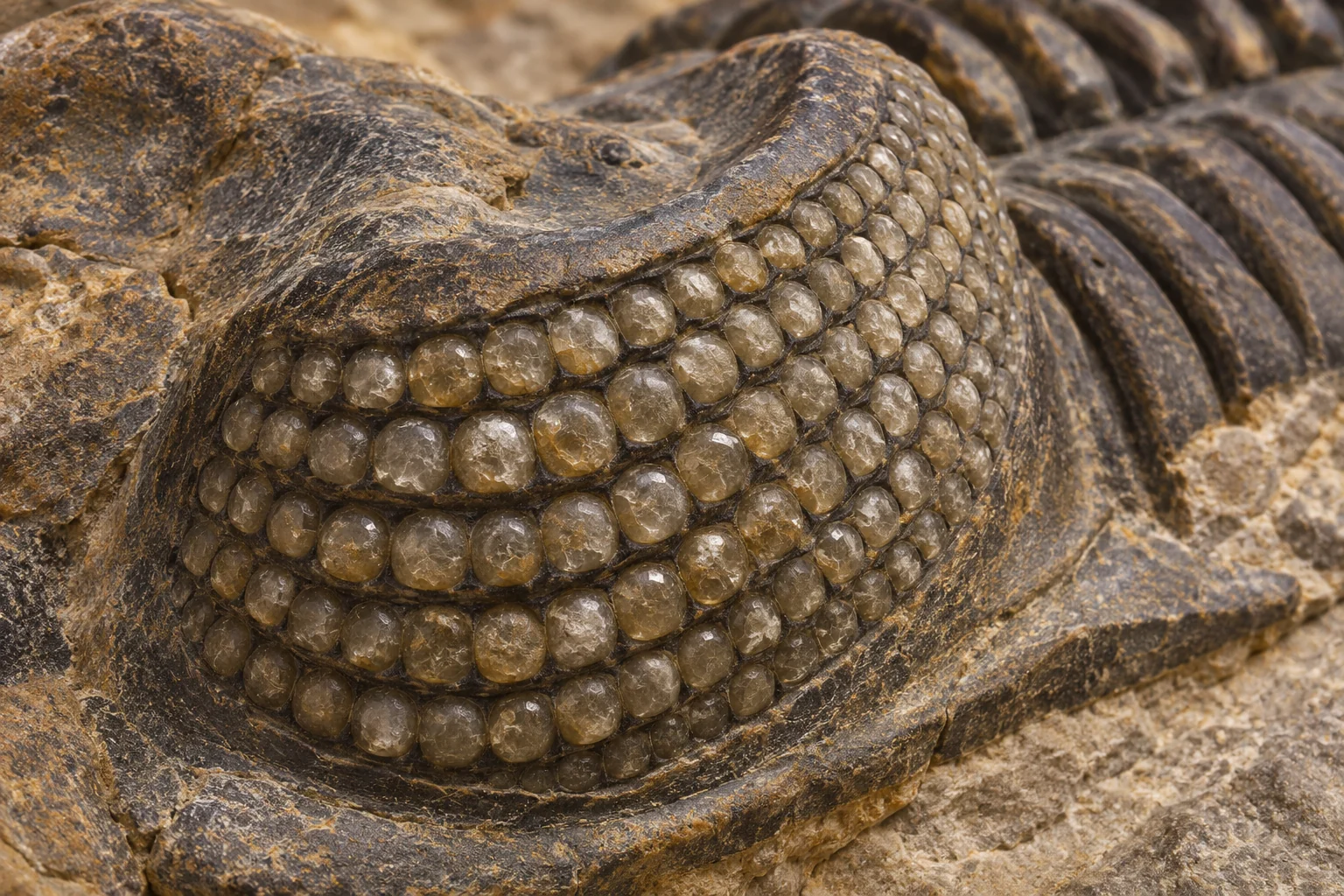
On some trilobite fossils, the most arresting detail is a cluster of little domes on the side of the head. They run in curved rows, each dome distinct even where the animal’s outline is hard to follow in the rock. These were the outward-facing lenses of a compound eye. A palaeontologist can measure their diameters and the directions they faced hundreds of millions of years after the animal last saw anything. Working out what lay behind them is a more difficult exercise.[1, 2]
A living eye has to gather light, turn it into signals, and send those signals to nervous tissue. A fossil can preserve evidence of those stages very unevenly. The outer surface of a trilobite eye was part of an exoskeleton with a good chance of entering the fossil record. Most specimens offer much less information about the delicate structures inside. That difference puts an interesting limit on a familiar museum question. We can often say where an animal could look more confidently than we can say what its view looked like.[1, 2]
What one facet can tell us
Consider a single lens near the front of a curved eye. A line through its centre, perpendicular to its surface at the middle, gives a first estimate of its viewing direction. Make the same measurement farther round the curve and the second line points elsewhere. With many such measurements it becomes possible to map an array of directions onto the space around the head. The curvature matters as much as the number of lenses. A flat patch of similar facets would distribute its lines of sight differently.[1]
That map has two scales. The whole curved surface gives a sense of how wide an area the animal could sample. The angular gaps between neighbouring viewing directions help indicate how finely it could sample detail within that area. Think of posts set along a bend in a road. You need to know where the bend goes to work out the overall sweep, and how closely the posts stand to know how precisely they mark it. Neither measurement, by itself, gives a complete description of the eye.[1, 2]
Two very different surfaces
Many trilobites had what researchers call holochroal eyes. Small, closely packed lenses share a continuous outer covering. An eye of this kind can look almost smooth in an ordinary photograph until light rakes across the facets. In a second kind, called schizochroal, the lenses are larger and separated by bands of exoskeleton. Those are the conspicuous button-like rows often seen on phacopid trilobites. A third, rarer kind is recognized too. Treating the showiest fossil as the standard eye for the whole group would hide much of the variation.[1, 2]
For a specimen behind glass, the simplest first question is whether adjacent lenses actually touch. In a tightly packed array you can follow one facet straight into its neighbour. In a phacopid there is room to trace a rim around a lens before reaching the next one, even along the more sharply curved parts of the eye. That observation concerns the outer architecture alone. It remains useful even when the rock below the lenses has lost every recognizable trace of a receptor. It is also one reason two trilobites of comparable size can make very different exhibits.[1, 3]
Did a living trilobite really look through stone?
The lenses of many specimens contain calcite, a mineral whose optical behaviour depends on the orientation of its crystal structure. Researchers studying sections of phacopid lenses have documented organized arrangements within the calcite. Orientations that repeat across a specimen and line up with its optical surfaces are evidence to take seriously. A review of trilobite eyes argues that the living lenses themselves were substantially calcitic. The distinction between a measured fossil and an inference about the animal matters especially here.[2, 3]
A study of fossil crane flies supplied a reason for caution. Those insects had originally organic outer lenses, yet the fossil lenses contained oriented calcite. The researchers argued that replacement after death could produce features resembling those cited as evidence of mineral lenses in trilobites. They raised the possibility that trilobite lenses were more organic in life than the fossils suggest. A crane fly cannot settle the composition of every trilobite eye. It does show why finding an orderly crystal today, on its own, cannot establish exactly when that crystal formed.[4]
Looking under the big lenses
Exceptionally preserved eyes can test ideas that stall at the surface. In a study of Devonian phacopids, researchers returned to material examined decades earlier by Wilhelm Stürmer, who used X-rays to investigate fossils. The team reported groups of smaller optical units beneath individual large lenses. Their interpretation was striking. Each of the readily visible outer lenses sat above an assembly resembling a little compound eye of its own. The entire eye would combine many such groups. This is a proposed reconstruction for particular fossils and an unusual branch of the trilobite family.[5]
That interpretation changes the meaning of a simple count. Suppose a curator counts sixty obvious lenses on one side of a head. Sixty is still an observation about the surface. If several smaller units served each large lens, however, the visible tally is no direct count of the underlying receptors. Even an accurate count would not tell us which signals the nervous system combined or whether the animal distinguished colours. Those questions require different kinds of evidence. A reconstruction can respect the measured geometry without assigning a modern animal’s visual experience to its ancient relative.[2, 5]
Next time you see a trilobite, start at one end of the eye and trace a row round the bend. Do the rows turn out towards the sides? Can you see spaces between the lenses? Is there any view into the eye, or only a remarkably good view of its surface? Each answer has a different evidentiary weight. The rows themselves are right there in the rock. From their placement researchers can recover part of an animal’s relationship with the sea around it, even where the picture that reached its nervous system is gone.[1, 2]
Related reading
Sources
- The eyes of trilobites: The oldest preserved visual system
- Brigitte Schoenemann — An overview on trilobite eyes and their functioning
- Microstructure and growth of the lenses of schizochroal trilobite eyes
- Lindgren and colleagues — Fossil insect eyes shed light on trilobite optics and the arthropod pigment screen
- A 390 million-year-old hyper-compound eye in Devonian phacopid trilobites
Keep exploring.
One remarkable idea at a time—nature, science, history and beyond.
Last updated November 22, 2026.

Barnakle Editorial Team
Barnakle Editorial Team is the collective byline used for Barnakle’s editorial articles. The contributor profile explains the team identity and links to the publication’s editorial policies.
More from the editorial team →