The first dinosaur evidence found in Alaska’s Denali National Park was a footprint that stuck out of a rock. A dinosaur had pressed its foot into soft sediment. More sediment filled the hollow and hardened, and erosion eventually removed the material that had held the original depression. The bump was a natural cast. It survived a journey from wet ground to solid rock even though the foot that made it was lifted away in a single step. [1]
What the ground has to remember
A footprint is a trace fossil, evidence of an animal’s activity. To leave a readable trace, a foot has to disturb a surface that can hold some part of the disturbance. Imagine crossing a strip of beach from loose dry sand to damp sand and then to watery mud. The same foot may leave a collapsed hollow, a crisp outline and a deep, partly refilled pit in three successive steps. The animal’s anatomy stayed constant while the ground changed how it recorded a foot. [2]
Water content is only one part of the problem. The sizes of the grains, layers beneath the surface and the way the foot entered and withdrew all influence the result. A toe pressed straight down into firm mud may register a pointed tip. The same toe pulled forward during withdrawal can leave a longer groove. A deep mark might reflect softer material, greater load or some combination of the two. Estimating an animal’s weight from the depth of one print would require knowing much more about the surface it walked on. [2, 3]
A hollow on one slab and a bump on another
Preservation starts with a race. Rain, currents, drying, trampling and ordinary erosion can erase a track before it is buried. A covering of sediment that settles gently enough can protect the surface and fill its hollows. With further burial, sediment may become rock as it compacts and minerals cement grains together. The rock that records the step may sit underground for a very long time before erosion or excavation reveals it. [1, 2]
Picture the boundary between two layers in a successful case. The top of the lower layer bears the hollow where the foot displaced material. The underside of the upper layer bears a projection where sediment filled the hollow. If the rock splits along the boundary, either face can tell part of the story. Finding a raised print on the underside of an overhang does not require an animal to have walked on a ceiling. The direction of the toes and the position of the bedding surface must be interpreted together. [1, 2]
At Denali, the cast discovered in 2005 came from rocks of the Cantwell Formation. The National Park Service describes a roughly 70-million-year-old three-toed track exposed after the mudstone around the fill weathered away. The find is a particularly clear answer to a practical question. What if the part of the rock the animal actually touched is gone? The sediment that fitted against it can still preserve the form of that contact. [1]
One footstep can affect several layers
Push a finger into the top of a layered material and the displacement spreads below the point of contact. A dinosaur foot could do the same. A lower bedding plane may preserve an undertrack, a deformation transmitted through sediment beneath the walking surface. Viewed in isolation, it can look like a less detailed version of a footprint. It may exaggerate some dimensions or lose the separation between toes. Counting every marked layer as a separate visit by the animal would multiply the evidence for a single step. [2, 3]
There is another possibility in deep, soft ground. The foot itself can penetrate several levels, so a slice below the original surface may show where toes actually passed through. Researchers Peter Falkingham and Stephen Gatesy examined this problem by recording the foot movements of living guineafowl with X-rays and modelling the surrounding grains. In the model they could remove material virtually, exposing patterns at different depths after the same step. Some features made sense only after the researchers accounted for how the toes withdrew. [3]
That experiment gives a reader of fossils a useful question to ask of a slab. Does it show the original top surface, a layer the foot passed through or sediment squeezed beneath the foot? A clean break in the rock tells you where two layers separated today. It does not guarantee that the exposed plane is the one a dinosaur saw under its feet.
What changes when there is a whole trackway
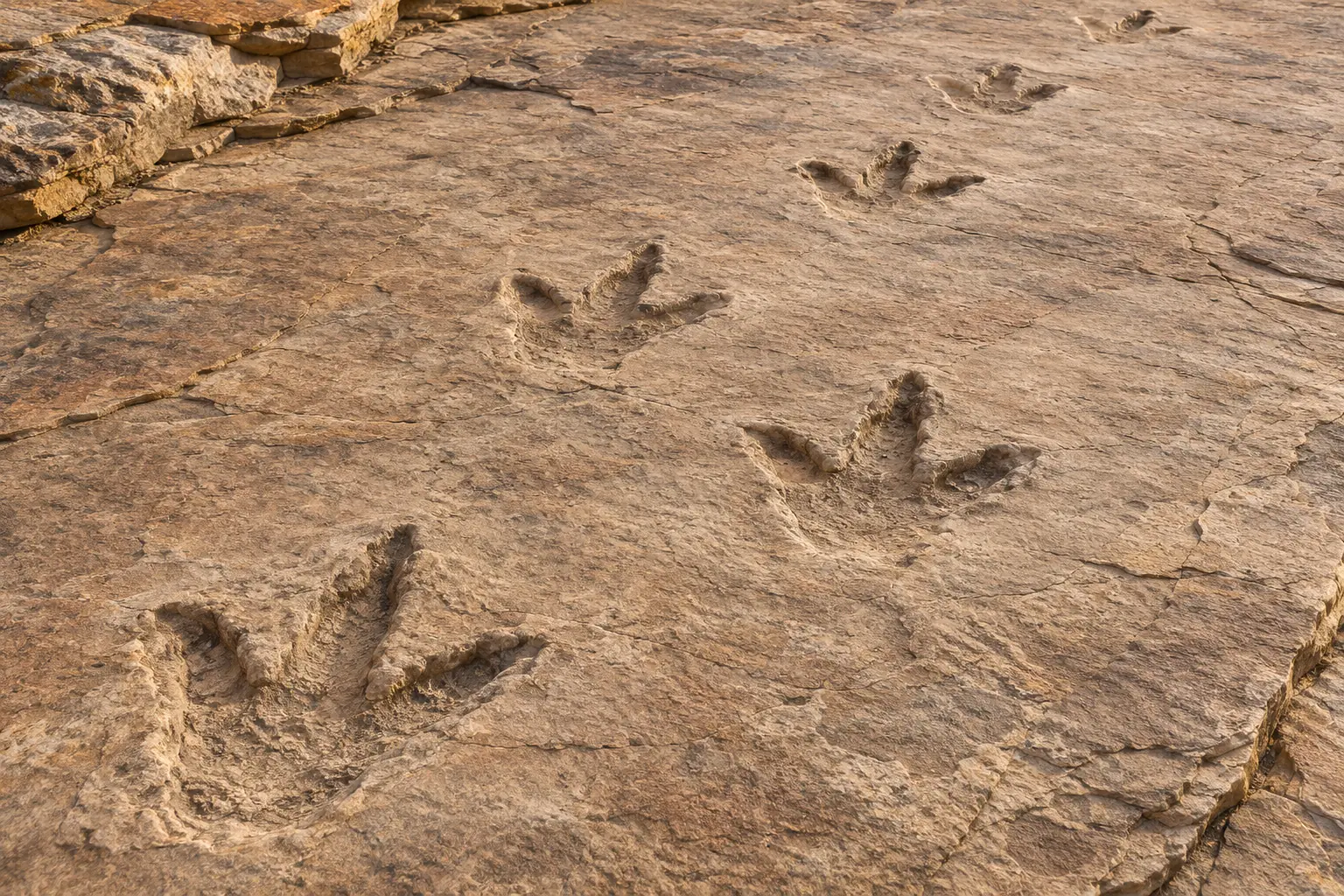
A trackway preserves successive steps. It lets researchers compare the direction, spacing and arrangement of multiple prints. In an alternating two-footed sequence, a pace runs from one footfall to the next footfall of the other foot. A stride runs from one footfall back to the same foot, for instance from left to left. If three alternating prints are spaced 60 centimetres apart along a straight line, the two intervals make a stride of about 1.2 metres. Mixing up those measurements would give a very different impression of how far the animal travelled with each cycle. [2, 4]
Other marks on a bedding plane can put the walk into context. At the Dinosaur Trackway National Natural Landmark in Connecticut, researchers describe track-bearing rocks associated with a lake environment. Ripple marks record water movement, while mud cracks indicate surfaces exposed to air. Footprints document animals using the site. Those observations together can support a reconstruction of an ancient shoreline even where identifiable bones are scarce. They still leave open exactly what an individual animal was doing between preserved steps. [4]
The next time you see a photograph of a fossil track, look just beyond the toes. Check whether the light comes from above a hollow or across a raised cast. Look for the edge of the layer and for a second print continuing across it. Those details can tell you how the footprint came into view and how much of a walk survives on the slab. In many cases the most informative part of the fossil is the relationship between the mark and the rock around it.
Keep exploring
Explore two other routes into the fossil record, one involving tree resin and the other minerals carried into buried wood.
Sources and further reading
The Denali cast and Connecticut trackways are documented sites. The guineafowl experiment tests how different slices of one footprint can preserve different shapes.
- US National Park Service — Discovery of Dinosaur Tracks in Denali
- Natural History Museum, London — How dinosaur footprints form and what they reveal
- Falkingham and Gatesy — The birth of a dinosaur footprint, using X-rays and simulation
- US National Park Service — Paleontology of Dinosaur Trackway National Natural Landmark
Keep exploring.
One remarkable idea at a time—nature, science, history and beyond.
Last updated November 18, 2026.

Barnakle Editorial Team
Barnakle Editorial Team is the collective byline used for Barnakle’s editorial articles. The contributor profile explains the team identity and links to the publication’s editorial policies.
More from the editorial team →