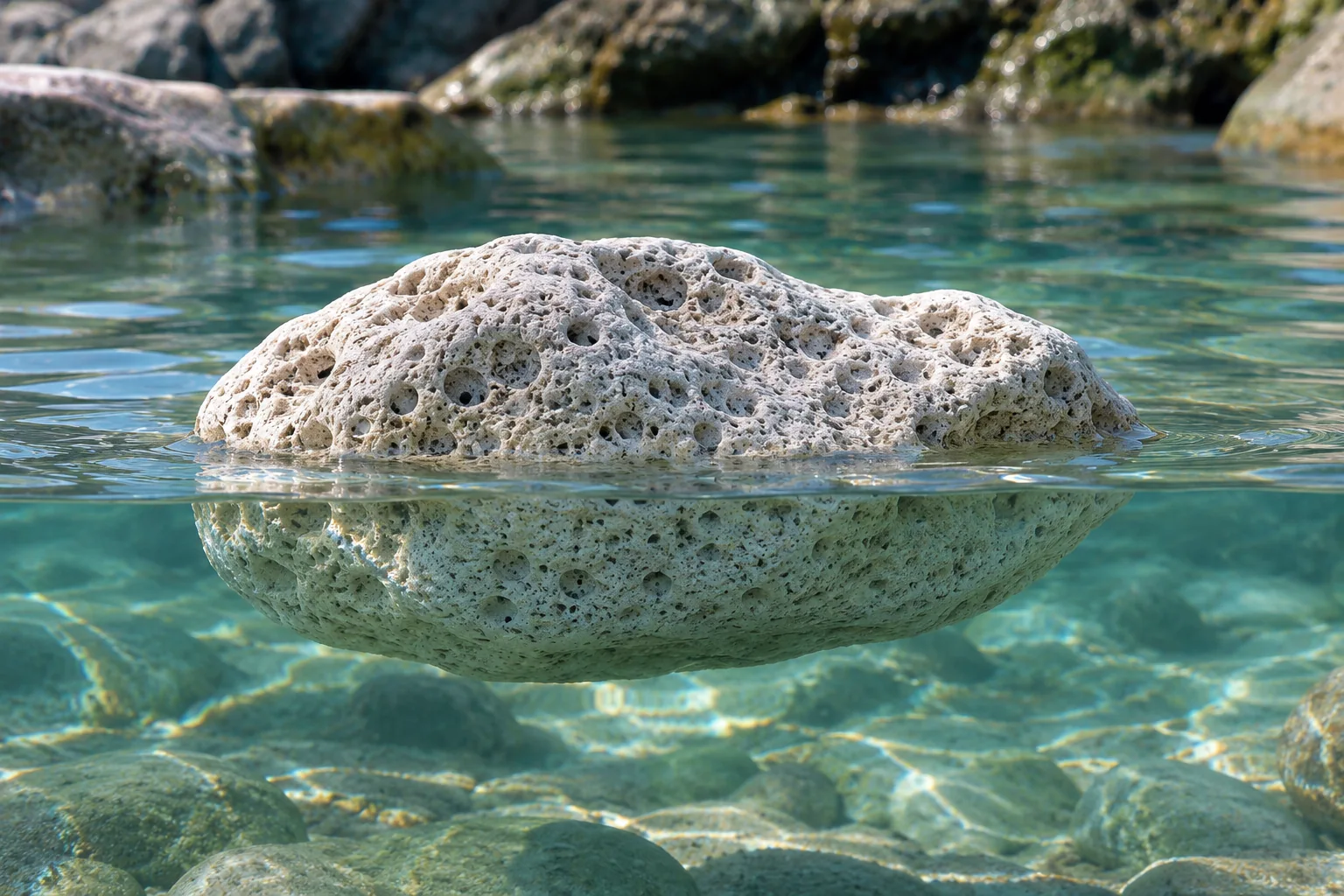
A chunk of pumice can take on water almost as soon as it touches the sea and still be floating months later. The secret is inside its pores. Water finds a route into the rock, then cuts off some of the gas on its way through. As long as enough gas stays behind, the stone is light enough for the water it displaces to support it. That accounts for something a beachcomber can actually see on a wet piece of pumice. A dark, soaked surface can surround a stone that still rides high in the water. [1, 2]
How an eruption puts bubbles into stone
Deep underground, pressure helps keep gases dissolved in molten rock. As magma rises and the pressure falls, gas can come out of solution and bubbles expand. During some eruptions the melt becomes a froth. Rapid cooling preserves thin walls of volcanic glass around the spaces the bubbles occupied. Geologists call these spaces vesicles. Break a piece of pumice and the rough new face reveals more cavities because the froth extends through the material. [3, 4]
That history matters more for floating than the pale colour commonly associated with pumice. The solid glass is dense enough to sink. Pick the stone up, though, and most of the volume enclosed by your fingers can be empty space. Two pieces that look about the same size can feel very different in the hand. A piece with thicker walls carries more stone for every pocket of gas. Its margin for taking on water is correspondingly smaller. [2, 3]
What the water has to support
Picture a hypothetical chunk whose outside dimensions enclose 100 cubic centimetres. Just under the surface it can displace about 100 grams of fresh water, provided we count any water that has entered the chunk along with its mass. If glass and contents together weigh the equivalent of 70 grams on a scale, it can float partly exposed. If enough gas space fills to bring the total above 100 grams, the same outside shape can no longer support the load. Those round numbers illustrate the balance. They do not describe a particular rock.
There are two equivalent ways to keep that account. Count the flooded pore water on both sides, as in the example, or leave it out and count just the solid and the trapped gas as the volume available to displace water. Counting that water as weight while also subtracting the flooded space from the displaced volume would count its effect twice. The rock need not become completely free of bubbles to sink. It only needs to cross the balance point.
Why the water leaves pockets of gas behind
A hole with only one opening looks like an obvious place for a bubble to get stuck. The more interesting case is a network in which many holes connect. Scientists used X-rays to examine the arrangement of water and gas inside pieces of pumice. Even in connected passages, the water could occupy narrow links and surround separate pockets of gas. Surface tension at the curved boundaries between gas and water helped hold those pockets in place. A channel open to gas when the stone was dry could be closed to a bubble after wetting. [1, 2]
Imagine dropping a bead of dye into the water outside a floating stone. Even if the dye eventually coloured an accessible passage, that would tell you only that liquid had reached it. It would say very little about how much gas remained in neighbouring branches. The distinction explains why measuring the amount of open space in dry pumice alone cannot tell you exactly how long it will float.
How a bubble escapes without rising to the surface
Gas can leave in a less conspicuous way than a stream of bubbles. Individual gas molecules can dissolve into the water and diffuse away. As a trapped pocket shrinks, water occupies more of the interior. Experiments and modelling connect the time required to lose this gas to the distance it must travel. Other things being equal, a larger piece offers longer paths from its interior. Size gives a clue to flotation time, although texture and starting conditions also vary among pieces. [1, 2]
One way to read that result is to imagine two fragments from the same block. Splitting one fragment exposes some formerly interior cavities directly to the water and shortens the route from others to the outside. It also changes the arrangement of the pore openings. A handful of fine crumbs therefore makes a poor stand-in for a single large lump in a test of how far the original block might drift.
An eruption you could trace from orbit
In August 2019, satellites observed a spreading patch on the Pacific near Late Island in Tonga. The pale material was a raft of pumice from a submarine eruption. NASA’s account includes a Landsat 8 view from August 13 in which the patch bends and breaks into traces on the water. A solid island would have a shoreline tied to the seabed. This feature could stretch and split because its pieces travelled at the surface. [5]
A satellite sees the combined effect of many floating pieces. It cannot tell whether one particular stone stayed at the surface for the entire passage, and a gap between two patches need not mark a gap in the original deposit. Wind and currents can rearrange a raft while some fragments lose buoyancy. Checking where a patch was observed on a given date answers a different question from cutting open one fragment to measure its pores. Together, the two scales explain how a rock made in a brief eruption can make a long sea journey. [2, 5]
Keep exploring
Compare buoyancy in another porous material, then look at a different consequence of a gas-rich volcanic eruption.
Sources and further reading
The two experimental accounts explain flooding and diffusion. The geological references describe how vesicles form, and the satellite image records the Tonga raft.
- Lawrence Berkeley National Laboratory — X-ray observations inside floating volcanic rock
- Fauria, Manga and Wei — Trapped bubbles keep pumice afloat and gas diffusion makes pumice sink
- US Geological Survey, Volcano Hazards Program — Pumice
- US National Park Service — Pyroclasts and pyroclastic rocks
- NASA Earth Observatory — A Raft of Rock
Keep exploring.
One remarkable idea at a time—nature, science, history and beyond.
Last updated November 18, 2026.

Barnakle Editorial Team
Barnakle Editorial Team is the collective byline used for Barnakle’s editorial articles. The contributor profile explains the team identity and links to the publication’s editorial policies.
More from the editorial team →