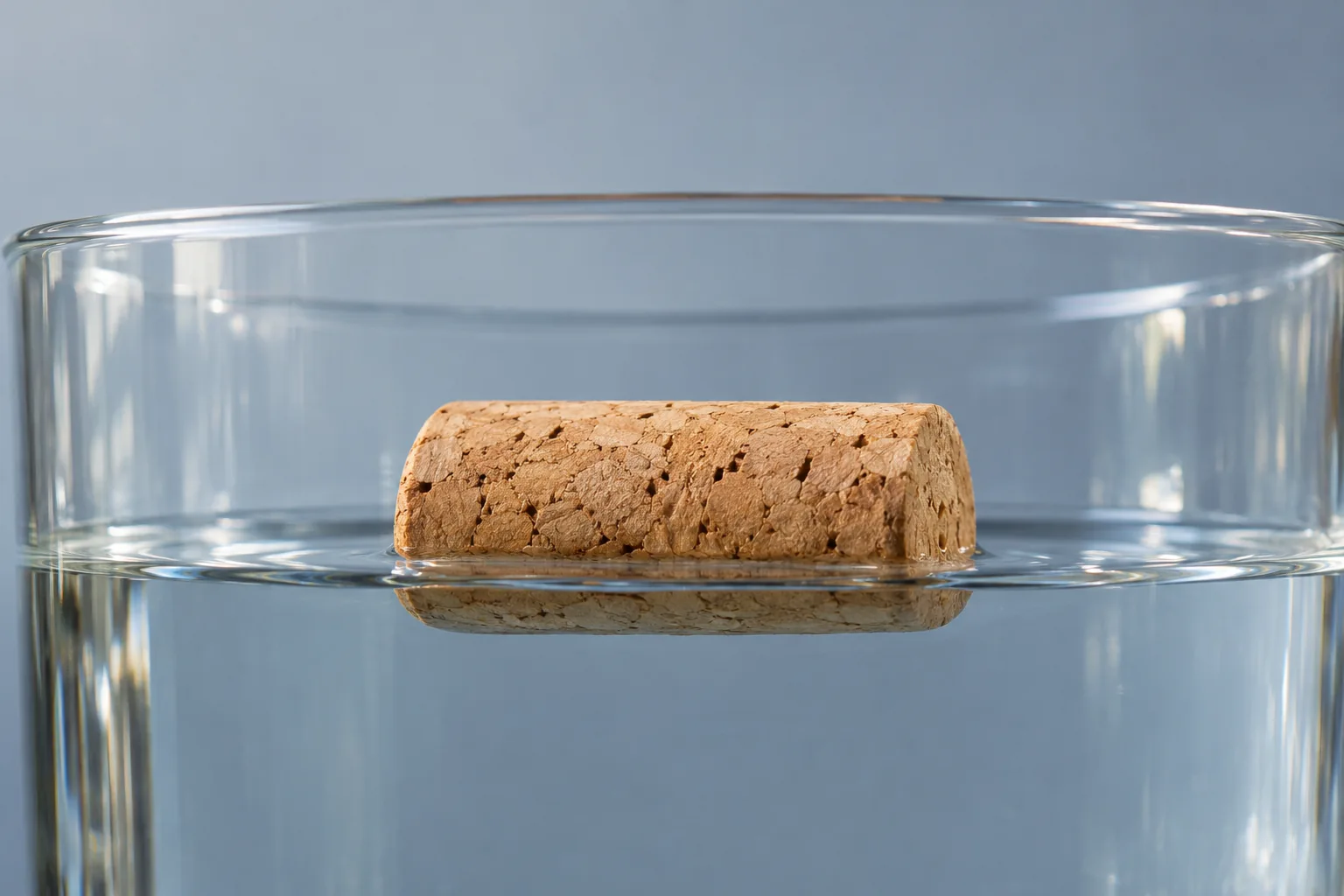
Drop a natural cork stopper into water and it usually stays at the surface. The water is supporting a material with a remarkably low overall density: much of cork’s volume consists of tiny enclosed spaces rather than solid cell walls. Its structure combines low mass with enough volume to displace the water needed to support it. [1, 3]
That answer is more precise than “cork is light.” A small stone can weigh less than a large cork block and still sink. Floating depends on the relationship between mass and volume, together with the surrounding fluid, rather than the object’s weight considered alone.
What is cork made from?
Commercial natural cork comes from the thick outer bark of the cork oak, Quercus suber. The tree produces an unusually substantial cork layer. Skilled harvesting can remove that layer while leaving the tree standing and able to grow replacement bark. [5, 6]
The material is plant tissue, but its structure differs from the everyday image of a solid piece of timber. Cork is built from closely packed cells with thin walls and hollow interiors. The spaces are part of the material’s biological architecture rather than large holes drilled into a solid block. [2]
This distinction helps explain why a cork stopper can look continuous and substantial while containing relatively little solid matter. Its large-scale appearance gives little indication of the enclosed structure at the cellular scale.
How do closed cells make cork less dense?
Natural cork behaves as a cellular solid, often described as a closed-cell foam. Its cells have gas-filled interiors and walls whose mass occupies only a fraction of the bulk volume. A review reports common air-dried densities around 150–160 kilograms per cubic metre, while noting a wider range in real samples. [1]
For comparison, a cubic metre of fresh water has a mass of roughly 1,000 kilograms under ordinary conditions. The solid cell-wall substance itself is denser than water; it is the architecture, including the enclosed spaces, that brings the overall density down. [1]
Think of the difference between the material in a wall and the entire room that the wall encloses. This is only an analogy, but it captures why measuring the density of a solid ingredient is not enough to predict the density of the larger structure.
The “closed” part matters too. These are not simply broad channels freely admitting water throughout the material. Cork’s cellular arrangement and suberised walls limit fluid movement, helping it retain a low bulk density during ordinary use. [2]
What force holds cork at the surface?
Water pressure increases with depth. The resulting pressure forces on an immersed object combine into an upward buoyant force. Archimedes’ principle states that this force equals the weight of the displaced fluid. [3]
At rest, a floating cork displaces enough water for that upward force to balance its weight. It need not be completely submerged to achieve that balance. If pushed down and released, ordinary dry cork can experience enough upward force to return toward the surface.
This is different from the way very small insects can be supported at a water surface. Surface effects exist around the waterline, but the main explanation for a normal cork stopper’s floating ability is bulk buoyancy, not a fragile surface skin carrying the whole object.
A simple floating calculation
Consider an idealised cork block with a volume of 100 cubic centimetres and a density of 0.16 grams per cubic centimetre. Its mass would be 16 grams. In fresh water treated as 1 gram per cubic centimetre, it would need to displace 16 cubic centimetres to balance its weight. [3]
That is 16 percent of its total volume. For a uniform rectangular block floating flat in this simplified example, the same fraction of its height would lie underwater. A rounded stopper is a different shape, so volume fraction and height fraction should not be casually interchanged.
These values illustrate the calculation rather than predict every cork’s waterline. Real density, absorbed water, attached loads and shape affect the result. The accompanying image is illustrative and should not be used to extract a density measurement.
Is cork completely waterproof?
No. “Resistant to water entering” is a more useful description than “incapable of absorbing water.” Cork has low permeability, but that is not the same as absolute impermeability over all conditions and timescales. [1, 4]
Rosa and Fortes investigated liquid-water absorption at room temperature and at higher temperatures. Their abstract describes initial changes involving the cell walls, followed by water entering the cells over longer exposure. Under the experimental conditions, eventual filling could raise density enough for cork to sink. [4]
This does not establish a universal sinking time for every bottle stopper. Sample condition, temperature and exposure matter. It does establish why “cork always floats forever” goes beyond the evidence.
An ordinary observation and a long-duration experiment can therefore both be correct. A dry stopper may remain buoyant during everyday use while the material still admits slow changes during prolonged immersion.
Why can two pieces of cork sit differently in water?
Natural material varies. Cork cells formed at different stages of growth can differ in dimensions and wall thickness. The reviews describe structural variation that affects the proportion of solid material within a sample. [1, 2]
Two similarly sized pieces need not have identical mass. If one contains a larger solid fraction or has taken up more water, it can require more displaced water to float. This is a density question, not evidence that one piece experiences a different law of buoyancy.
Objects sold as “cork” also need not be identical products. A natural one-piece stopper, a composite and a synthetic closure should not be assumed to share one material specification. This article concerns the cellular natural bark material rather than certifying every lookalike product.
Does cork have to be harvested by cutting down the tree?
No. Kew describes carefully trained workers removing cork while allowing the tree to remain. The Natural Cork Council emphasises timing and technique because inappropriate stripping can damage living tissue. “Renewable bark” does not mean harvesting is harmless regardless of how it is carried out. [5, 6]
That origin is part of cork’s interest as a material. A living tree produces a protective tissue whose cellular architecture later becomes useful in stoppers, floats and insulation. Different uses take advantage of different properties; being buoyant alone would not explain why a stopper can form a seal. [5]
The floating stopper is therefore a visible result of a much smaller structure. Thin walls, enclosed gas and slow water entry give natural cork an average density low enough for water to support it well before the whole object disappears below the surface.
Keep exploring
Compare cork with two other examples in which average density controls floating:
Sources and further reading
Cork structure and buoyancy checked November 16, 2026. The water-absorption study is used from its abstract; the numerical block below is an idealised calculation, not a test result.
- Pereira (2015) — The rationale behind cork properties: A review of structure and chemistry, BioResources
- Pereira (2016) — Cork-Containing Barks—A Review, Frontiers in Materials
- OpenStax, College Physics 2e — Archimedes’ Principle
- Rosa and Fortes — Water Absorption By Cork, Wood and Fiber Science; abstract
- Royal Botanic Gardens, Kew — Quercus suber: An example of sustainability
- Natural Cork Council — Cork Harvesting
Keep exploring.
One remarkable idea at a time—nature, science, history and beyond.
Last updated November 16, 2026.

Barnakle Editorial Team
Barnakle Editorial Team is the collective byline used for Barnakle’s editorial articles. The contributor profile explains the team identity and links to the publication’s editorial policies.
More from the editorial team →