
Explosive eruptions can electrify ash plumes. Fragmenting rock and colliding particles transfer charge near the vent; higher in tall, water-rich plumes, ice collisions can produce thunderstorm-like charging. Lightning sensors can help detect and track hazardous ash clouds.
- Volcanic lightning is a family of electrical processes, not one mechanism.
- Near-vent flashes can begin within seconds as magma fragments and particles collide.
- Large plumes can form ice and produce extensive lightning far above the volcano.
- Flash rates provide useful monitoring information but do not measure every eruption equally.
A thunderstorm made of rock
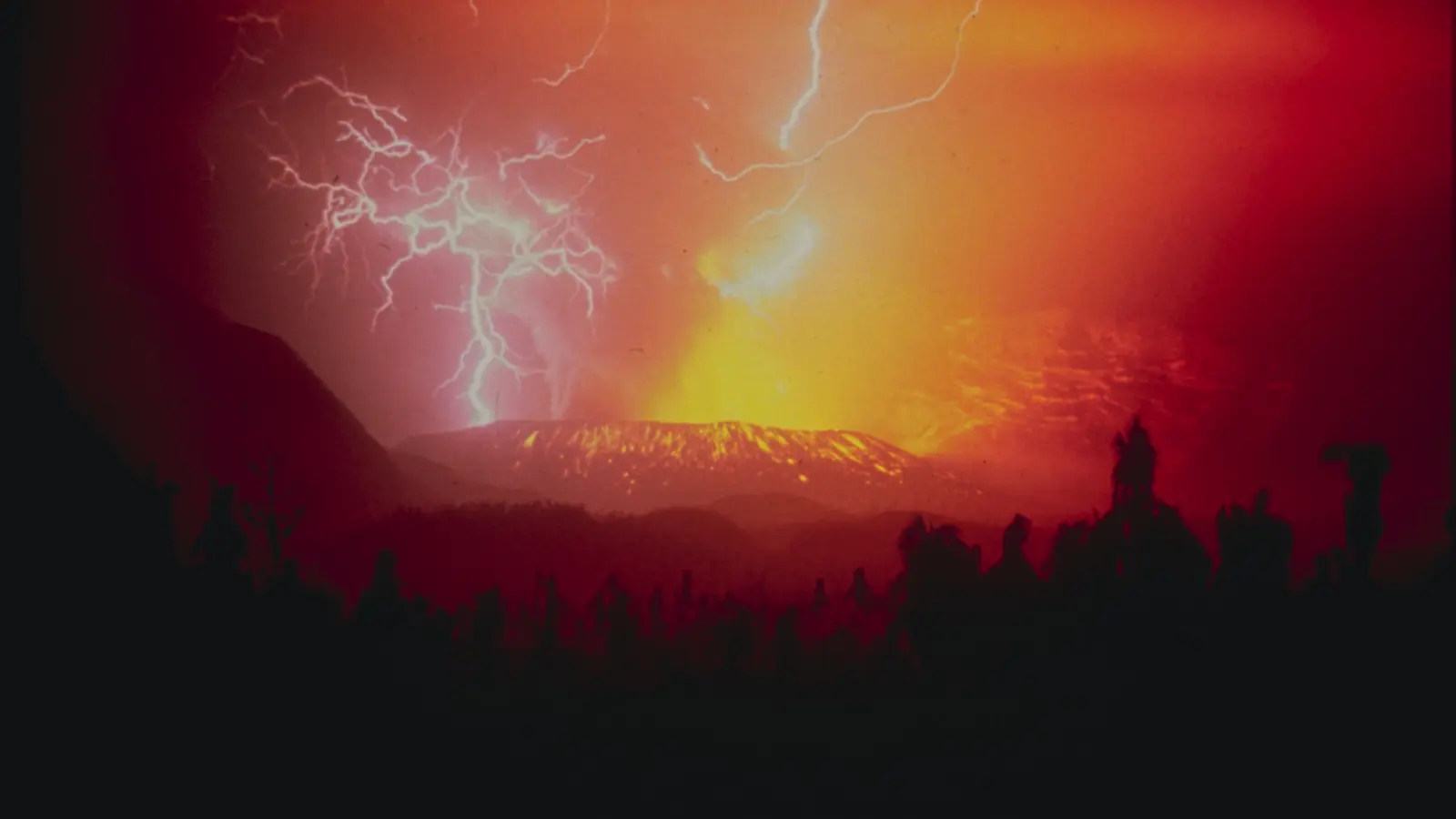
An eruption column can resemble a dark thundercloud, but it begins with hot gas, shattered magma and fragments of older rock. When electric charge separates across the plume, the electric field can grow strong enough to break down the surrounding air. A bright channel forms: volcanic lightning.
Photographs often compress the event into a single spectacular frame. Instruments reveal a changing electrical system with tiny sparks near the vent, larger flashes through the column and lightning in the spreading umbrella cloud.
Charging begins with fragmentation
Explosive decompression breaks magma into ash and larger particles. New surfaces form rapidly. Collisions, fracture and contact between materials can transfer electrons or ions. This triboelectric and fracto-emission charging is especially important close to the vent, where ash concentration is high.
Particle size matters because smaller and larger grains can acquire different charge tendencies and then separate through turbulence and settling. Charge separation, not merely charge creation, is necessary for a large electric field.
Ice changes the plume
A powerful eruption can rise into air cold enough for water to condense and freeze. Collisions among ice crystals, graupel-like particles and supercooled water can electrify the cloud through processes similar to ordinary thunderstorms. Water may come from magma, the atmosphere, a crater lake, seawater or melted ice and snow.
This ice-based pathway helps explain intense lightning in tall, water-rich plumes. It also shows why two eruptions with similar ash output may not produce identical electrical behavior.
The three electrical regions
USGS researchers describe activity near the gas-thrust region above the vent, through the convective rising column and within the umbrella cloud that spreads near the plume top. Each region differs in temperature, particle concentration, water phase and turbulence.
Near-vent discharges may be short and frequent. Large flashes can span kilometers higher in the cloud. Mapping their timing and location helps scientists infer how the plume is developing.
Hunga’s record-breaking storm
The January 2022 Hunga eruption produced extraordinary electrical activity. A study combining satellite and radio observations documented nearly 200,000 flashes and peak rates above 2,600 per minute. Lightning rings expanded around the plume, revealing waves and dynamics not visible from one viewpoint.
The record did not mean lightning caused the eruption. It meant the immense, water-rich plume created exceptional conditions for electrification.
Lightning as a volcanic sensor
Radio networks can detect discharges through darkness and bad weather. In remote regions, lightning may confirm that an explosion produced an ash plume. Combined with satellites, infrasound, seismic data and observations, it can improve situational awareness for aviation and communities downwind.
There are limits. Small discharges may escape detection. Network geometry affects locations. Some ash-producing explosions generate no detected lightning. Monitoring works best when independent instruments are interpreted together.
Can lightning change the ash?
Electrical activity may influence particle aggregation, in which fine ash sticks into larger clusters that fall faster. Lightning also drives high-temperature chemical reactions along narrow channels. Researchers study whether these processes leave recognizable textures or compounds in deposits.
Those traces could potentially help reconstruct ancient eruptions, but preservation and alternative processes complicate the interpretation. A laboratory spark and a natural plume are not automatically equivalent.
The useful signal inside the spectacle
Volcanic lightning is visually dramatic because it joins two hazards in one scene. Scientifically, its greater value is diagnostic. It carries information about fragmentation, moisture, ice, particle collisions and plume height.
The best question is therefore not simply “Why is the volcano making lightning?” It is “Where and when is charge separating, and what does that reveal about an eruption changing faster than observers can safely approach?”
Sources and further reading
Keep exploring.
One remarkable idea at a time—nature, science, history and beyond.
Sources and further reading
Barnakle uses credible primary and authoritative sources wherever possible.
- USGS Volcano Hazards; Van Eaton et al. 2016 and 2023; USGS Hunga
Last reviewed September 17, 2026.

Barnakle Editorial Team
A member of the Barnakle editorial team, exploring remarkable ideas with clarity, curiosity and care.
More from this author →