Floating and staying upright are different requirements. An iceberg can satisfy the first while suddenly failing the second.
Quick answer
An iceberg flips when its orientation becomes unstable. Melting, breaking or losing support can change how gravity and buoyancy act on its irregular shape. A small tilt may then produce a torque that increases the tilt instead of restoring it. The iceberg rolls toward another orientation, releasing energy into its own movement, surrounding water, turbulence and waves.
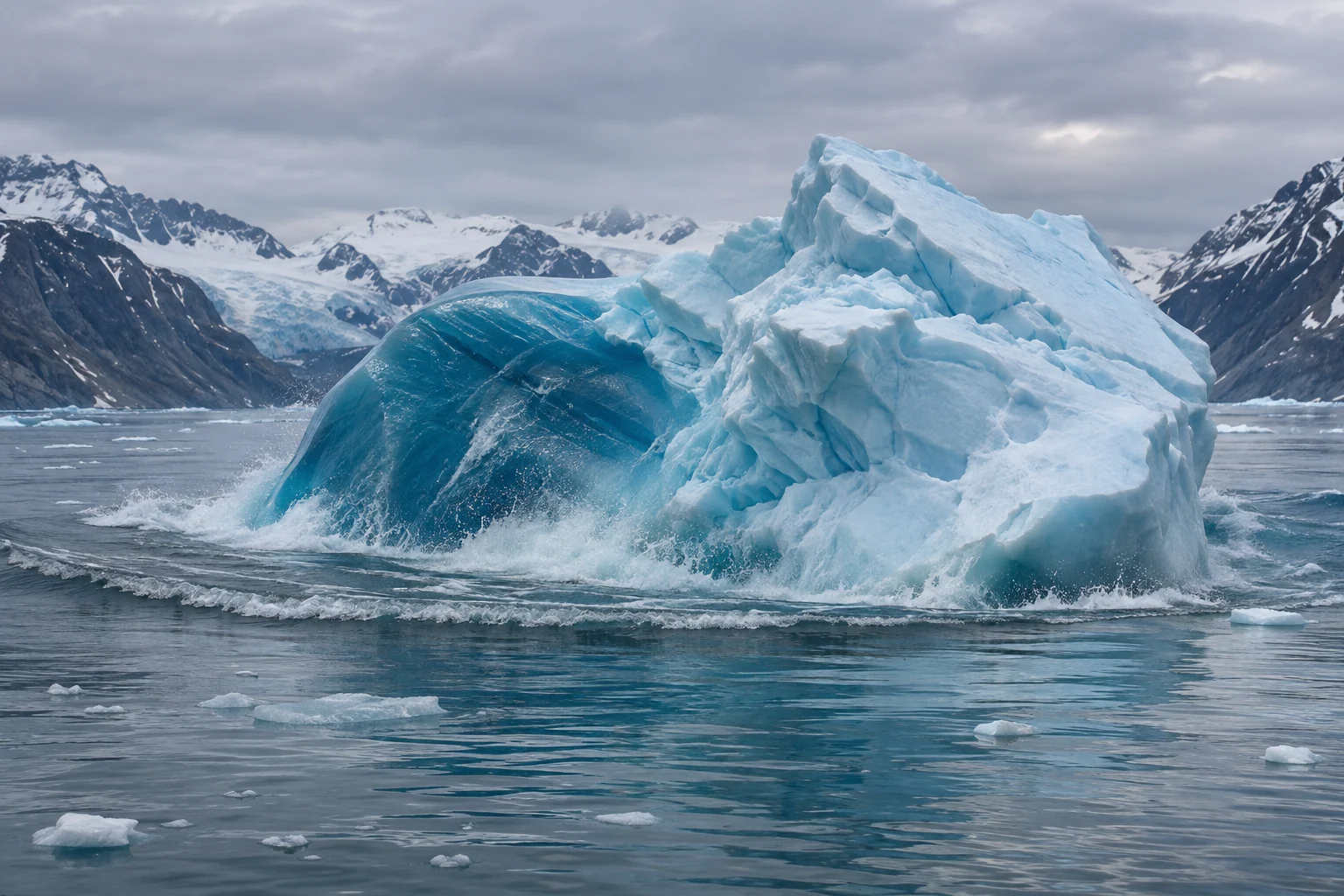
An iceberg can appear almost motionless, then reveal a dark blue surface that was hidden underwater moments earlier. Water surges outward as an enormous mass turns. The event looks like something has pushed the ice from below, but changing balance can provide the explanation.
The useful starting point is to ask two separate questions. Why does the ice float at all? And why does it float in this particular orientation? Density answers much of the first question. Shape, mass distribution and the response to a tilt determine the second.
What an iceberg is—and what you cannot see
NOAA describes an iceberg as ice that has broken from a glacier or ice shelf and is floating in open water. It is different from sea ice formed by freezing seawater. Icebergs can have flat tabular forms or irregular domes and spires. [1]
The visible outline is only part of the object. A large submerged region supplies much of the displaced-water volume. Looking at the height of the exposed tip does not reveal every underwater shelf, rounded side or projecting spur.
That hidden geometry matters because stability depends on the entire floating object. A photograph showing a broad white surface above water can leave its most mechanically important features out of view.
Why so much lies below the surface
Floating requires the upward buoyant force to balance weight. In a simple model, the fraction of an object’s volume submerged equals its average density divided by the water density. Environment and Climate Change Canada gives approximate densities of 900 kilograms per cubic metre for iceberg ice and 1,025 for seawater. [2]
Using those illustrative values gives 900 ÷ 1,025, or about 0.88. Roughly 88 per cent of the total volume would lie underwater in that model. The familiar “about ninety per cent” is an approximation, not an exact property of every iceberg.
Most importantly, the ratio does not specify the iceberg’s shape. Two differently shaped objects with the same average density can require the same submerged volume while having very different stability.
Gravity and buoyancy act through different reference points
The downward weight acts through the centre of mass. The buoyant force can be represented as acting through the centre of the displaced-water volume. In a floating equilibrium, the forces balance and their lines of action do not produce an unbalanced turning effect.
A small tilt changes the submerged shape and therefore the location of the effective buoyant force. If the resulting torque opposes the tilt, the orientation has a restoring tendency. If it reinforces the tilt, the object can continue rotating away from that position.
Imagine balancing an irregular object on a support that shifts as the object turns. Knowing only its total weight would not tell you whether it returns after a disturbance. In an iceberg, the “support” is distributed water pressure, and the shift follows the changing submerged geometry.
Why melting can make a stable iceberg unstable
Melting does not remove equal amounts from every surface. Water temperature, waves and exposure vary, so the submerged and exposed regions can change differently. The Canadian Coast Guard describes how deterioration alters the centre of buoyancy and can produce instability and rolling. [3]
Removing a projecting section can change more than total mass. It changes the shape displacing water and may shift where weight is concentrated. A gradually changing object can therefore cross a stability threshold without a dramatic new impact.
This helps explain an apparent surprise: a quiet period is not proof that an iceberg’s balance is unchanged. The visible motion can remain small while the conditions governing the next motion evolve.
Why capsizing can happen during calving
Before an iceberg separates, surrounding ice or a glacier front can constrain it. Breaking free changes those constraints. A newly released block can be unstable as a floating object even though it remained supported while attached.
Laboratory research on iceberg capsize examines that transition and the influence of block geometry. Burton and colleagues studied buoyancy-driven rolling, measuring stability and the energy budget as model icebergs moved through water. [4]
Calving and capsize are therefore related but different events. Calving is the separation of ice; capsize is a rotation into a different floating orientation. Either can move water, and a real event may combine several motions.
Where the energy comes from
An unstable floating system can move toward a lower total gravitational potential energy. The accounting includes the ice and the surrounding water that moves as the iceberg turns. It is not enough to track only the most visible point on the ice.
The University of Chicago’s research description identifies this release of gravitational potential energy as the source of vigorous surrounding motion. No internal engine or underwater explosion is required. [6]
A useful analogy is an object tipping off an unstable perch. The initial nudge can be small compared with the energy released by the subsequent movement. For an iceberg, buoyancy and displaced water make the full balance more complex, but the distinction between trigger and energy source remains useful.
Does all that energy become a wave?
No. Energy goes into several channels, including movement of the iceberg, surrounding flow and turbulent dissipation. In the conditions tested by Burton and colleagues, most released energy was rapidly transferred and dissipated in the water rather than radiating away as surface waves. [4]
A spectacular wave is easy to observe, but less visible water motion can account for an important share of the event. Visual drama is not a reliable measure of the complete energy budget.
Likewise, an experiment’s measured fraction is not a universal percentage for every natural capsize. Shape, water depth, neighbouring ice and constraints affect the motion and the way energy is distributed.
Why different calving motions produce different waves
A 2019 large-scale experimental study compared several mechanisms, including capsizing, falling and overturning. Distinguishing them matters because the interaction between ice and water changes with the motion, affecting the resulting wave field. [5]
Compare lowering an object into a bath with dropping it and with rotating it while partly submerged. Even with the same object, the surrounding water receives a different sequence of displacement and force. Real iceberg events add irregular geometry and enormous scale.
This is why a brief clip cannot support a precise prediction of wave size somewhere else. Interpreting the event requires information about the initial geometry, movement and surrounding water, not just a dramatic splash.
Does a freshly exposed blue surface prove a capsize?
A roll can reveal ice that was underwater, but colour alone is not a complete motion record. Lighting, surface texture and the optical properties of the ice affect appearance. Following the geometry across several frames provides stronger evidence than identifying one blue patch.
Researchers separate observations from explanations: the object rotated; its surface changed orientation; waves developed. Inferring exactly why it began to roll requires additional knowledge of the changing shape and forces.
Frequently asked questions
Does an iceberg need to melt before it flips?
No. A newly calved piece may already be unstable, and other changes in support or geometry can initiate a roll. Melting is one possible route, not a requirement.
Does having most of its volume underwater make it stable?
Not automatically. Density determines the necessary displaced volume; the arrangement of that volume and the mass determines the response to a tilt.
Is every iceberg capsize a tsunami?
Capsizing can generate waves, but their size and propagation depend on the event and setting. The presence of a splash does not establish a particular wave scale. [5]
Does rolling mean the iceberg has stopped floating?
No. It can remain buoyantly supported throughout the event while changing orientation. Floating and rotational stability are different properties.
Keep exploring
Sources and further reading
- NOAA National Ocean Service — What is an iceberg?
- Environment and Climate Change Canada — Iceberg drift and density
- Canadian Coast Guard — Ice climatology and iceberg deterioration
- Burton and colleagues (2012) — Laboratory investigations of iceberg capsize dynamics, energy dissipation and tsunamigenesis
- Research paper (2019) — Large-scale experiments into the tsunamigenic potential of different iceberg calving mechanisms
- University of Chicago — Iceberg capsize hydrodynamics research abstract
Reference review: November 10, 2026.
Keep exploring.
One remarkable idea at a time—nature, science, history and beyond.
Last updated November 12, 2026.

Barnakle Editorial Team
Barnakle Editorial Team is the collective byline used for Barnakle’s editorial articles. The contributor profile explains the team identity and links to the publication’s editorial policies.
More from the editorial team →