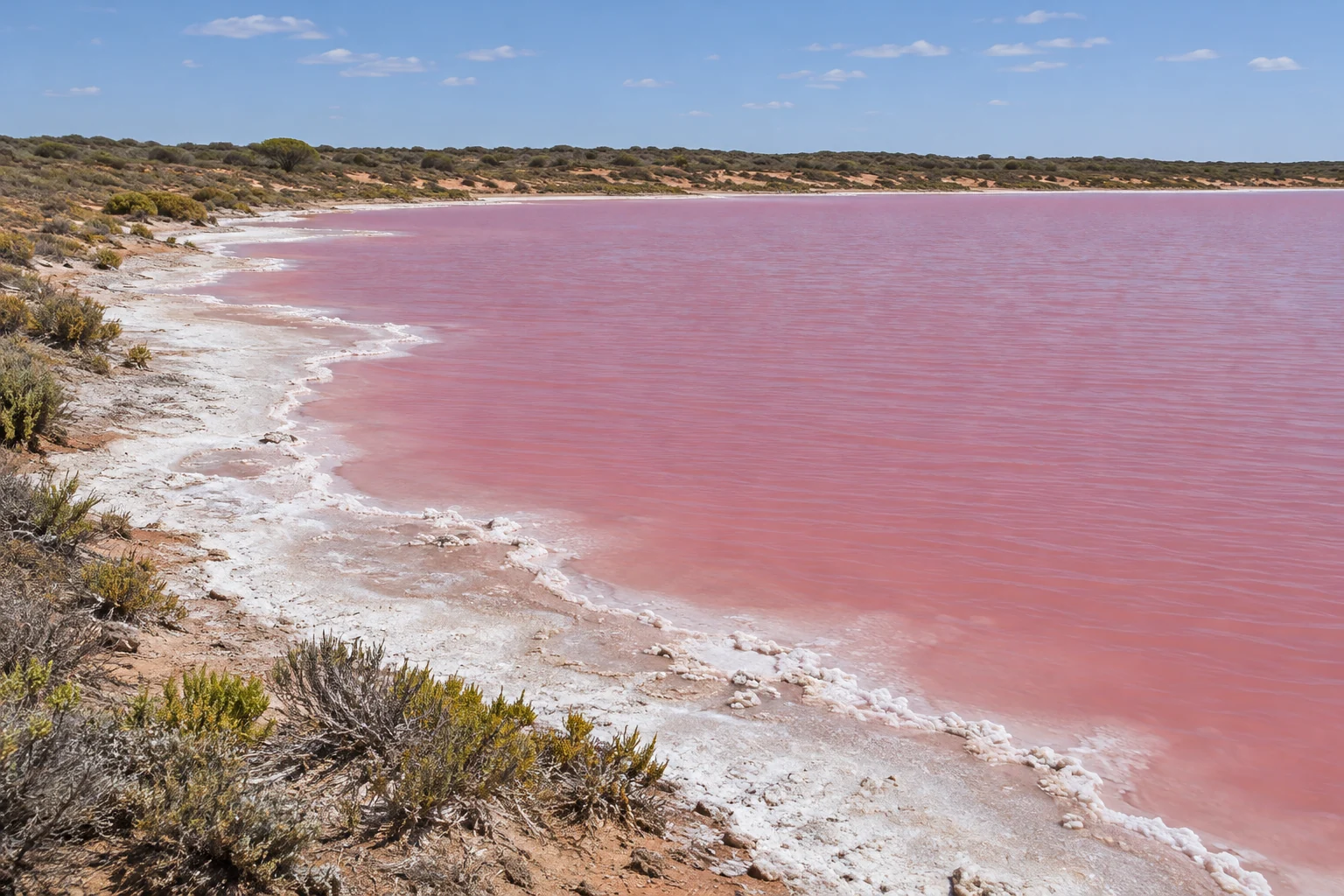
Some lakes look as though someone has poured dye into them. In many naturally pink salt lakes, the colour is evidence of microscopic life thriving under conditions that exclude much of the aquatic world.
Why do some lakes turn pink? Pigment-producing microorganisms can become abundant enough to colour saline water. Depending on the lake, contributors include algae, bacteria and archaea. Salinity, sunlight, water depth and the changing community influence the result. “Pink lake” describes an appearance, not one universal organism or a fixed recipe. [2]
The water is coloured by microscopic inhabitants
A microorganism can be invisible as an individual yet conspicuous as part of a large population. When many cells contain pigments that alter the balance of reflected and scattered light, the combined effect can become visible across a body of water. The visible landscape is therefore linked to processes occurring at a scale far below the eye’s resolution.
One well-known participant is Dunaliella salina, a salt-tolerant microalga. NASA’s account of Senegal’s Lake Retba describes its production of orange-red carotenoids under stressful conditions such as high salinity and intense sunlight. An organism classed as a green alga can consequently contribute to a lake that looks pink. Its taxonomic label is not a guarantee of its visible colour in every environment. [1]
The appearance is not explained by ordinary dissolved salt being pink. Salt helps create the habitat, while pigments in the microbial community help create the colour. Those two roles are connected but distinct.
More than one kind of microbe can contribute
It is easy to turn a vivid natural phenomenon into a one-organism story. Research on Australia’s Lake Hillier instead found a diverse microbiome containing several kinds of pigment producers. Sierra and colleagues used metagenomic sequencing and culture-based approaches to investigate the lake’s organisms and their metabolic potential.
Their 2022 paper identified a community that included Dunaliella, Salinibacter and other pigment-associated groups. The authors proposed a combined contribution to the colour and explicitly left room for further work. The findings support a microbial community explanation; they do not provide a universally settled percentage of colour attributable to each organism in every pink lake. [2]
Bacteria and archaea are different groups, even though both include microscopic organisms adapted to very salty conditions. “Algae” is therefore not an adequate name for everything contributing to a colourful brine. Identifying the participants requires more than choosing whichever group is most familiar.
How salinity helps shape the community
Evaporation removes water while leaving much of its dissolved salt behind. Where water is not replenished at the same rate, the remaining brine can become more concentrated. That changes the conditions organisms must tolerate. A community suited to less salty water may give way to one that can function at much higher salt concentrations.
Utah’s Great Salt Lake provides a visible comparison within one lake system. The Utah Geological Survey describes a colour contrast across its causeway: different water exchange and freshwater inputs create different salinities, with different microbial communities contributing to the colours of the two arms. The north arm can appear red-violet while the less saline south arm often looks blue-green. [3]
This is a powerful natural comparison because the two colours are close together. The landscape contains a boundary in water movement, and that boundary has biological and optical consequences. The colour is part of a larger system of inflow, evaporation and habitat.
Why rain can change a pink lake
Freshwater entering a saline lake can dilute the brine, alter depth and change the conditions for pigment-producing organisms. It can also coincide with changes in sunlight and cloud cover. A seasonal colour shift can therefore reflect several influences operating together, rather than a simple switch activated by one weather event.
NASA compared Landsat observations of Lake Retba from May and September 2022. Its account connects the brighter dry-season pink with stronger sunlight and concentrated salt, and the fading wet-season colour with fresher water and cloudier conditions. This is a dated observation of a particular lake, not a promise of its appearance on any future visit. [1]
A useful distinction follows: a lake can be naturally pink without being permanently pink. The process that produces its colour is biological and environmental, so variation is part of the phenomenon.
What satellites reveal—and what they cannot identify
A satellite can show that different parts of a lake have different colours and can track changes over time. It cannot establish the identity of every organism from colour alone. NASA’s account of Lake Eyre’s contrasting reddish and greenish waters emphasizes that direct sampling is needed to identify the microbes present. [4]
That distinction prevents a common leap in reasoning. A pink patch can suggest hypotheses about pigment-rich organisms, but a photograph is not a DNA analysis. Field sampling, microscopy, culturing and sequencing address questions that an aerial view cannot settle by itself.
Combining the scales is especially useful. Images show where and when a visible change occurred. Samples investigate what was living there and what pigments or metabolic capacities might explain the observation.
Why the name “Pink Lake” can outlast the colour
Near Esperance in Western Australia, a lake named Pink Lake has been the subject of a local feasibility study into its lost colour. The Shire of Esperance describes historic Dunaliella salina pigmentation and links the diminished pink appearance to changes in the salt balance, including past salt removal. [5]
The important lesson is that a familiar colour can depend on conditions that are vulnerable to change. A place name records human history; the present microbial community responds to the present environment. The two need not continue to match.
It would be too simple to conclude that adding salt to any lake would recreate a pink ecosystem. Water balance, nutrient availability, organisms already present and the wider setting all matter. The cited study concerns a particular lake and a particular investigation, rather than a general instruction for changing natural waters.
Why no photograph guarantees the next view
Parks Victoria describes the intensity of Loch Iel’s pink as varying with season, temperature, cloud cover and water level. A lake can look pale, strongly coloured or salt-white under different conditions. [6]
Lighting and viewpoint also affect the impression a photograph gives. The scientifically useful question is not whether every picture has exactly the same shade. It is whether observations and samples support an explanation for the colour at that time and place.
Frequently asked questions
Are all pink lakes coloured by the same alga?
No. Several kinds of pigment-producing microorganisms can contribute, and the mix differs among environments.
Does the salt itself dye the water pink?
In the microbial examples discussed here, high salinity shapes the habitat while biological pigments provide the colour.
Can a pink lake lose its colour?
Yes. Changes in salinity, water balance and the community can change its appearance, sometimes for long periods. [5]
Can a satellite photograph name the microbes?
No. Colour observations and biological identification provide different kinds of evidence. Direct samples are needed to investigate the organisms present. [4]
Keep exploring
Sources and further reading
- NASA Earth Observatory — Lake Retba’s changing pink colour
- Sierra and colleagues (2022) — Lake Hillier’s pigment-rich microbiome; research paper
- Utah Geological Survey — Great Salt Lake water colour and salinity
- NASA Earth Observatory — Lake Eyre Blushes
- Shire of Esperance — Pink Lake feasibility study and historic colour
- Parks Victoria — Loch Iel (Pink Lake) and changing colour
Reference review: November 10, 2026.
Keep exploring.
One remarkable idea at a time—nature, science, history and beyond.
Last updated November 12, 2026.

Barnakle Editorial Team
Barnakle Editorial Team is the collective byline used for Barnakle’s editorial articles. The contributor profile explains the team identity and links to the publication’s editorial policies.
More from the editorial team →