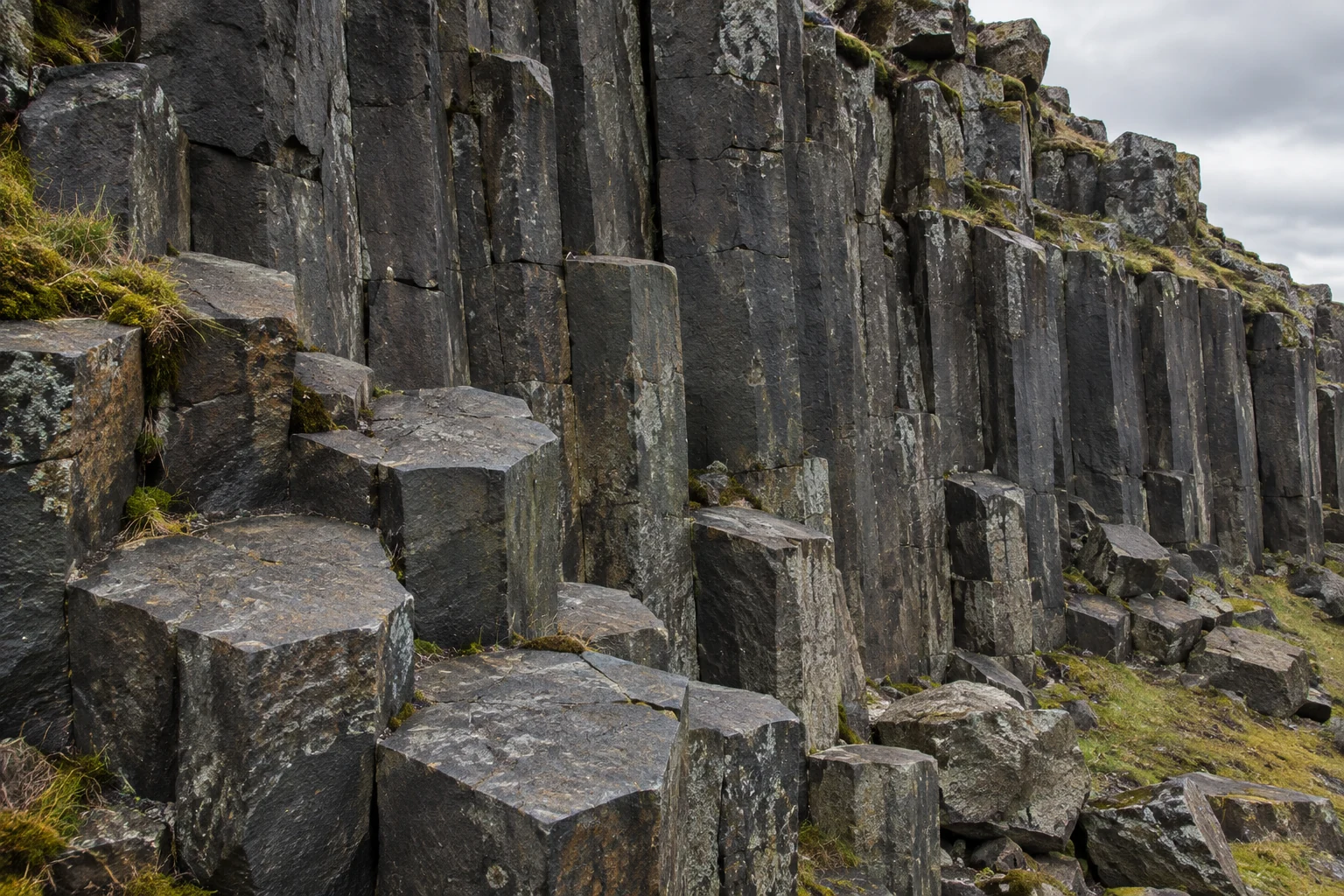
The columns are not giant crystals. They are pieces separated by a fracture network that grew as the rock cooled.
Quick answer
Polygonal rock columns form when cooling causes contraction and tensile stress in solidifying or already solid rock. Cracks relieve that stress and advance inward with the cooling front, separating the rock into long prisms. Six-sided cross-sections are common because of how the crack network organizes, but five-, seven- and other-sided columns occur too.
A cliff of close-packed stone pillars can resemble an enormous construction project. Exposed tops look like paving blocks; long flat faces meet along crisp edges. The apparent regularity is so striking that the natural explanation can seem less intuitive than an imaginary builder.
These structures are examples of columnar jointing. Their geometry comes from a sequence of fractures, not from separate columns growing upward like trees. To understand them, follow the cooling of a thick body of hot rock.
Hot rock contracts as it cools
A lava flow loses heat through its boundaries. The surface, base and sides can cool differently, while the interior remains hotter for longer. USGS describes cooling progressing from these boundaries toward the centre of a basalt flow. [1]
Cooling generally makes the material contract. But one part of a connected rock body cannot always shrink independently of its neighbours. Those constraints create stress. When the rock can no longer accommodate it by deforming, a fracture can open.
A useful comparison is an unevenly heated ceramic object. Neighbouring regions want to change size by different amounts, but their physical connection restricts them. The resulting stress can crack the object. The scales and materials differ, yet thermal strain links both phenomena.
The columns are bounded by cracks
A joint is a fracture surface without the large sliding displacement associated with a fault. In columnar jointing, connected joints divide the body into elongated polygonal pieces. The solid rock inside a column remains part of the original flow or intrusion.
This distinction rules out a common misconception: a hexagonal column is not simply one enormous mineral crystal. Basalt contains many mineral grains. The column’s outline belongs to the fracture pattern at a far larger scale.
Imagine slicing a loaf into pieces. The cuts define the pieces without implying that each slice was baked separately. In rock, the joints grow naturally rather than being made with a blade, but they similarly create boundaries within a previously connected body.
Why cracking follows a moving front
The whole lava body does not usually reach the same temperature at once. A layer where contraction stresses can build and fractures can advance moves inward as cooling proceeds. The tips of the joints follow that changing region. [3]
A surface pattern can therefore extend into the rock to form long columns. It is not necessary for every vertical crack face to appear simultaneously over the column’s entire height.
Laboratory work published in 2018 investigated the temperatures at which basalt fractured during controlled cooling. Its results support the point that column-forming cracks propagate in solid rock, rather than being openings maintained in freely flowing liquid lava. Exact thresholds depend on the material and experiment. [4]
Why are six sides so common?
As a fracture network develops, neighbouring cracks interact and the pattern can become more organized. Three-way junctions with angles near 120 degrees favour a largely hexagonal arrangement. The National Park Service describes this geometry in terms of relieving contractional stress. [2]
A regular hexagonal tiling is an especially recognizable outcome, but the actual rock never has to consult a geometrical template. Local crack growth and interaction create a larger pattern.
Compare the distinction between a rule and an emergent result. No single crack has to draw a complete six-sided column. Many advancing segments, each responding to local conditions, collectively define the boundaries around neighbouring pieces.
Why not every column is a hexagon
Natural fracture networks contain disorder. A few columns have more sides, others fewer, and their sizes vary. USGS notes three- to eight-sided examples at Sheepeater Cliffs. Six is common, not mandatory. [5]
Research comparing basalt with laboratory analogues also emphasizes that even mature, well-ordered patterns retain pentagons, heptagons and other deviations. A theory that produces perfect hexagons everywhere would miss an important feature of the real formations. [3]
This is a useful reminder when reading a simplified diagram. A tidy drawing can show the dominant geometry without representing the full distribution of shapes. The exceptions are part of the evidence, not mistakes made by nature.
What determines the direction of a column?
Columns tend to extend perpendicular to the local cooling surface. If heat mainly leaves through a roughly horizontal boundary, approximately vertical columns can develop. Changing boundary geometry can produce inclined or curved arrangements. [1]
The word “local” matters. A flow does not have one universal cooling direction. Topography, neighbouring rock, water and the shape of the original body can change the path along which cooling progresses.
A column pointing sideways is therefore not necessarily a formerly vertical pillar that somebody moved. Its orientation may record how heat left that part of the rock.
Can column size reveal cooling history?
Cooling and fracture spacing are related, but not by a single universal ruler. Studies examine how heat transport, advancing fronts and crack growth influence the characteristic scale. Larger columns are broadly associated with slower cooling, while detailed relationships require more context. [3]
It is similar to reconstructing an event from several clues. Width, joint texture, surrounding layers and the overall geological setting contribute information. A measurement of one attractive column does not uniquely determine the original temperature or duration of cooling.
Natural systems also preserve changes through a single deposit. A regular lower colonnade can lie beneath an irregularly jointed region called an entablature. The different patterns reflect differences in the cooling and fracture history rather than a requirement for every layer to match. [2]
Is columnar jointing found only in basalt?
No. Basalt provides many famous examples, but columnar joints also occur in other volcanic materials and some shallow intrusions. The Colorado Geological Survey describes examples beyond a single rock composition. [6]
The underlying problem is constrained contraction and fracture. Chemistry and texture influence the response, but the geometrical pattern is not exclusive to one mineral mixture.
That is why researchers can use suitable laboratory materials as analogues. A model can reproduce aspects of a contraction-driven fracture network without being molten basalt. Matching a relevant physical process is different from reproducing every geological detail.
Why columns become visible as cliffs or paving-like surfaces
Jointing forms within the rock, while later erosion exposes it. A cliff can reveal the long sides; an exposed upper surface can reveal the polygonal cross-sections. These are different views of the same three-dimensional network.
Weathering can widen fractures and separate pieces further. The final landscape therefore combines the original cooling structure with everything that happened afterward. Its present outline is not a photograph of the moment the lava stopped flowing.
Frequently asked questions
Were the columns cut by people?
Natural columnar jointing results from cooling, contraction and cracking. Regular-looking geometry alone is not evidence of construction.
Are they always exactly six-sided?
No. Mixed polygon counts and irregular dimensions are normal features of the fracture network. [5]
Do the cracks form in liquid lava?
The fractures require material capable of sustaining stress. Experimental work supports their propagation in solid rock during continued cooling. [4]
Why can a column curve?
The cooling front can change direction as it moves through an irregular body. A curved column can record that changing geometry rather than later bending of a loose pillar.
Keep exploring
Sources and further reading
- USGS — Columnar jointing and the cooling history of lava flows
- National Park Service — Columnar jointing
- Goehring and Morris (2008) — Scaling of columnar joints in basalt
- Research paper (2018) — Disclosing the temperature of columnar jointing in lavas
- USGS — The spectacular columns of Sheepeater Cliffs
- Colorado Geological Survey — Volcanic rocks and columnar joints
Reference review: November 10, 2026.
Keep exploring.
One remarkable idea at a time—nature, science, history and beyond.
Last updated November 12, 2026.

Barnakle Editorial Team
Barnakle Editorial Team is the collective byline used for Barnakle’s editorial articles. The contributor profile explains the team identity and links to the publication’s editorial policies.
More from the editorial team →