A Fresnel lens focuses or redirects light using a series of stepped optical sections. Those sections preserve much of the light-bending action of a conventional curved lens while dispensing with much of its thickness. The result can be a large, light-gathering surface that is relatively thin and light for its size. [1, 7]
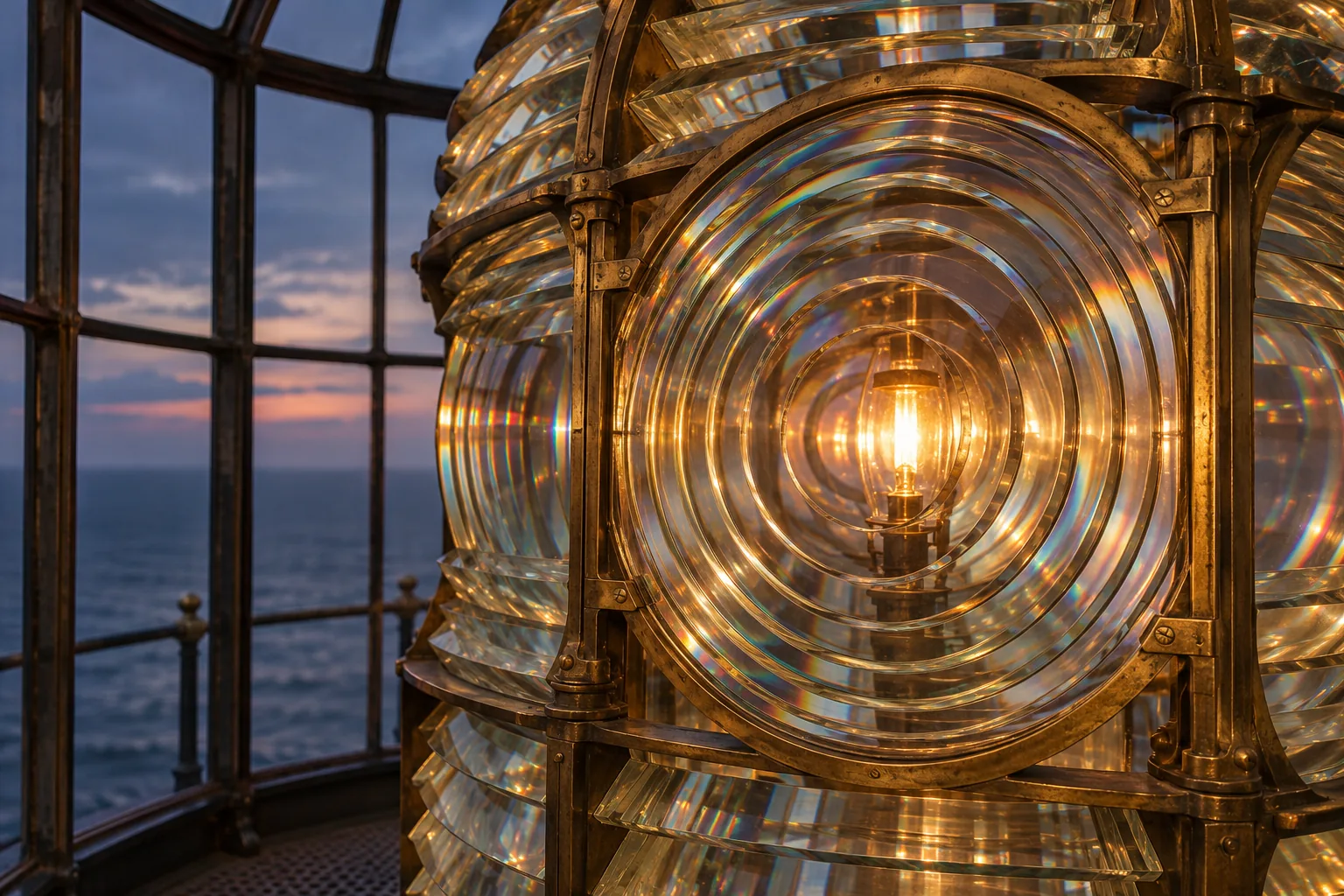
The familiar rings are functional surfaces, not decoration. Each section changes the direction of the light passing through it. In a lighthouse, a more elaborate assembly of lens panels and prisms can gather light from a lamp and send it outward in useful directions, making better use of the light already available. [3, 5]
Why does the angle of a glass surface matter?
Light changes speed when it passes between air and glass. When it crosses the boundary at an angle, its direction generally changes too. This is refraction. The amount of bending depends on the materials and the incoming angle relative to the perpendicular to the surface. [2]
A curved lens presents different surface angles to rays passing through different positions. Its shape therefore redirects those rays by different amounts. For a converging lens, that geometry brings an incoming bundle of parallel rays toward a focal region. It is the controlled sequence of surface angles that matters, rather than thickness alone. [1, 2]
Think of the surface as a collection of small windows, each tilted to redirect the view in a particular way. This is only an analogy: a real lens is designed using its refractive index and geometry. But it helps explain why the orientation of each part can be more important than retaining a solid mound of glass behind it. [1, 2]
How do the rings replace a thick lens?
In a simple Fresnel design, concentric zones reproduce the useful optical slopes at different distances from the center. Moving those zones closer to a common plane produces the stepped profile. The lens retains a broad aperture without requiring the full thickness of its conventional counterpart. [1, 7]
Viewed from the front, the result resembles a target. In cross-section, its zones look more like a succession of small refracting wedges. Each zone contributes to the overall optical action. The rings do not all need the same slope, because light reaching the outer zones must be redirected differently from light near the center. [7]
This arrangement also makes large optics easier to handle. California State Parks explains that a single solid lens suitable for a lighthouse would have been impractical to cast. Fresnel's solution used smaller lenses and prisms arranged in steps, allowing an assembly to be transported in sections. [3]
Does a lighthouse lens make extra light?
The lamp supplies the light. The optical assembly redirects more of that output toward mariners instead of allowing it to spread in less useful directions. A beam can consequently appear much brighter from a particular viewpoint without the lens supplying electrical or chemical energy of its own. [3, 5]
The National Park Service describes how Fresnel optics changed successive Bodie Island lighthouses. Different towers used different lens orders, with the present tower receiving a first-order lens. These orders distinguish sizes of lighthouse optics; they are not a measure of how many concentric rings a modern plastic magnifier has. [4]
Range figures in lighthouse histories describe particular installations. They should not be treated as a universal distance that every Fresnel lens can achieve. The light source, arrangement and viewing conditions belong to the whole lighthouse system, while the lens is one essential component. [4, 6]
Why do some lighthouse beams seem to flash?
An apparent flash need not mean the lamp switches off between flashes. A rotating optical assembly can sweep concentrated beams across a distant observer. The observer sees a bright interval when a beam points their way and a darker interval as it passes. [6]
Point Reyes provides a specific historical example. Its lens has twenty-four vertical panels directing separate beams outward. The National Park Service records a rotation period of two minutes, which produced a flash every five seconds. The distinctive timing was part of how mariners recognized that lighthouse. [6]
Different arrangements produce different characteristics. California State Parks notes that Fresnel assemblies could be configured for varied patterns of light and darkness. The optics therefore helped solve two related problems: making light visible at a distance and making its source recognizable. [3]
Are all Fresnel lenses giant glass beehives?
No. The term covers an optical design approach, not one particular shape or material. Historic lighthouse assemblies can surround a lamp with large tiers of glass. A modern Fresnel element can instead be a thin molded plastic sheet with fine grooves on one surface. [1, 5]
The historic Anacapa lens illustrates the elaborate lighthouse form. The National Park Service describes upper and lower prism sections, a central bull's-eye panel and a rotating third-order assembly. Those details belong to that installation; they should not be transferred to every lens bearing Fresnel's name. [5]
In thin-sheet optics, concentric grooves provide a compact way to collect light. Edmund Optics describes applications involving condenser systems and emitter-detector arrangements. A broad receiving surface can be useful even when the objective is collecting light rather than producing a sharply detailed picture. [7]
What is the trade-off?
Low weight does not make a Fresnel lens the best choice for every optical task. Groove design involves compromises between efficiency and image quality, and distortion can limit its usefulness for precision imaging. Conventional optical elements remain preferable when a demanding application needs cleaner image formation. [7]
The design's achievement is selective use of material. A lighthouse needed an effective way to direct a lamp's output across the sea; a compact optical instrument may need to collect light without a heavy solid lens. Fresnel's stepped surfaces address those needs by preserving useful bending geometry while removing much of the bulk. [1, 4]
Keep exploring
Explore why glass transmits visible light, then follow refraction through a very different optical system: a falling raindrop.
Sources and further reading
Optical principles and lighthouse examples checked November 17, 2026. Named historic installations below come from park records; the illustration depicts no particular lighthouse.
- Edmund Optics — Advantages of Fresnel Lenses
- OpenStax, College Physics 2e — The Law of Refraction
- California State Parks — Fresnel Lens at Pigeon Point
- National Park Service — The Fresnel Lens at Bodie Island
- National Park Service — The Fresnel Lens, Channel Islands
- National Park Service — Lighthouse History at Point Reyes
- Edmund Optics — Fresnel Lenses: construction and optical compromises
Keep exploring.
One remarkable idea at a time—nature, science, history and beyond.
Last updated November 20, 2026.

Barnakle Editorial Team
Barnakle Editorial Team is the collective byline used for Barnakle’s editorial articles. The contributor profile explains the team identity and links to the publication’s editorial policies.
More from the editorial team →