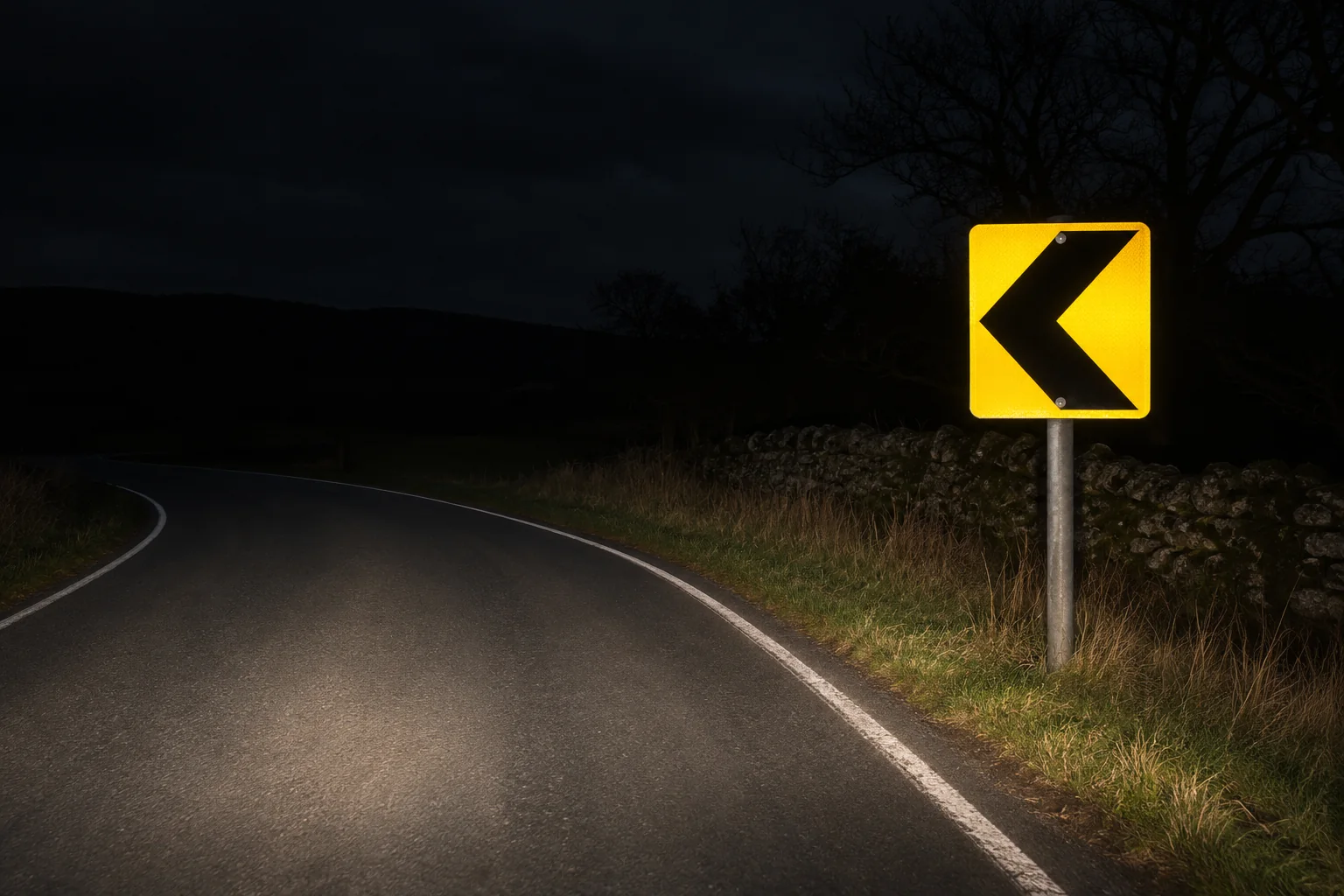
On a dark bend, the yellow chevron ahead can look bright enough to have a lamp inside it. A wooden fence beside the sign catches the same headlights and is barely visible. Someone looking across the road from a field might see quite an ordinary yellow panel. All three views make sense once you ask where the light goes after it lands.
Many road signs wear a thin sheet of retroreflective material. Tiny glass beads or transparent prisms in the sheet send a share of the incoming light back towards its source. A driver’s eyes are close enough to the headlights to receive some of that returning light. The sign borrows its illumination from the vehicle, and its brightness depends in part on who is looking.[1, 2]
What a bathroom mirror would do at the bend
Imagine replacing the yellow sign with a flat mirror. A ray from the left headlight strikes it. Measure the angle the ray makes to a line pointing straight out of the mirror. The reflected ray leaves at the same angle on the other side of that line. If the mirror happens to face the headlight squarely, a glint can come straight back. Turn the mirror a little and that concentrated glint goes somewhere else.
A board coated in ordinary matte yellow paint does a different job. Its surface scatters light in many directions. That makes a painted board visible from widely separated positions in daylight, when there is plenty of light available. In a headlight beam after dark, much of the scattered light travels above, below or to either side of the car. Only a small share goes where the driver can use it. A retroreflective sheet favours a narrower family of return directions.[1, 2]
There is a subtle advantage to that arrangement. A sign beside a curve is serving successive vehicles. The useful direction changes as each one moves. A mirror fixed to one post has one fixed orientation. A working retroreflector can send light back towards several different approach directions, within the range its optical elements accept. Each car supplies the light for its own view, even when two cars can see the sign at once.[1, 2]
Three faces do what one mirror cannot
Look up at a square corner of a room. Two walls and the ceiling make three surfaces at right angles. Shrink that geometry down and give the three faces the ability to reflect light. A ray that hits all three can leave travelling parallel to the direction it arrived from, but going back the other way. The outgoing ray can be displaced a little sideways. It does not have to retrace exactly the same line to be useful.[3]
You can work through the reflections without drawing any angles. Describe an incoming ray as moving a little to the right, a little upwards and a little forwards. A reflection at a side wall reverses the sideways part. A reflection at the ceiling reverses the vertical part. The remaining wall reverses the forward part. After all three, the ray is moving left, down and back. Each surface has dealt with one part of the original direction.[3]
Microprismatic sheeting packs tiny versions of that geometry across the face of a sign. Beaded sheeting reaches a similar destination by a different path. A transparent bead bends light as it enters. A reflecting layer behind the bead sends a portion back, and the bead bends it again on the way out. Highway engineers choose among grades of sheeting with different performance at different angles. From a car, either construction can look like one uninterrupted patch of yellow.[1, 4]
Why the person behind the headlights gets the best view
A perfect mathematical return to a single point would be an inconvenient design. The light would arrive back at the lamp, a little way below and to the side of the driver’s eyes. Actual sheeting returns light over a small spread of directions. To describe that spread, imagine two lines drawn outwards from the sign. One reaches the headlight. The other reaches the observer’s eye. The angle between them is the observation angle.[2, 4]
Put some numbers on the drawing. Suppose the eye and one headlight are one metre apart, measured across the line of sight. At a range of 100 metres they are about 0.57 degrees apart as seen from the sign. From 25 metres away the angle is about 2.3 degrees. Nothing in the sheeting changed while the car covered those 75 metres. What changed was which part of the reflected beam reached the eye. These numbers illustrate the geometry. They do not by themselves predict how bright the approaching sign will look.
The light arriving at the sign is also changing as a car approaches. How strongly the headlight illuminates that particular spot, where the road bends, the height of the eye and the condition of the sign all contribute. A second angle describes how far the incoming light is from an imaginary line perpendicular to the sign face. Engineers call this the entrance angle. Turning a sign on its post alters this angle even when the observer and the lamp stay put.[2, 4]
Try changing just one thing
A piece of reflective tape on a bag makes a convenient indoor test. Put the bag across a dim room and hold a small torch close beside your face, aimed at the tape. Then hold the torch farther to one side while keeping your eyes and the bag in place. Aim at the tape again. Depending on the tape and the size of the room, its apparent brightness can drop noticeably. Try the same change with a piece of plain white paper beside it. The paper makes a useful reference for how much of the change comes from moving the beam itself.
A daylight inspection asks a different question. A sign can retain a recognisable colour and a legible arrow while weathering reduces the amount of light it sends back at night. Road agencies can inspect signs at night or use instruments that illuminate a patch and measure its return at a defined geometry. A number obtained at one pair of angles means something precise, though it cannot stand in for every driver, vehicle or bend.[1, 2, 5]
Think again of the fence beside the road. Both the fence and the chevron are receiving light. A viewer in the field, a driver in the car and a camera placed next to the headlamp would record different pictures of the same moment. The bright yellow arrow is easiest to understand when you include one more object in the scene than a daytime photograph normally shows: the source of the light.
Keep exploring
A wet road and a pair of polarized glasses each change which reflected light reaches your eyes.
Sources and further reading
- Federal Highway Administration — Sign materials and sheeting
- Federal Highway Administration — Viewing geometry and sign luminance
- Smithsonian Astrophysical Observatory — Basic properties of a cube-corner retroreflector, section 2
- Transportation Engineering Agency — Better Military Traffic Engineering, chapter 7
- Federal Highway Administration — Nighttime visibility and sign retroreflectivity
Keep exploring.
One remarkable idea at a time—nature, science, history and beyond.
Last updated November 20, 2026.

Barnakle Editorial Team
Barnakle Editorial Team is the collective byline used for Barnakle’s editorial articles. The contributor profile explains the team identity and links to the publication’s editorial policies.
More from the editorial team →