Water changes how light crosses, scatters within and escapes from a rough surface
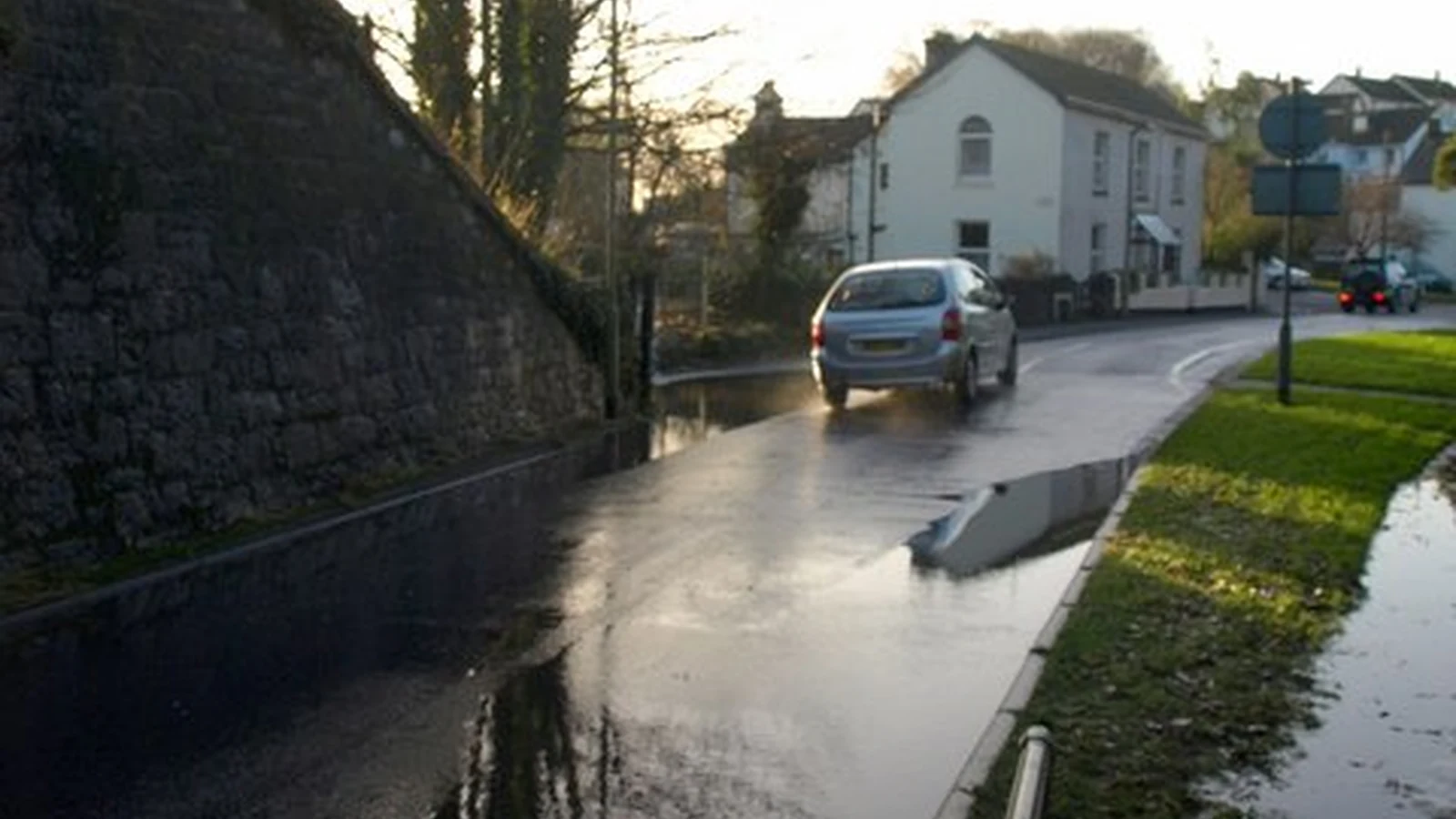
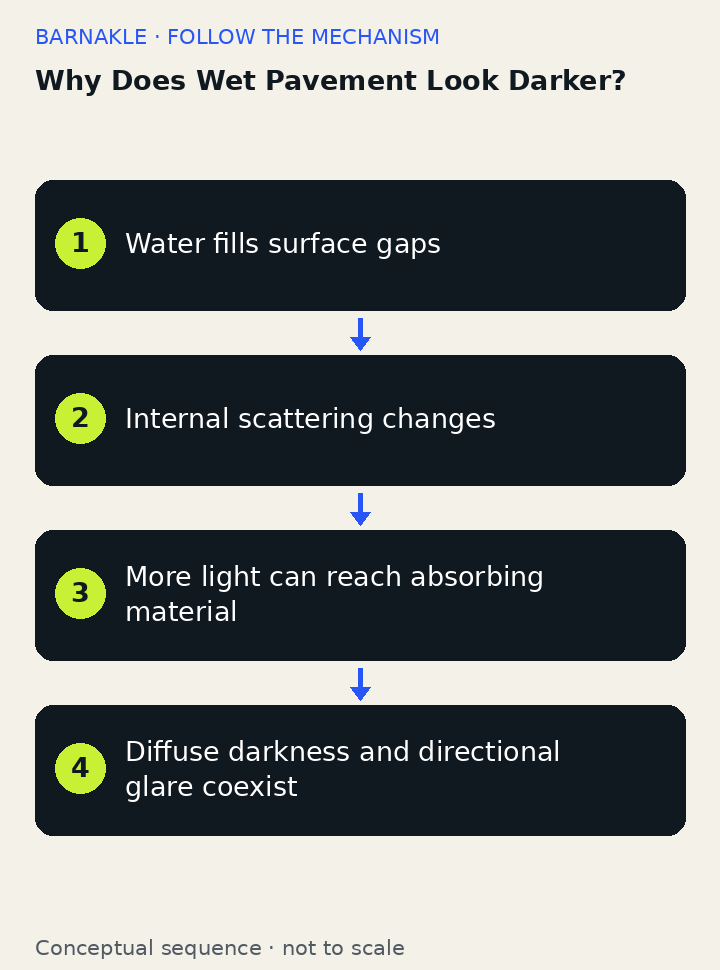
Rain can make a road look darker and more dazzling at the same time. Away from a reflected lamp, the pavement loses some of its dry brightness; at the right angle, a headlight stretches across it in a bright glare. These are compatible observations. Water changes the routes light takes through a rough surface and the directions in which it can return.
A dry surface sends light back along many paths
Asphalt and concrete contain grains, pores, cracks and binder with many tiny boundaries between air and solid. Incoming light encounters changing orientation and refractive index, producing widespread diffuse scattering.
A matte dry surface can appear bright from a broad range of positions because multiple scattering redirects part of the illumination toward each viewing direction. Its apparent brightness is not simply the amount of light hitting it.
Roughness matters at more than one scale. Large surface slopes redirect a reflected view of the sky, while pores and grains change the small-scale scattering inside the material. Calling the road simply 'smoother when wet' captures only part of the story. A damp porous surface can darken without becoming a perfect flat mirror.
Sources: [1]
Water changes the internal boundaries
The refractive index of water lies closer to many mineral and organic materials than the refractive index of air does. Filling voids therefore weakens reflection at numerous internal interfaces.
At an air-solid interface, the refractive-index difference influences how light is reflected and transmitted. Replacing air with water changes that contrast. More light can enter parts of the surface instead of being scattered back immediately. The visible effect therefore depends on the material underneath the water as well as on the water film itself.
Sources: [2]
Absorption and trapping reduce diffuse brightness
With less immediate back-scattering, photons penetrate farther through aggregate and binder. Each additional path creates another opportunity for pigments, carbon-rich asphalt and minerals to absorb energy.
Light scattered upward inside the wet layer may strike the water-air boundary beyond the critical angle and undergo total internal reflection. It is sent back toward the pavement, lengthening its path and increasing absorption probability.
Water need not absorb most of the visible light to make a material darker. By changing scattering and escape probabilities, it can give light more opportunity to encounter absorbing material. A clear liquid can alter an object's apparent colour even when that liquid contributes little colour of its own.
Sources: [2]
A wet surface can still produce bright glare
A relatively smooth film reflects part of the sky, lamps or headlights in a preferred mirror direction. Away from that direction the surface looks dark; near it, a bright stretched reflection can dominate and impair visibility.
A damp porous surface, a continuous film and a deep puddle combine scattering, refraction and reflection differently. Thickness, roughness, viewing angle and ripple geometry change the observed brightness.
Light-coloured concrete has strong dry multiple scattering and can darken dramatically. Already dark asphalt also darkens, while its smoother wet surface can produce conspicuous headlight glare and polarized reflections.
Raised areas and exposed grains lose water first, restoring air-solid boundaries and diffuse reflection. Dark patches can therefore map retained moisture even when no standing water is visible.
Brightness is directional. A surface that returns less light broadly can return a concentrated reflection toward an observer positioned near the mirror direction. That is why a wet road can hide diffuse detail while a particular lamp reflection looks strikingly bright. The same patch can look different when viewed from another position.
Sources: [2]
Why one wet patch can look dark or reflective
Compare a wet patch from directly above with the same patch viewed along a low angle toward a bright window. It may appear dark in the first position and reflective in the second. This is a useful observation of viewing geometry, not a contradiction to be resolved by deciding that water must either brighten or darken everything.
Diffuse reflection, specular reflection and absorption
| Term or component | What it means here |
|---|---|
| Diffuse reflection | Sends light into a broad range of directions. |
| Specular reflection | Concentrates a view of a light source in selected directions. |
| Absorption | Removes light from paths that might otherwise reach the eye. |
Wet surfaces are not dark from every angle
Water does not simply absorb all the light, and wet pavement is not darker from every possible angle. A clear film can reduce diffuse brightness while increasing mirror-like brightness toward a reflected light source. The visual result depends on material, film thickness, illumination and the observer’s direction.
How wet-surface reflectance is measured
Optical researchers measure directional reflectance and albedo of dry, wet and submerged samples, control liquid refractive index and use models that track scattering, absorption, refraction and total internal reflection. Road-safety studies additionally measure glare and contrast under headlights.
Wet-pavement questions
Why do road markings sometimes remain bright?
Their pigments, glass beads, texture and water drainage differ from the surrounding pavement, though heavy water can still reduce performance.
Does every material darken when wet?
No. Transparent backing, colour, texture and viewing geometry can make some materials brighter, glossier or more translucent.
Why are drying edges easy to see?
Dry areas recover diffuse scattering before water-rich regions, producing a sharp brightness difference.
Water changes the paths and directions of light
Wet pavement is an everyday lesson in directional optics. Water changes scattering at internal boundaries, the chance that light escapes and the direction of reflection at the top surface. The result is more informative than 'water makes things dark': it connects the appearance of a road to its texture, composition, lighting and viewing angle.
Continue exploring
Sources and further reading
Keep exploring.
One remarkable idea at a time—nature, science, history and beyond.
Last updated November 6, 2026.

Barnakle Editorial Team
Barnakle Editorial Team is the collective byline used for Barnakle’s editorial articles. The contributor profile explains the team identity and links to the publication’s editorial policies.
More from the editorial team →