Temperature-dependent physical changes become calibrated readings
A thermometer does not count degrees floating through the air. It watches something else change: a column lengthens, a wire's resistance shifts, or a detector receives more infrared energy. The difficult part is turning that change into a trustworthy statement about temperature. That is why a perfectly functioning thermometer can still give a misleading answer when it is pointed at the wrong surface or left in the sun.
The property behind the number
Temperature differences determine the direction of spontaneous heat transfer, though the thermodynamic definition is broader than simple particle speed.
A probe gains or loses energy until its sensing element approaches the temperature of the measured location.
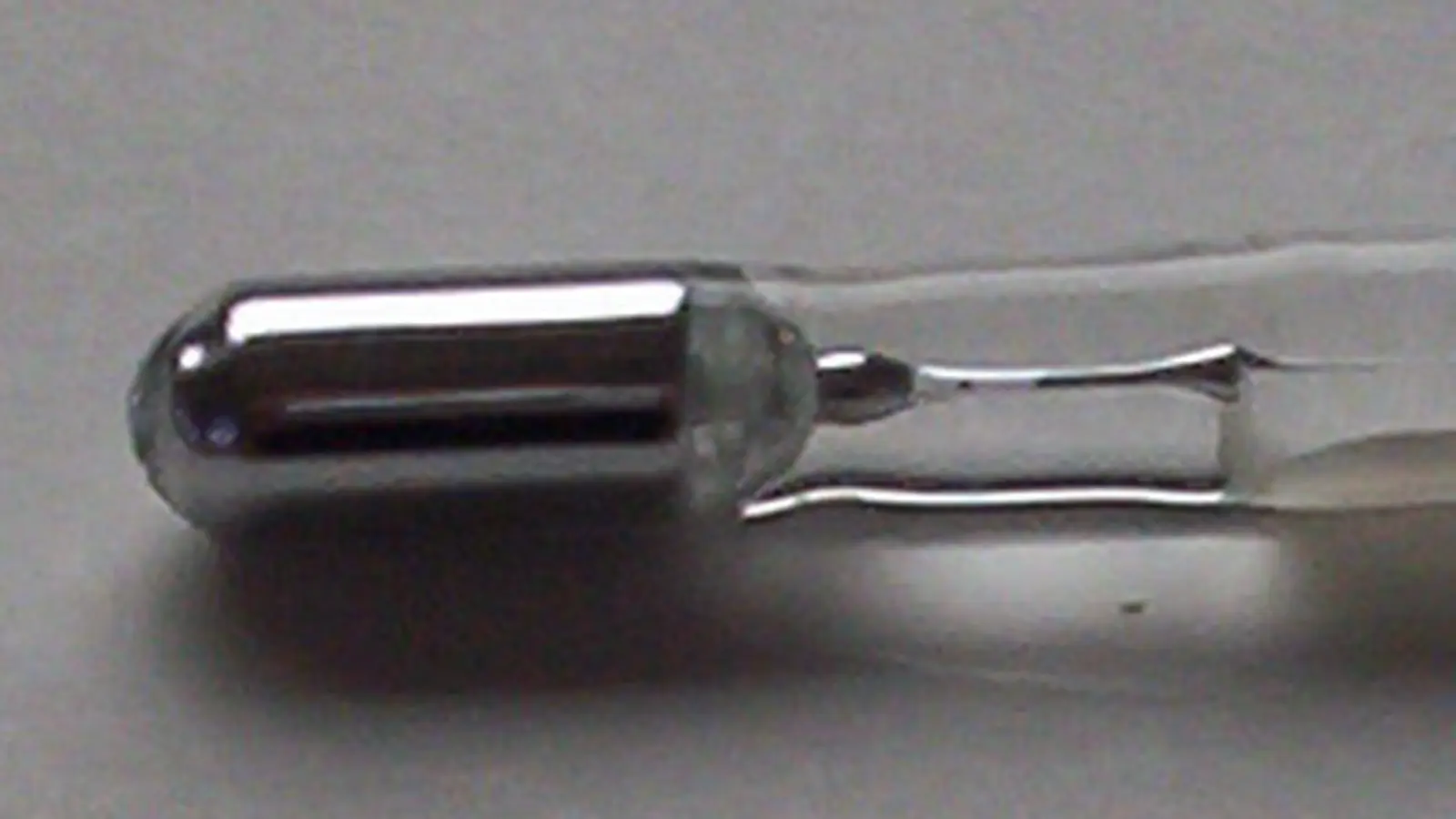
In a liquid-in-glass thermometer, warming expands the liquid. A narrow capillary turns that small change in volume into a visible rise along the scale. A bimetallic thermometer uses a different response: two bonded metals expand by different amounts, bending a strip or coil that moves a pointer.
Temperature and heat are related but different. Heat is energy transferred because of a temperature difference; temperature describes the thermal state that helps determine the direction of that transfer. A probe needs a repeatable relationship between its own temperature and a measurable property. It also needs enough contact with its surroundings for its reading to represent the intended target.
How electrical sensors become thermometers
Platinum detectors and semiconductor thermistors translate predictable resistance changes into electronic readings.
Dissimilar conductors extending through a temperature gradient develop different thermoelectric voltages. A thermocouple instrument measures their net effect and accounts for a reference-junction temperature to infer the measurement-junction temperature. The voltage does not come from a tiny battery located only at the hot junction.
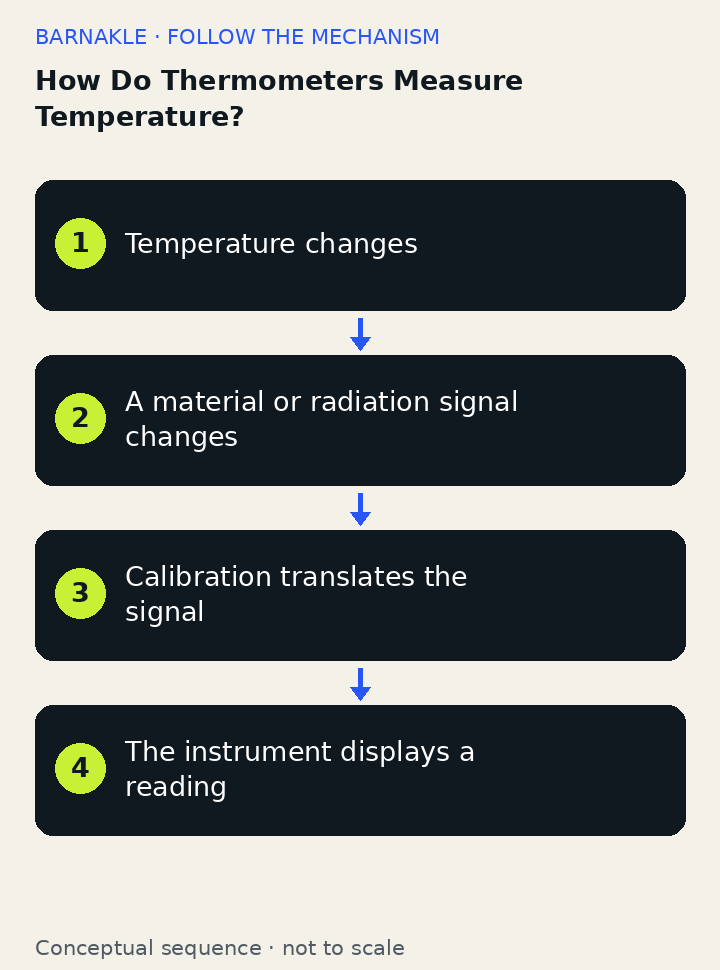
An electronic display hides a chain of measurements. The instrument supplies or measures an electrical signal, converts that signal using a calibration relationship, then rounds the result for display. More digits reveal the resolution of that display. They do not, by themselves, establish the accuracy of the entire measurement.
Reading temperature without touching
Infrared thermometers collect thermal radiation and estimate surface temperature using the detected signal, the instrument’s optics and the surface’s emissivity.
An infrared thermometer looks at a patch of surface. The farther away it is, the larger that patch may become, depending on the optics. Reflections and surface emissivity also matter. A reading from shiny metal therefore needs a different interpretation from a reading from a dull painted surface, even when both objects have the same true temperature.
Sources: [4]
Why the measuring setup matters
Comparisons with traceable standards identify offset, sensitivity and uncertainty.
A reading can accurately describe the wrong location when a probe is shallow, poorly coupled or affected by nearby heat sources.
Calibration checks the instrument against references; good technique connects that instrument to the thing being measured. Both are necessary. A calibrated air sensor beside a hot wall can faithfully measure air warmed by the wall while failing to represent the wider outdoor conditions. The error is in the question the setup actually asks.
Why direct sunlight changes a thermometer reading
Think about an outdoor thermometer in direct sunlight. Its casing absorbs radiation and can warm above the surrounding air. The sensor may accurately report its own elevated temperature. Weather stations use shielding and appropriate ventilation to reduce this effect. Moving the same instrument into shade is not a recalibration; it changes the heat exchanges that determine what the sensor is measuring.
Contact, infrared and calibration compared
| Term or component | What it means here |
|---|---|
| Contact sensor | Its reading depends on heat exchange and placement. |
| Infrared sensor | Its inference depends on the viewed surface and radiation. |
| Calibration | Connects signals to references; it cannot fix poor placement. |
More digits do not guarantee more accuracy
Digital displays are not automatically more accurate, and extra decimal places do not guarantee meaningful precision. Infrared thermometers measure a viewed surface, not the intervening air.
How temperature measurements are checked
Metrologists use reference thermometers, fixed points, comparison baths and uncertainty budgets that include gradients, stability, immersion and electrical measurement.
Thermometer questions
Why does a contact thermometer need time to settle?
The sensing element must exchange heat with the measured location. Its reading changes as it approaches that temperature, so taking a number too soon can capture the sensor’s response rather than a settled measurement.
Does the laser on an infrared thermometer measure temperature?
The laser usually acts as an aiming aid. The temperature estimate comes from infrared radiation collected by a separate detector, and the instrument measures a patch of surface rather than the visible laser dot alone.
What makes a temperature measurement traceable?
Traceability is a documented chain connecting a measurement to recognized references. It supports comparison between instruments, but it does not remove errors caused by poor placement or an unsuitable measuring method.
A reading depends on the sensor and its setup
A useful temperature reading is a small argument supported by a sensor, a calibration and a sensible setup. Once those pieces are visible, disagreements between devices become easier to investigate: ask what each instrument measures, where it measures it and whether it has had time to respond.
Continue exploring
Sources and further reading
Keep exploring.
One remarkable idea at a time—nature, science, history and beyond.
Last updated November 6, 2026.

Barnakle Editorial Team
Barnakle Editorial Team is the collective byline used for Barnakle’s editorial articles. The contributor profile explains the team identity and links to the publication’s editorial policies.
More from the editorial team →