Two Arctic cod, each 160 millimetres long, appear on the same page of a fisheries laboratory guide. Lay a ruler alongside them and it would give you the same answer twice. Look at their ear stones and even the size of the first year’s growth mark differs. The guide puts the photographs side by side because knowing how big a fish is today tells you surprisingly little about the route it took to get there.[5]
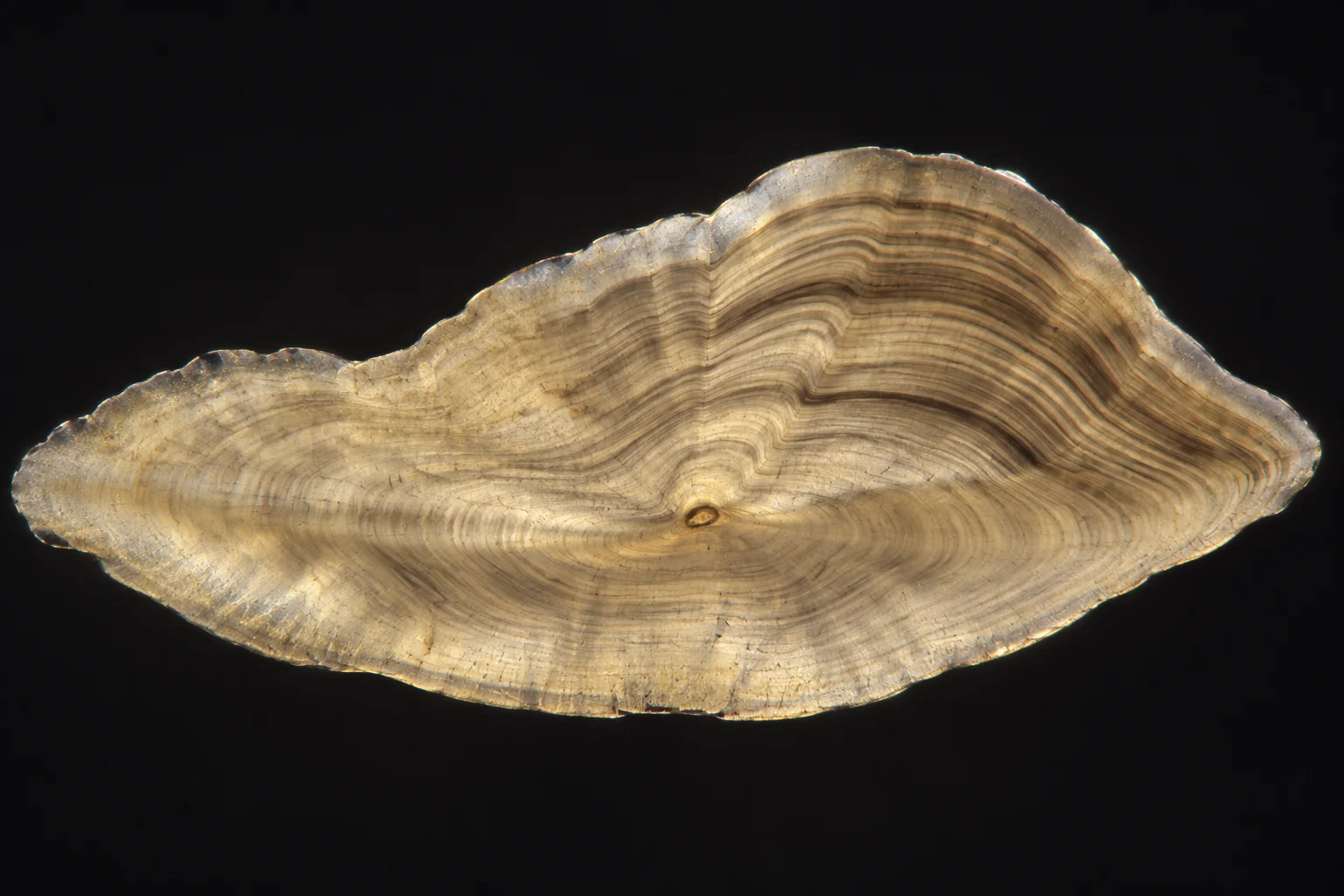
An otolith is a small mineral structure in a fish’s inner ear. New material accumulates on its outside as the fish grows, leaving earlier material inside. In many species, changes over the year produce a repeating pair of bands that scientists can count to estimate age. The hard part comes long before anyone writes down a number. How do you know which lines represent years, and how do you tell when two lines belong to the same year?[1, 2, 3]
A stone that helps a fish hear
A bony fish typically has three pairs of otoliths. They are made largely of calcium carbonate and sit in the soft structures of the inner ear. Their ordinary work involves hearing and balance. Their shapes differ, and the largest pair, the sagittae in many familiar species, often provides the specimens used by age readers. The fish doesn’t need an internal calendar. The calendar is a consequence of how the structures grow while doing their other jobs.[1, 2]
Think of adding fresh material to the outside of a rounded object. Yesterday’s surface is now a little way inside today’s. Add more during one part of the year and less during another, and the layers can differ in thickness and appearance. A cut through the centre can reveal earlier surfaces arranged around the oldest material. The result seldom resembles a target drawn with a compass. A real otolith grows differently along different edges, and some paths through it show the sequence much better than others.[1, 2, 5]
Which bands count as a year?
Age readers often distinguish opaque material from more translucent material. Under reflected light one zone may stand out as pale, while changing the lighting changes the contrast. Where the annual pattern has been established, a complete cycle includes both kinds of material. Counting every change from dark to light and then every change from light to dark as another birthday would give an impressive answer about twice as large as it should be.[1, 2]
The outermost edge needs particular care. Imagine two fish from the same hatch that are examined several months apart. The older sample might have laid down much of the next zone. That incomplete band records real growth, but it needn’t represent a whole additional year. The capture date and the species’ usual timing of band formation give the reader context that a photograph alone cannot supply. That is one reason archived specimens are most valuable when their collection information stays with them.[1, 2, 5]
Sometimes the outside is enough
The Arctic cod guide from NOAA’s Alaska Fisheries Science Center gives a good example of matching the method to the fish. Many Arctic cod ear stones show a readable pattern on their outer surface. The laboratory examines them under magnification in water using reflected light. If the surface pattern is vague, an internal face can reveal details that were difficult to separate from above. One illustrated specimen from the Bering Sea received an age estimate of four years after comparison of surface and internal patterns.[5]
With an older or thicker otolith, the apparent spacing of the bands may become extremely tight near an edge. Picture several nested bowls seen from directly overhead. If the rims crowd together on one side, a cross section through the middle may distinguish boundaries that the top view merges. The choice of preparation can therefore change how much of a sequence a reader sees. An estimate that assigns too few years to older fish would also make those fish appear to have grown unusually quickly.[1, 2, 4]
How do you check a fish's age independently?
The most persuasive test begins with a fish whose age is already known. Researchers can mark young fish of known age, release them and compare the band counts with the actual time elapsed if they are caught again. A related approach marks a fish at a known time in its life. The layers added outside that dated mark can test how often new bands form even if the fish’s original hatch date is unknown. That second test answers a narrower question, but a particularly useful one.[3]
Consider a hypothetical recapture three years after marking. Three completed cycles outside the mark support an annual interpretation for that interval. They cannot establish that the fish was six years old when first marked, or that bands will remain equally readable when it reaches old age. Validation has a scope. Evidence for fast-growing young fish may leave an open question about the last, crowded increments in the oldest specimens. Waiting for known-age individuals of a long-lived species to return can take a considerable part of a researcher’s career.[3]
When two readers give the same answer
Fisheries laboratories also keep reference collections and compare readings. If a reader who formerly counted eleven bands on a specimen begins counting nine, the fish is the one participant that plainly hasn’t changed. Comparing readings across ages can show whether disagreement clusters in the oldest fish. Two readers agreeing closely demonstrates consistency. Their shared estimate can still be wrong if both learned to interpret a particular mark in the same mistaken way. Independent validation and repeated reading solve different parts of the problem.[3, 4]
Put ages alongside lengths from many fish and a population acquires a history. An unusually numerous group of young fish may be traceable through later samples. A catch dominated by smaller fish could reflect a recent successful year of reproduction, slow growth, or the way the catch was sampled. Ages help distinguish those possibilities. The two Arctic cod that fitted the same ruler are a good place to begin. A ruler records the endpoint. An ear stone keeps some of the journey.[1, 5]
Related reading
Sources
- NOAA Fisheries — Age and growth
- Fisheries and Oceans Canada — Otoliths and how to read their growth zones
- Fisheries and Oceans Canada — Validating otolith age estimates
- Fisheries and Oceans Canada — Age-reading quality control
- Alaska Fisheries Science Center — Guide to age determination of Arctic cod
Keep exploring.
One remarkable idea at a time—nature, science, history and beyond.
Last updated November 21, 2026.

Barnakle Editorial Team
Barnakle Editorial Team is the collective byline used for Barnakle’s editorial articles. The contributor profile explains the team identity and links to the publication’s editorial policies.
More from the editorial team →