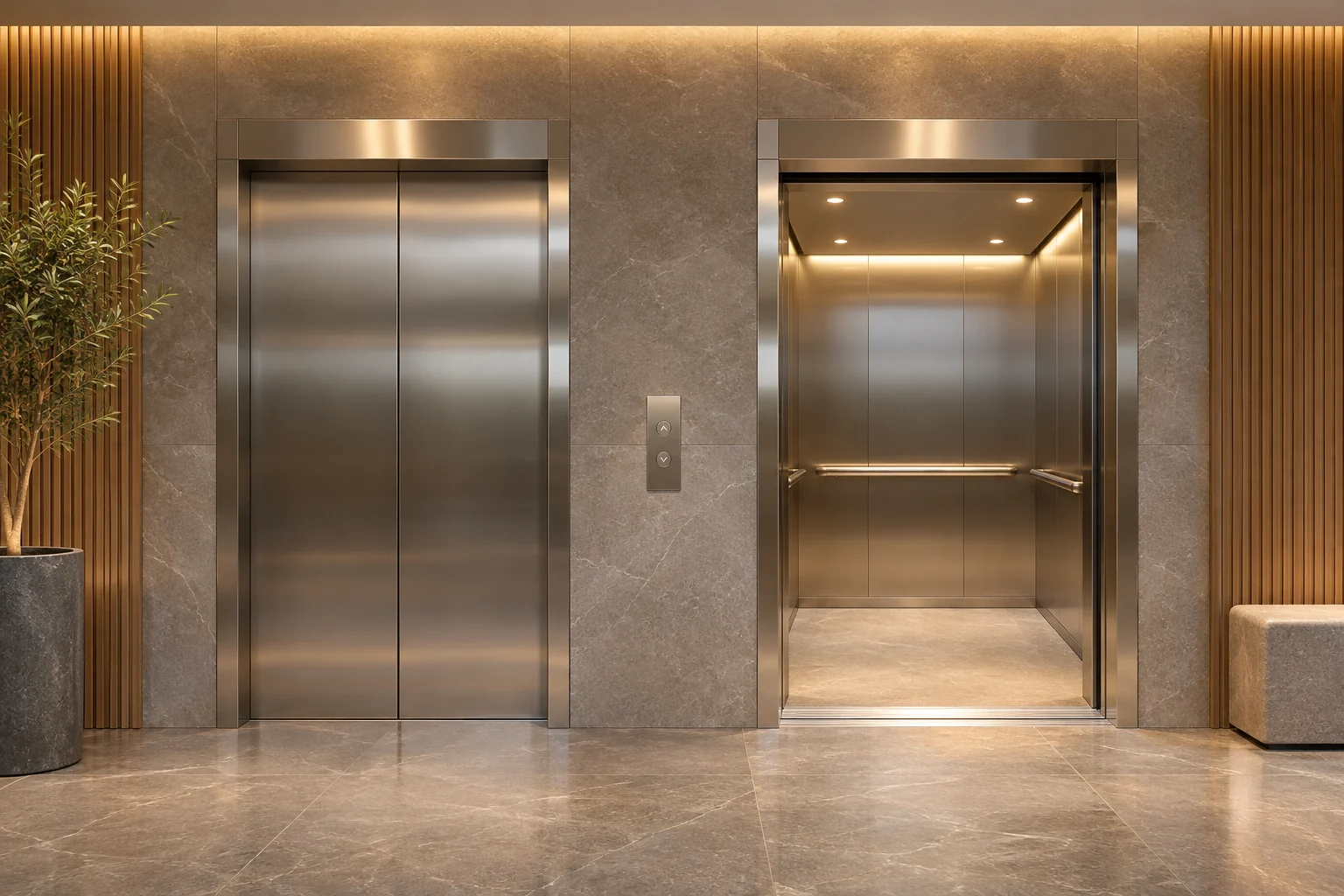
A quiet ride between floors depends on a carefully balanced machine and a continuous conversation between sensors and controls.
Quick answer
Most passenger elevators use either traction or hydraulics. A traction elevator moves a car and counterweight using ropes or belts passing over a motor-driven sheave. A hydraulic elevator uses pressurized fluid to move a piston. Controls coordinate speed, position and doors, while brakes and other protective systems perform separate safety functions.
Press a button, wait for a chime and step inside. From the passenger’s perspective, an elevator seems to be a room that happens to move. Its real achievement is making a changing load start, travel and stop predictably, while keeping the landing and cabin doors coordinated.
Understanding it becomes easier if we separate three questions: what supports the car, what makes it move and what tells it when to stop. Those jobs overlap, but they are not interchangeable. The motor is not the entire elevator.
The two main ways to move an elevator
In a traction system, a rotating grooved wheel, called a sheave, transfers motion to suspension ropes or belts through friction. The car travels on one side and a counterweight on the other. Guide rails constrain their paths through the hoistway. The suspension system carries the load; the rails guide movement. [1]
Hydraulic systems instead develop force using fluid pressure and a piston. A pump moves oil into the cylinder to raise the car; controlled return flow permits descent. They are commonly associated with shorter travel distances. Some arrangements include additional ropes, so “hydraulic” describes the driving principle rather than every visible component. [6]
The difference is rather like moving an object with a balanced hoist versus lifting it on a powered platform. Both achieve vertical travel, but their mechanical layouts and energy flows differ. Looking only at the passenger cabin usually does not reveal which arrangement is behind the walls.
Why traction elevators need a counterweight
The counterweight offsets much of the car’s weight and a selected portion of its rated load. It reduces the imbalance the drive must overcome; it does not match every possible passenger load perfectly. An empty cabin and a full cabin therefore present different operating conditions. [6]
Consider a deliberately simplified example. Suppose one side of an ideal system has a mass of 1,000 kilograms and the other 800 kilograms. The gravitational imbalance corresponds to 200 kilograms, even though both sides have to accelerate. In a real elevator, friction, rotating parts, suspension geometry and other losses add demands.
This distinction prevents a common mistake: a counterweight does not make the entire moving system weightless. It reduces the difference between the downward gravitational pulls. The motor still controls motion, and the structure still supports substantial loads.
What happens after you press the button?
The controller takes requests and information from the elevator’s subsystems, then coordinates the trip. Rather than simply switching a motor fully on, the drive regulates motion so the car can accelerate and decelerate in a controlled way. The precise sensing and dispatch arrangements vary by equipment. [3] [6]
- A request enters the system. The elevator receives a call or a destination selection.
- Door conditions are checked. Movement depends on the required door and safety conditions being satisfied.
- The drive controls departure. Motion is built up rather than imposed as an instantaneous change in speed.
- The approach is managed. The car decelerates toward the landing.
- The stopped car and landing interface align. The doors provide access at the destination.
This sequence is a conceptual overview, not a maintenance procedure. Real controls monitor more conditions than a passenger can see. The important idea is that vertical force, position and access must agree throughout a trip.
Why you feel heavier or lighter
Your apparent weight depends on the force the floor applies to your feet. During upward acceleration, that support force exceeds your usual stationary weight. During downward acceleration, it is smaller. Once the elevator moves at constant speed, the support force returns approximately to its stationary value.
Direction of travel and direction of acceleration are different. A descending elevator slowing for a landing accelerates upward, so the floor can briefly feel firmer beneath you. An ascending elevator slowing near its destination accelerates downward, producing the opposite sensation. The everyday phrase “going down makes you lighter” misses half of the journey.
Why there are two sets of doors
The cabin has moving doors, and the building has landing doors at the floors. The car’s door equipment interfaces with the landing entrance when the cabin is appropriately positioned. Door locks and monitoring help prevent normal travel with unsafe door conditions. A presence sensor at the entrance and a door-lock circuit have different jobs. [1] [4]
A useful comparison is a train arriving beside a station barrier: access should open when the passenger space and the exit are aligned. For an elevator, that alignment must be repeated vertically at every served floor. Doors are part of the transport system rather than a decorative finishing detail.
What stops the car if something goes wrong?
Traction elevators use several protective mechanisms. The machine brake can hold or stop motion; a speed governor monitors excessive speed; car safeties can grip guide rails when activated. Buffers at the bottom of the hoistway provide another distinct protective function. These components are not substitutes for one another. [3]
Otis describes spring-applied machine brakes that are released electrically: loss of power applies the brake. That helps explain why a power interruption does not simply turn a suspended car into an uncontrolled falling object. The full response depends on the installation and any rescue equipment fitted. [3]
Can an elevator generate electricity?
A regenerative drive can return energy to the building’s electrical system when mechanical motion drives the motor as a generator. Whether a particular journey consumes or recovers energy depends on load, travel direction and system design. Regeneration captures energy that would otherwise be dissipated; it does not create energy from nothing. [5]
Think of moving two unequal weights over a pulley. In one direction the drive must work against the imbalance; in the other it must control motion encouraged by gravity. The ability to recover some of that energy is useful, but a building’s total elevator demand also includes lights, controls and idle operation.
Frequently asked questions
Do all elevators use cables?
No. Hydraulic elevators use fluid pressure as their driving principle, while traction machines use suspension ropes or belts. Designs within those families vary. [2]
Does a gearless elevator have no sheave?
It still has a traction sheave. “Gearless” means the machine does not use a reduction gearbox between the motor and sheave; it does not mean the suspension system has disappeared. [2] [3]
What does machine-room-less mean?
It describes the equipment arrangement: machinery fits within the hoistway or associated compact spaces instead of requiring a traditional separate machine room. It does not mean the elevator operates without machinery. [2]
Why can the same elevator feel different with more passengers?
Passengers change the load and its balance against the counterweight. Controls must manage the resulting forces while maintaining the intended ride, just as a vehicle’s power system responds to changing demands.
Keep exploring
Sources and further reading
- Otis — The basic workings of a lift
- Schindler — Different types of elevators
- Otis — The elevator safety chain (PDF)
- Otis — Elevator door lock monitoring
- KONE — How elevators contribute to energy efficiency in buildings
- Nidec Drives — How drives work in an elevator
Reference review: November 9, 2026.
Keep exploring.
One remarkable idea at a time—nature, science, history and beyond.
Last updated November 9, 2026.

Barnakle Editorial Team
Barnakle Editorial Team is the collective byline used for Barnakle’s editorial articles. The contributor profile explains the team identity and links to the publication’s editorial policies.
More from the editorial team →