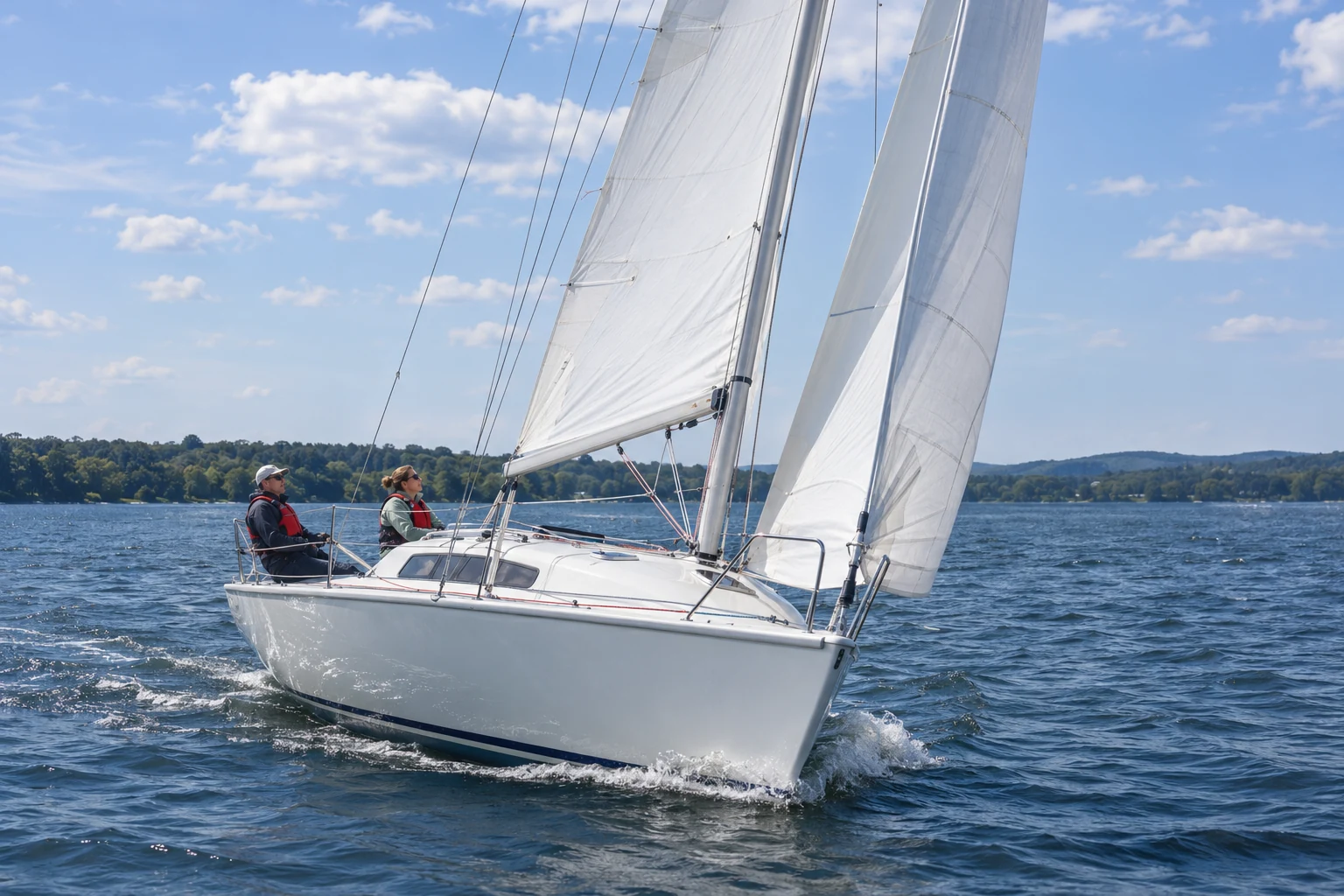
A sail and a keel work across two fluids to make progress toward the wind.
Quick answer
A conventional sailboat cannot sail straight into the wind. It can sail at an angle toward it because airflow around the sails produces a force with a forward component, while the keel or centreboard helps resist sideways drift. Alternating between two upwind courses—a manoeuvre called tacking—allows the boat to reach a destination in the direction the wind comes from.
Watch a yacht cross a lake and it can look as though the wind is pulling it toward the place the wind began. That seems contradictory if a sail is imagined only as a bag being pushed from behind. The missing pieces are the angle of the sail and the water flowing past the underwater hull and foils.
The boat uses a difference in motion between air and water. It changes the direction of those flows and experiences forces in response. Following those forces is more revealing than asking whether the wind is simply “behind” or “in front” of the boat.
First, upwind does not mean straight into the wind
Sailors distinguish sailing toward the wind at an angle from pointing directly into it. Around the latter direction is a no-go zone in which a conventional sailing boat cannot maintain normal forward sailing. Beginner explanations commonly use angles of roughly 40–45 degrees to illustrate close-hauled sailing, but the usable angle varies with the boat and conditions. [1] [2]
Imagine the wind blowing from north to south. A boat may be able to head northeast or northwest while sailing effectively. Both headings include northward progress. Neither requires the boat to sail due north.
The geographical destination and the instantaneous heading are therefore different things. A route can lead north overall even though no single leg follows a straight northward line.
A sail behaves as an aerodynamic surface
When sailing across or toward the wind at an angle, a properly trimmed sail interacts with airflow like an aerodynamic foil. The air changes direction and its pressure distribution around the sail produces a force. Aerodynamic lift is defined relative to the approaching airflow, so it does not have to point upward. [1]
This use of “lift” can be confusing. On an airplane, the familiar useful component supports weight. On a sailboat, much of the sail’s aerodynamic force acts sideways. A forward component can nevertheless propel the boat.
Pressure and momentum are complementary ways to describe the interaction. A pressure distribution over the sail and the change in momentum of the surrounding flow belong to the same physical process. They should not be presented as two competing engines that separately pull the boat.
For the related airborne example, read how airplanes stay in the air. The useful comparison is the interaction with a flowing fluid, not a claim that a sail and a wing operate in identical circumstances.
Why the boat does not just slide sideways
The underwater surfaces complete the system. A keel, centreboard or other lateral area interacts with the water as the boat moves. Its hydrodynamic force can oppose much of the sail’s sideways force, allowing useful forward motion. Some sideways motion, called leeway, generally remains. [1] [4]
The water is not a rigid railway track. The boat can slip sideways, and the underwater flow matters. Saying that the keel “stops all sideways motion” would replace a fluid-dynamics explanation with an imaginary fixed constraint.
One way to picture the force balance is to separate every force into along-course and across-course components. The large sideways effects can largely oppose one another while a smaller forward drive remains. At a steady speed, the forward drive is balanced by resistance; when the forces are unbalanced, the boat’s motion changes.
A numerical illustration makes the idea less mysterious. Suppose a hypothetical force has a strong sideways component and a weaker forward one. If an opposing water force largely cancels the sideways component, the forward part has not been cancelled merely because the largest arrows oppose each other. These invented quantities describe vector bookkeeping, not measurements of a particular yacht.
Why a sailboat heels over
The sideways force on the sail acts above the water, while the opposing hydrodynamic force acts lower down. Their separation creates a turning effect, or torque. Weight, buoyancy, hull shape, ballast and crew position contribute to the boat’s response and restoring tendency. [1]
This is why force balance alone does not explain the boat’s attitude. Two equal and opposite forces can still tend to rotate an object if they act along different lines. Holding a tray with two hands illustrates the distinction: where forces act matters as well as how large they are.
Boat designs solve this problem differently. A ballasted keelboat and a small dinghy with crew moving their weight are not the same stability system. The shared aerodynamic explanation should not erase those differences.
What tacking changes
To tack, a boat turns its bow through the direction of the wind and emerges on the other close-hauled course. The sail moves to the other side. By joining such legs, the boat can beat to windward along a zigzag route. [2] [3]
In the north-wind example, a northeast leg gains northing while moving east. A northwest leg can recover the east-west displacement while gaining more northing. In ideal symmetrical conditions, the crosswind parts cancel over a pair of legs while the upwind parts add.
Real routes are less tidy. Wind shifts, shorelines, waves and current influence where a tack is useful. A diagram showing a symmetrical zigzag teaches the geometry; it does not specify the best route through a particular harbour.
Why pointing higher is not always faster
The useful goal is progress toward the destination, not the smallest possible angle between bow and wind. Sailors use velocity made good, or VMG, to describe the relevant component of velocity. Instrument systems combine this idea with boat-performance information and layline calculations. [5]
Consider two invented sailing states in still water. At six knots and 45 degrees from the upwind direction, the upwind component is approximately 6 × cos 45°, or 4.24 knots. At four knots and 35 degrees, it is approximately 4 × cos 35°, or 3.28 knots. In this example, the boat pointing less directly toward the destination makes faster upwind progress.
The calculation assumes the stated angles describe the actual direction of travel, not merely the bow’s heading. It also leaves out current and manoeuvring losses. Its purpose is to show why course and speed must be considered together.
A car travelling quickly around a long bend and one travelling slowly along a shortcut create a similar planning question: the speedometer alone does not tell you which will reach the destination first.
True wind and apparent wind are different
Apparent wind is the airflow experienced by the moving boat. It combines the environmental wind with the effect of the boat’s own motion. The relationship is a vector difference, so direction matters as much as speed. [1]
As a simple illustration, walk forward on a windless day and you feel air approaching from ahead because you are moving through it. Add a crosswind and the air you feel approaches from a new direction. A moving sailboat experiences the same kind of relative-motion effect.
This explains why a photograph of filled sails does not by itself establish the direction of the true wind. A sail responds to local apparent flow. To label an exact point of sail confidently, an observer needs information beyond the visual shape of the cloth.
Can a boat move faster than the wind?
Yes, some sailing boats can exceed the true wind speed on suitable courses. Sailing is not limited to being pushed directly downwind at the speed of the air. Apparent wind, aerodynamic forces, hydrodynamic forces and resistance must be considered together. [1]
There is no free energy in that statement. The sailboat extracts energy from the relative motion of its environment. Its speed compared with one environmental speed does not, by itself, establish an energy violation.
It also does not mean every ordinary yacht exceeds wind speed, or that a conventional boat can sustain direct head-to-wind sailing. A statement about some boats on some courses should retain those qualifications.
Frequently asked questions
Can a conventional sailboat sail directly into the wind?
Not under ordinary sail alone. It reaches upwind destinations by making progress at an angle and changing tacks.
Does the keel provide the boat’s fuel?
No. It supplies an important interaction with the water. It is part of the force system rather than a separate energy source.
Is 45 degrees a universal limit?
No. It is a useful teaching example. Design, sail trim, sea state and other conditions affect performance.
Are tacking and jibing the same manoeuvre?
No. Tacking takes the bow through the wind direction; jibing changes sides while turning the stern through the downwind direction. This article explains the physics, not a practical handling procedure.
Follow the flow elsewhere
Compare wind-driven sailing with hummingbird hovering, where moving wings continually alter the surrounding air. The geometry differs, but both explanations become clearer when forces are connected to changes in fluid motion.
Sources and further reading
Reference review: November 8, 2026.
Keep exploring.
One remarkable idea at a time—nature, science, history and beyond.
Sources and further reading
Barnakle uses credible primary and authoritative sources wherever possible.
- University of New South Wales, Joe Wolfe — The physics of sailing
- https://www.phys.unsw.edu.au/~jw/sailing.html
- Royal Yachting Association — Do you know your points of sail?
- https://www.rya.org.uk/training/do-you-know-your-points-of-sail/
- MIT Sailing — Sailing and the Tech Dinghy
- https://sailing.mit.edu/lts/sailing-booklet/booklet_unified.shtml
- VDWS instructor education — Physics
- https://www.vdws.de/en/vdws-academy/content/sailing-instructor-course-level-1/general-topics/physics
- Raymarine documentation — Sailing glossary, velocity made good and tacking
- https://docs.raymarine.com/81406/en-US/latest/SailingGlossary-71147499.html
Last updated November 8, 2026.

Barnakle Editorial Team
Barnakle Editorial Team is the collective byline used for Barnakle’s editorial articles. The contributor profile explains the team identity and links to the publication’s editorial policies.
More from the editorial team →