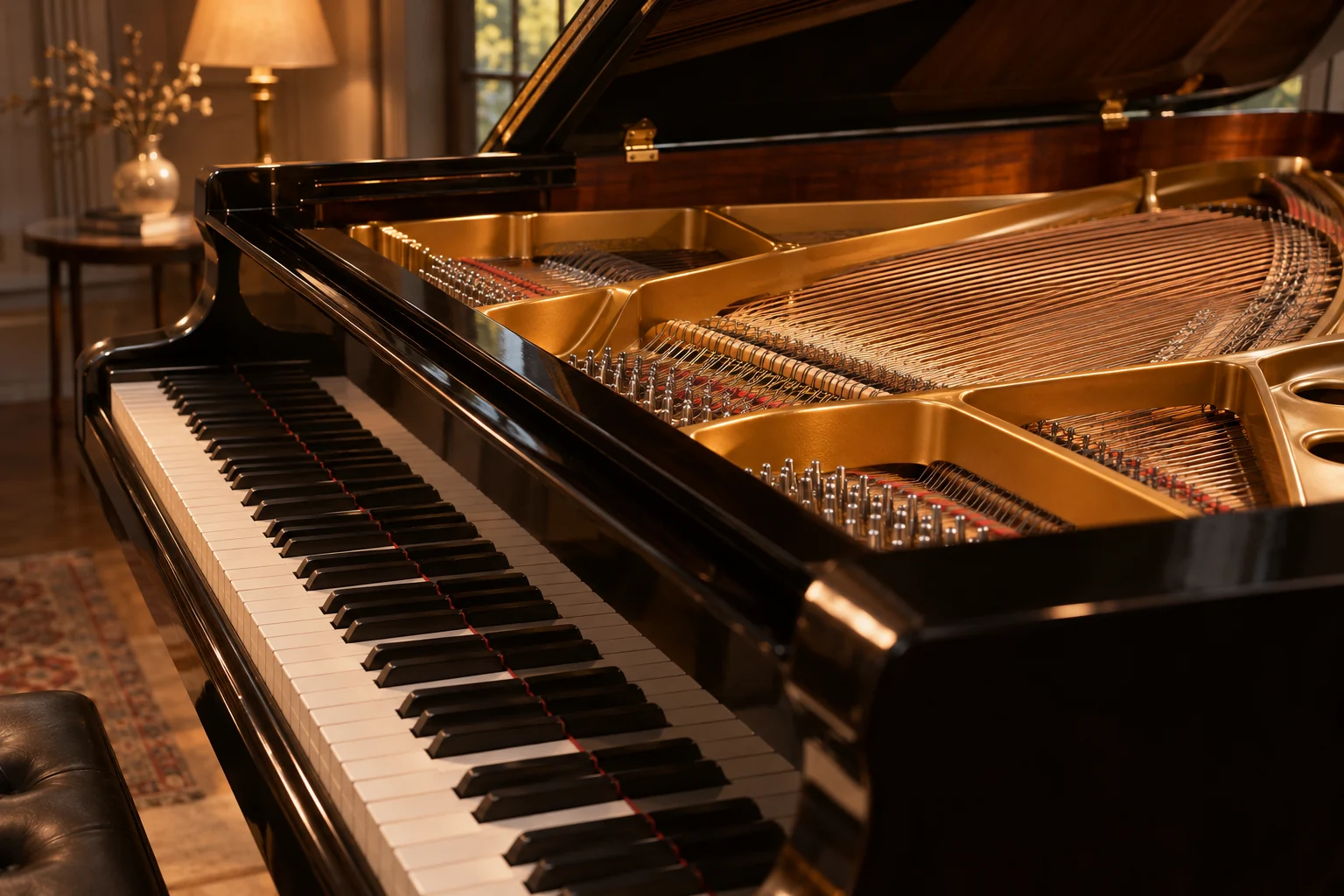
Pressing a key launches a mechanical chain reaction. The string starts the vibration, but the soundboard makes it carry across the room.
Quick answer
In an acoustic piano, a key operates an action that sends a felt-covered hammer into one or more strings. Vibrations pass through bridges into a wooden soundboard, which couples the motion to a much larger area of air. String dimensions and tension influence pitch; the action, dampers, pedals and resonances shape loudness, duration and tone.
A pianist holds a key down, and a note hangs in the room. It can sound as if the finger is continuously feeding the sound. In a normal acoustic piano, however, the hammer has already struck and moved away. What you hear afterward is the instrument spending the energy deposited by that brief event.
The note makes more sense if you follow its path in order: finger, key, action, hammer, string, bridge, soundboard and air. Every stage changes how motion is delivered, sustained or radiated.
A key is a lever, not the sound source
The key sets a mechanism called the action in motion. Its connected parts accelerate a hammer toward the strings. Escapement lets the hammer complete a free strike rather than remaining pressed against the string; otherwise it would interfere with the vibration it had just initiated. [4]
That distinction separates a piano from a simple switch. The action translates a player’s motion into the conditions of the impact. It must also prepare the hammer for another note, sometimes before the key has returned all the way to its resting position.
Yamaha’s action guide describes the repetition mechanism associated with modern grand-piano actions: it permits rapid repetition without requiring complete key release. That is a mechanical reset system, not an electronic delay or a second set of hidden strings. [2]
The hammer strikes, then the string vibrates
The struck string is displaced and begins moving in patterns constrained by its supports. Rather than moving bodily through the instrument, disturbances travel along it and reflect. The resulting vibration contains a fundamental component and higher-frequency components that contribute to the note’s character.
It is useful to separate pitch from timbre. Pitch tells us whether the note is high or low. Timbre helps distinguish that piano note from a flute or guitar playing approximately the same pitch. The distribution and changing strength of vibration components help make that difference audible.
The string also transfers energy into the rest of the piano. If it were perfectly isolated, its vibration might persist differently, but it would not efficiently produce the room-filling sound expected from the complete instrument.
Why low notes need different strings
In a simplified stretched-string model, increasing length lowers the fundamental frequency, increasing tension raises it, and increasing mass per unit length lowers it. A real piano uses combinations of these variables rather than setting every pitch with tension alone.
Yamaha describes shorter, thinner strings toward the high end of the instrument and copper-wound strings in the bass. Winding adds mass per unit length, helping produce low notes within a practical instrument size. The arrangement of strings changes across the keyboard. [3]
Imagine trying to fit the entire bass range using only progressively longer versions of one thin wire. The lowest notes would demand unwieldy lengths. Changing the construction provides another design tool. The finished instrument balances useful pitch, strength, space and tonal behaviour.
Why many notes have several strings
Most middle and upper notes use several strings struck together, while lower notes use fewer. Those closely tuned strings contribute both radiated energy and a richer combined vibration. Their motions interact through the instrument rather than behaving as perfectly independent copies. [3]
“One key” therefore does not always mean “one string.” It means one playable note within the keyboard mechanism. Counting keys and counting strings answer different questions.
Small differences in closely spaced frequencies can produce beats: alternating reinforcement and cancellation as the vibrations move into and out of alignment. This is one reason tuning concerns relationships among components, not just whether a single string produces a familiar note name.
Why the soundboard is essential
A vibrating string by itself moves relatively little air. Bridges transmit string motion into the soundboard, whose much larger surface can set more surrounding air in motion. The soundboard is therefore central to the audible output, although the wider instrument also vibrates. [1]
Calling this “amplification” does not mean the wood creates energy. The player supplies mechanical energy through the action. The instrument distributes it, radiates some as sound and loses some through internal damping and other processes.
A useful comparison is communication through a larger interface. The string initiates the motion, and the board provides an effective connection to the room. The soundboard is not just a box wall keeping the strings from falling out.
Wood also changes which vibrations survive
A soundboard does not pass every frequency equally. Its material, structure and damping influence how different components of the vibration are transmitted and lost. Yamaha’s discussion of wooden soundboards emphasizes this tone-shaping role alongside sound radiation. [6]
It is more useful to think of a selective mechanical system than a perfectly transparent loudspeaker. Two structures can receive similar inputs yet produce different outputs because their resonances and losses differ. This is a broad principle of musical acoustics, not a special exception to energy conservation.
What dampers and the sustain pedal do
Dampers contact strings to reduce their vibration when notes are released. The sustain pedal lifts dampers across the relevant range, allowing notes to continue and additional strings to respond sympathetically. The highest notes may have no dampers because their vibrations decay quickly. [4]
Sympathetic vibration means one vibrating part excites another through their connection or the surrounding sound field. The second string has not been struck by a new hammer. It is responding to energy already moving through the instrument.
The pedal therefore changes more than note duration. It changes which parts of the piano are free to participate. A sequence played with sustain can blend differently from the same keys played with each note sharply damped.
Why a held note still fades
Once the strike is over, energy continues to leave the vibrating system. Sound radiation carries some away into the room, and internal friction turns some into heat. Holding the key prevents the relevant damper from stopping the note, but it does not continually bow the string or strike it again.
This explains the piano’s characteristic attack and decay. The beginning contains a rapid input, followed by a changing mixture of resonances. A sustained violin note has a different energy supply because the bow can keep doing work on the string.
How a digital piano differs
A conventional digital piano detects a performance electronically and generates sound using an electronic tone system and speakers or headphones. Weighted or hammer-style keys can reproduce aspects of the feel without using those hammers to strike acoustic strings. Hybrid instruments combine features in different ways. [5]
The familiar keyboard layout therefore does not identify the sound-producing mechanism. Two instruments can offer similar controls while following different paths from finger movement to audible pressure waves.
Frequently asked questions
Is a piano a string or percussion instrument?
Its vibrating sound sources include strings, and those strings are excited by hammer impacts. Both descriptions capture a useful part of its mechanism; classification depends on the context.
Does pressing harder keep making a held note louder?
After the hammer has escaped and struck, additional pressure does not create another strike. The important input is the action leading to the impact, rather than continuous pressure supplying the decaying note.
Is the soundboard the same as the metal frame?
No. The soundboard is the wooden vibrating component connected to the strings through bridges. The metal frame has a different structural role in the instrument. [1]
Why can one key have several strings?
Several closely tuned strings can sound together and interact, affecting both output and tonal character. The number changes through the keyboard range. [3]
Keep exploring
Sources and further reading
- Yamaha — The sound-producing mechanism
- Yamaha — What is a piano’s action?
- Yamaha — Design of the strings enriches the sound
- Yamaha — How does a piano work?
- Yamaha — Acoustic or digital?
- Yamaha — The piano soundboard also stops vibrations
Reference review: November 9, 2026.
Keep exploring.
One remarkable idea at a time—nature, science, history and beyond.
Last updated November 10, 2026.

Barnakle Editorial Team
Barnakle Editorial Team is the collective byline used for Barnakle’s editorial articles. The contributor profile explains the team identity and links to the publication’s editorial policies.
More from the editorial team →