Tempering changes the stress inside glass, making it harder to break—and changing what happens when a crack finally wins.
Quick answer
Thermally tempered glass has compressed outer surfaces balanced by a stretched interior. Surface compression resists the opening of small cracks. If a sufficiently serious crack reaches the tensile region, stored elastic energy drives rapid crack growth and branching, breaking the pane into many small pieces. Ordinary annealed glass has much less of this deliberately introduced stress.
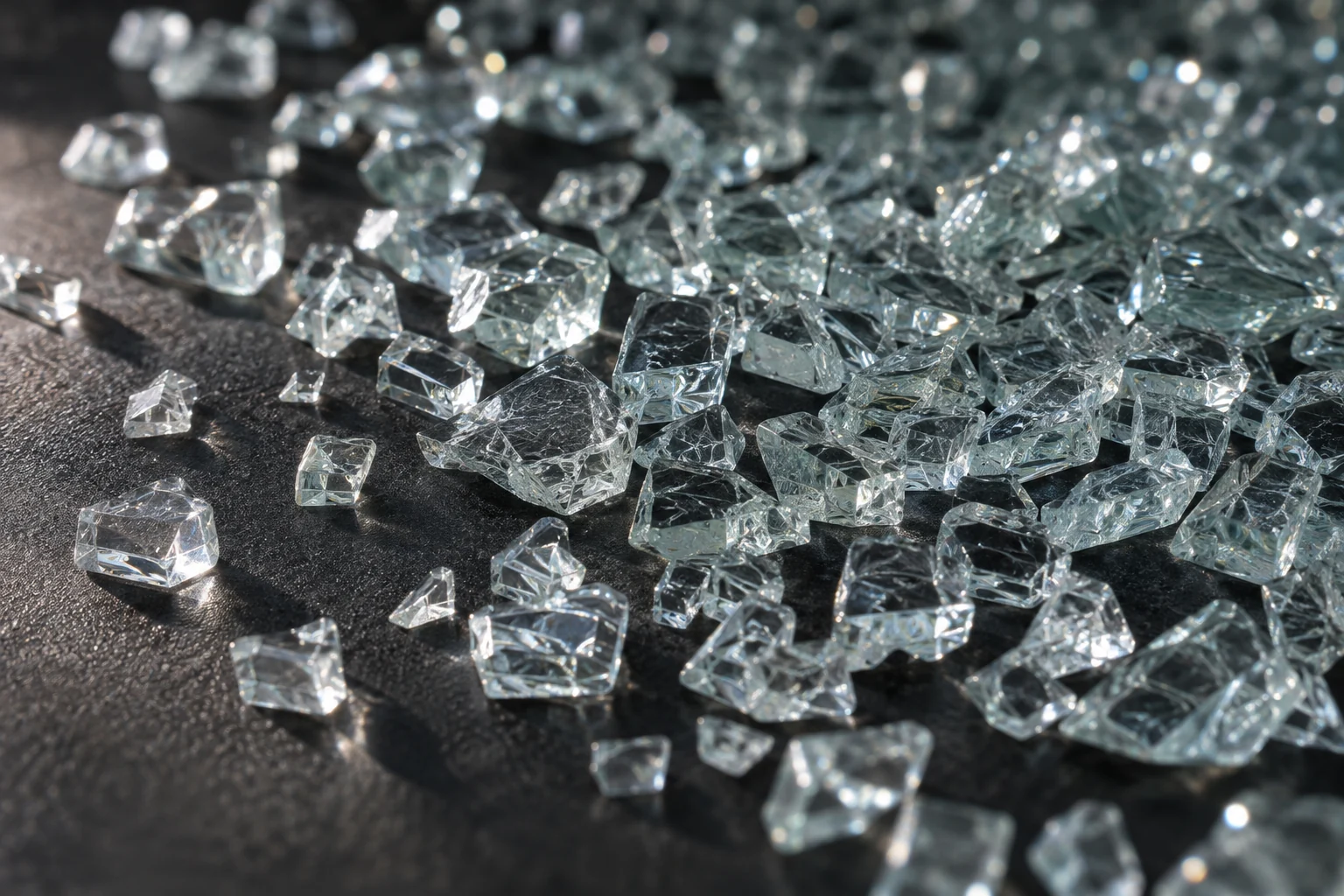
A broken ordinary window can leave long, blade-like shards. A broken tempered pane often becomes a dense scattering of small fragments. It is tempting to assume the second pane was simply made from a different ingredient. Usually, the crucial difference lies in its processing history.
Glass can look flat, motionless and relaxed while holding substantial internal stress. Tempering deliberately creates that condition. To understand its distinctive failure, follow the pane from the furnace to the first growing crack.
How heating and quenching change a pane
The glass is prepared to its final dimensions, heated and then rapidly cooled with air. The outside cools faster than the interior. As the rest of the pane cools and contracts, the interacting layers settle into a self-balanced stress pattern: compression near the surfaces and tension inside. [1]
Compression means material is being squeezed; tension means it is being pulled. A useful comparison is a tightly organized assembly in which one part presses while another pulls. No external hand needs to hold it in that state once the manufacturing process has established the arrangement.
The comparison has limits. A pane is not literally a sandwich of detachable sheets. The stress varies through a continuous solid. The words “surface” and “core” identify regions of that solid rather than separate ingredients glued together.
Why surface compression makes glass stronger
Glass strength depends strongly on flaws and the stresses acting at them. A tiny surface crack is more likely to spread when forces open it. Compression counteracts that opening tendency, so an additional tensile load must first overcome the compressive stress before it can open the flaw as readily.
This is why strengthening glass does not necessarily require making it soft or flexible like rubber. The material can remain brittle while becoming more resistant to particular applied loads. Brittle describes how it deforms and fails, not a promise that every brittle object breaks under the slightest touch.
Pilkington describes the increased mechanical and thermal-stress resistance of toughened glass while noting that severe impacts or extreme loads can still break it. Greater resistance is not the same thing as immunity. [2]
Why one fracture can spread across the whole pane
When a crack penetrates into the tensile interior, the stress that previously helped create a stronger surface becomes part of the failure process. The pane can release stored elastic energy as the crack advances and branches. Many fractures form in a very short interval, subdividing the sheet. [3]
Think of two separate questions: how difficult is failure to start, and what happens after it starts? Tempering changes both. Raising the threshold for initiation does not mean the eventual break must be slow or localized.
An analogy is a structure held in a carefully balanced state. Disturbing a minor part may do little, but a sufficiently important interruption allows stored forces to rearrange the entire assembly. The analogy explains the distinction between resistance and release; the actual process in glass is crack propagation through a stressed solid.
Are all the little pieces harmless?
No. The smaller, relatively blunt fragmentation pattern reduces some injury risks associated with large sharp shards, which is one reason fully tempered glass is used as safety glazing. Fragments can still cut, and a falling mass of broken glass can cause injury. “Safety glass” describes a tested safety function rather than permission to handle debris casually. [2]
Nor are the fragments manufactured cubes waiting inside the pane. Their exact shapes and sizes emerge from the fracture process. Looking closely reveals irregular pieces, not a hidden mosaic assembled before installation.
Tempered, heat-strengthened and laminated mean different things
Fully tempered and heat-strengthened glass both undergo controlled heating and cooling, but they develop different stress levels. Heat-strengthened glass generally breaks into larger pieces and should not be assumed to have the same safety fragmentation as fully tempered glass. The terms are not interchangeable. [1]
Laminated glass describes a different kind of construction: glass layers bonded with an interlayer. That interlayer helps retain broken pieces. A laminated assembly may use different glass types, so “laminated” and “tempered” answer different questions about a product. [5]
In other words, a pane’s resistance before failure and its behaviour after failure can be designed separately. One treatment changes residual stress; another construction helps hold fragments together. The appropriate combination depends on the application, support system and required performance.
Why glass sometimes seems to break by itself
“Spontaneous” breakage means no obvious immediate impact was observed. It does not establish that the pane had no physical cause of failure. Vitro identifies existing surface or edge damage, contact with metal and movement under load as possible contributors; relatively rare failures involve nickel-sulfide inclusions in the tensile region. [3]
A nickel-sulfide inclusion can undergo a phase change accompanied by expansion. If the surrounding stress conditions are unfavourable, that tiny internal disturbance can initiate fracture. It is one mechanism, not the explanation for every suddenly broken shower panel or building window. [4]
Heat-soak testing deliberately exposes tempered glass to elevated temperature to reduce the chance that susceptible panes fail later in service. It reduces risk without guaranteeing that every potential failure has been eliminated. [4]
Why cutting comes before tempering
Manufacturers prepare dimensions, edges and holes before the heat-treatment stage. Cutting into a finished tempered sheet disrupts the stress system that the process created. A pane designed for one opening therefore cannot be treated like ordinary untempered stock that can simply be trimmed to fit afterward. [1]
This also explains why the edge matters. Two panes that look equally smooth from the front can have different histories of handling and edge damage. The visible central surface does not provide the entire account of strength or future fracture.
What a break pattern can tell you
Fragmentation offers clues about material treatment, but it is not a complete failure investigation. Establishing the initiating cause can require examining the fracture origin, support conditions, damage and retained fragments. A photograph of scattered granules cannot reliably identify a microscopic inclusion or reconstruct every force acting beforehand.
The broad lesson is simpler and more useful: manufacturing changes the forces stored inside a material. In tempered glass, those forces improve resistance during service while helping explain a dramatic, characteristic end when failure finally occurs.
Frequently asked questions
Is toughened glass the same as tempered glass?
In this context, “toughened” commonly refers to thermally tempered glass. Product specifications matter because other strengthening methods also exist. [2]
Does tempering make glass unbreakable?
No. It increases resistance to certain mechanical and thermal stresses, but sufficient loading or damage can still cause failure. [2]
Will laminated glass also break into small granules?
That depends on the glass layers used. Lamination primarily describes the bonded construction and fragment retention, rather than a single required fracture pattern. [5]
Does small-piece breakage prove nickel sulfide was involved?
No. That pattern is characteristic of fully tempered glass failing for many reasons. Identifying the cause requires more evidence than the overall appearance of the fragments.
Keep exploring
Sources and further reading
- Guardian Glass — Heat-strengthened versus tempered glass
- Pilkington — Toughened glass
- Vitro — Heat-treated glass for architectural glazing, TD-138 (PDF)
- Guardian Glass — Heat soaking
- Guardian Glass — Laminated glass
Reference review: November 9, 2026.
Keep exploring.
One remarkable idea at a time—nature, science, history and beyond.
Last updated November 9, 2026.

Barnakle Editorial Team
Barnakle Editorial Team is the collective byline used for Barnakle’s editorial articles. The contributor profile explains the team identity and links to the publication’s editorial policies.
More from the editorial team →