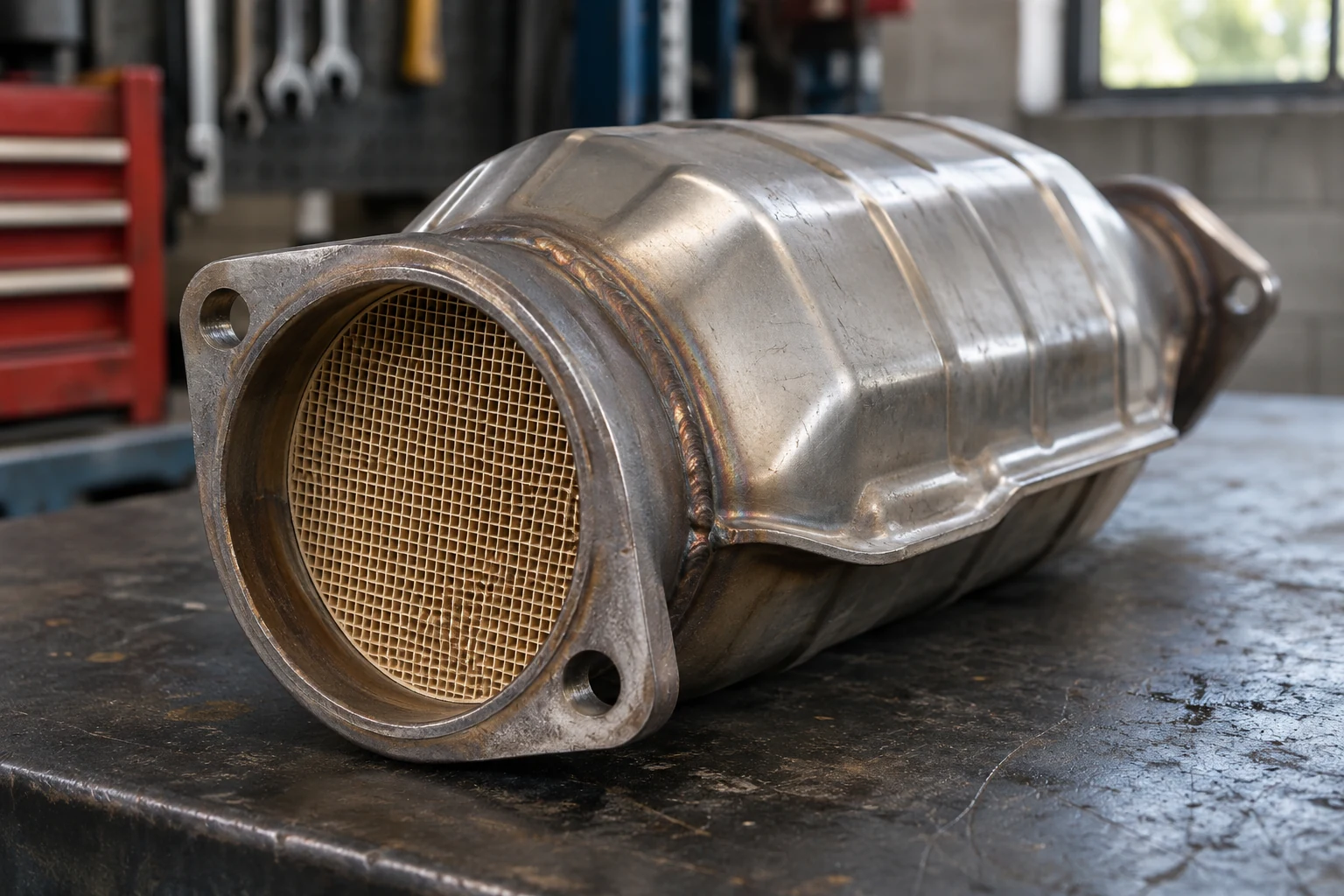
A metal canister turns a fast-moving exhaust stream into a controlled chemical reaction.
Quick answer
A catalytic converter reduces certain exhaust pollutants by helping chemical reactions happen on a coated internal surface. In a gasoline vehicle’s three-way converter, carbon monoxide and unburned hydrocarbons are oxidized, while nitrogen oxides are reduced. The main desired products are carbon dioxide, water and nitrogen. Temperature, exhaust composition and engine control determine how effectively it works.
The component beneath a car looks rather uneventful: a metal housing with an inlet and an outlet. There is no replaceable bag collecting poisonous gas. Instead, exhaust passes through a compact chemical reactor whose internal surfaces help rearrange molecules before they leave the tailpipe.
That distinction explains both the converter’s success and its limits. It can substantially reduce particular pollutants without making combustion disappear. The engine still uses fuel, produces carbon dioxide and requires an entire control system to keep exhaust treatment working properly.
What does a catalytic converter actually convert?
A conventional gasoline three-way catalyst targets three groups: carbon monoxide, unburned hydrocarbons and nitrogen oxides. Carbon monoxide contains one oxygen atom per carbon atom; oxidation produces carbon dioxide. Hydrocarbons contain carbon and hydrogen, which can be oxidized to carbon dioxide and water. Reduction reactions convert nitrogen oxides toward nitrogen gas. [1]
The labels describe different chemical tasks. Oxidation and reduction involve electron transfer; adding or removing oxygen offers an accessible way to follow these particular reactions. One simplified overall reaction is 2 CO + 2 NO → 2 CO₂ + N₂. It balances the atoms and shows how carbon monoxide can participate in reducing nitric oxide. It is an overall bookkeeping equation, not a complete account of every surface step. [3]
Notice what has not happened: the atoms have not vanished. Two nitrogen atoms leave together, and the carbon atoms remain in carbon dioxide. A converter changes chemical form rather than abolishing matter. Calling its output simply “clean air” loses that essential distinction.
Why the inside resembles a honeycomb
Exhaust needs access to an extensive reactive surface while still being able to flow through the component. A ceramic or metallic support contains many small channels. Their walls carry a high-surface-area washcoat and the active catalytic material. The support, coating and housing have different jobs; the precious metal is not a solid lump filling the canister. [2] [5]
Imagine replacing a broad tunnel with many narrower parallel passages. More of the moving stream is brought near a wall, while the passages remain open from end to end. The useful comparison is an organized network of contact surfaces, rather than a sieve catching individual gas molecules according to their size.
The visible honeycomb also does not reveal the full usable area. The coating has structure at much smaller scales. Looking at the open end shows the component’s architecture, not every place where an exhaust molecule might interact with a catalytic site.
What platinum, palladium and rhodium do
Platinum-group metals are used because they provide useful catalytic activity and can withstand demanding exhaust conditions. Formulations differ, but platinum and palladium are associated with oxidation chemistry, while rhodium is particularly important for nitrogen-oxide reduction. Only a relatively small amount is distributed over a support. [4] [5]
A catalyst offers a faster reaction pathway under the operating conditions. Reactants interact with its surface, undergo transformations and leave as products, making sites available again. It is not intended to be consumed as a fuel with every successful conversion.
Think of a reusable workbench. The bench helps workers arrange a task efficiently, but the finished object is made from the incoming materials. This is only an analogy: metal surfaces do not plan their work, and different molecules can compete for access. It does help distinguish the catalyst from the reactants passing over it.
“Not consumed in the overall reaction” also does not mean “impossible to damage.” Real components can lose performance. Their lifetime depends on keeping the active material accessible and preserving the structure around it.
Why the air-to-fuel mixture matters
The simultaneous reactions require a carefully managed exhaust composition. A three-way catalyst operates most effectively near the engine’s stoichiometric mixture: the proportions of air and fuel corresponding to complete combustion for that fuel. An oxygen sensor ahead of the catalyst supplies feedback for mixture control. A downstream sensor can help monitor catalyst performance. [3] [5]
This is why a converter cannot be understood as a completely independent accessory. What enters it depends on the engine. Temperature and gas composition change as the vehicle starts, accelerates or changes load; the control system continually responds.
A useful hypothetical comparison is two identical converters receiving different mixtures. If one receives a suitable balance of reactants and the other does not, their outputs need not match. Identical hardware does not guarantee identical chemistry. The operating state belongs in the explanation alongside the component’s materials.
Why cold starts are a challenge
Catalytic conversion depends on temperature. A cold component has not yet reached the conditions for strong conversion, so its effectiveness develops as it warms. HELLA’s technical explanation distinguishes the component’s operating temperature from merely having exhaust flowing through it. Johnson Matthey also identifies cold-start catalysts as an area of development. [5] [1]
There is no single universal warm-up time that follows from the word “catalytic.” A claim such as “it works perfectly after one minute” would need a vehicle, starting temperature, test procedure and definition of performance. An engine started after sitting outdoors in winter presents a different initial state from one restarted while warm.
The same caution applies to impressive conversion percentages. A result obtained under suitable controlled conditions should not be read as an identical reduction at every moment of every journey.
A converter, a particle filter and a muffler have different jobs
A flow-through three-way catalyst chemically treats gases. A particulate filter physically captures particles, although filters may also carry catalytic coatings. Diesel aftertreatment can combine several different components, including oxidation catalysts, particulate filters and selective catalytic reduction systems. A gasoline three-way explanation should not be applied unchanged to every diesel system. [4] [5]
A muffler addresses exhaust sound. The three components can all sit along the same exhaust route while solving different problems. Position alone does not make them interchangeable, just as a tap, a water filter and a drain trap do different things despite sharing a plumbing system.
Does it remove carbon dioxide?
The main oxidation reactions described here produce carbon dioxide; they do not capture it. Reducing carbon monoxide is valuable, but converting its carbon into CO₂ is a different task from reducing greenhouse-gas emissions. The phrase “less harmful products” needs that context. [1]
For example, if a hypothetical exhaust sample contains carbon monoxide before treatment and more carbon dioxide afterward, that shift can indicate the intended oxidation reaction. It does not show that the vehicle used less fuel. To evaluate fuel use or total climate effects, a different measurement and system boundary are needed.
This is a recurring issue in environmental engineering: success against one pollutant is not automatically success against every impact. Chemistry makes the categories clearer rather than making the trade-offs disappear.
How researchers know whether it works
A meaningful test compares specified pollutants entering and leaving the system under known conditions. The calculation must account for the quantity being measured: gas concentration alone is not always the same thing as total emitted mass. Temperature, flow and mixture control help explain why results change.
Consider an illustrative test in which 100 units of a particular pollutant enter and five comparable units leave. The conversion for that pollutant would be 95 percent under those test conditions. It would not establish a 95 percent reduction in every other exhaust constituent, nor prove the same performance during a cold start. This arithmetic example is explanatory, not a reported vehicle test.
Frequently asked questions
Is a catalytic converter a filter?
A conventional flow-through three-way converter primarily changes gas chemistry. Particle filters perform a different job, although combined and catalytically coated systems exist.
Does “three-way” mean three separate canisters?
No. It refers to treating the three pollutant groups through coupled oxidation and reduction reactions. Packaging varies by vehicle.
Why are precious metals spread over a support?
The reactive surface needs to meet the exhaust stream. Distributing catalytic material over a structured support uses it very differently from placing a solid metal block in the pipe.
Does a converter make exhaust safe to breathe?
No. Treatment is not a guarantee of complete removal under every condition, and the engine still produces a complex exhaust mixture.
Follow another material transformation
Catalysis controls reaction pathways; corrosion shows what happens when a material itself changes. Explore why metal rusts and how stainless steel resists rust for two contrasting surface-chemistry stories.
Sources and further reading
Reference review: November 8, 2026.
Keep exploring.
One remarkable idea at a time—nature, science, history and beyond.
Sources and further reading
Barnakle uses credible primary and authoritative sources wherever possible.
- Johnson Matthey — What is a catalytic converter?
- https://matthey.com/science-and-innovation/knowledge-hub/what-is-a-catalytic-converter
- Johnson Matthey — Three-way catalysts
- https://matthey.com/products-and-markets/emissions-control/mobile/gasoline-applications/three-way-catalysts
- Nett Technologies — How does a three-way catalyst work?
- https://www.nettinc.com/information/emissions-faq/how-does-a-three-way-catalyst-work
- Johnson Matthey — What metal is in a catalytic converter?
- https://matthey.com/science-and-innovation/knowledge-hub/what-metal-is-in-a-catalytic-converter
- HELLA — Exhaust gas aftertreatment: design, function and diagnostics
- https://www.hella.com/techworld/us/technical/exhaust-technology/exhaust-gas-aftertreatment-design-diagnostics/
Last updated November 8, 2026.

Barnakle Editorial Team
Barnakle Editorial Team is the collective byline used for Barnakle’s editorial articles. The contributor profile explains the team identity and links to the publication’s editorial policies.
More from the editorial team →