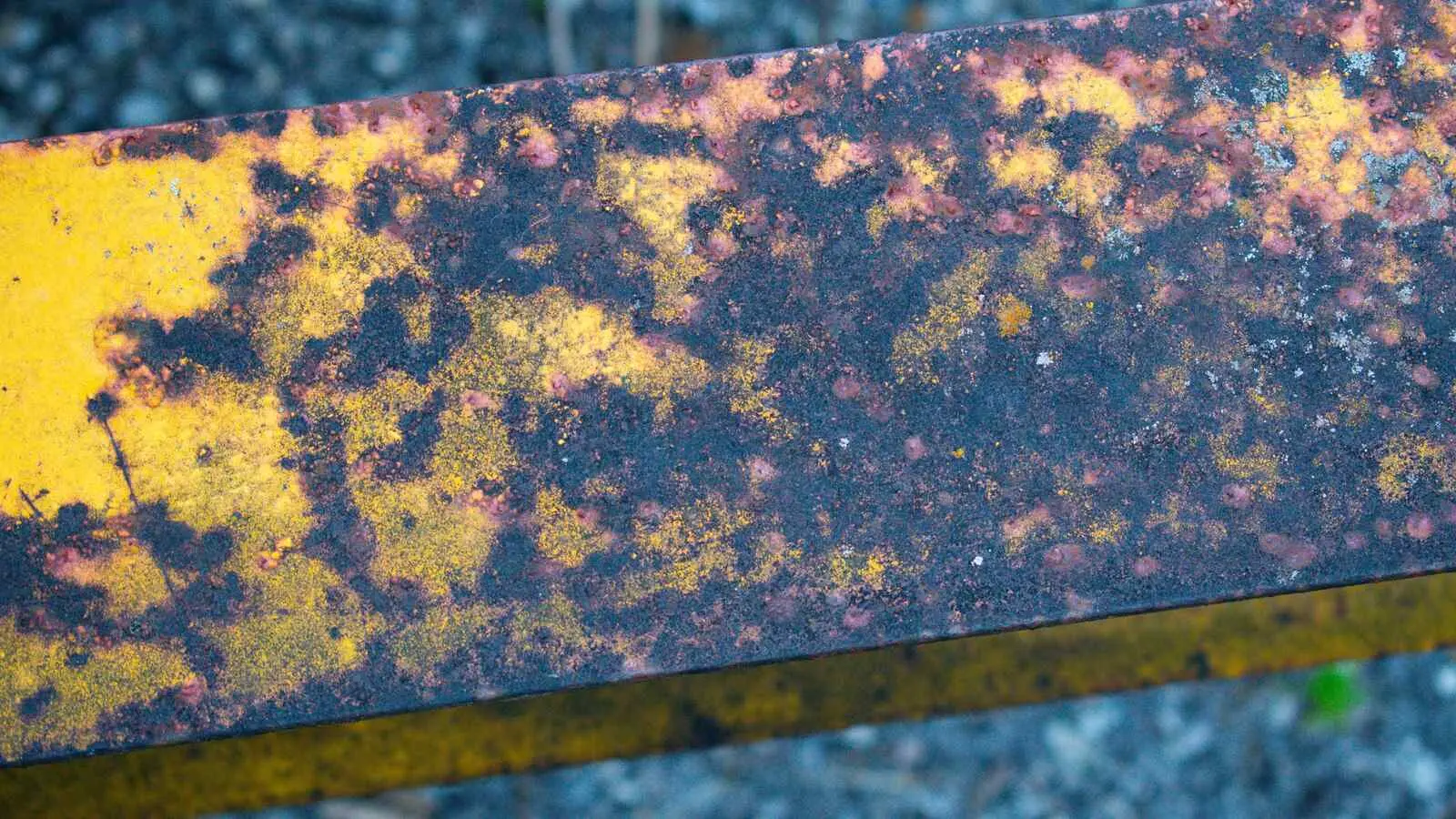
Rust forms when iron or iron-containing materials such as ordinary steel react with their environment. In familiar outdoor conditions, moisture and oxygen support electrochemical reactions that turn some of the metal into iron corrosion products. The red-brown coating is evidence of a material changing chemically, rather than dirt settling on it.
Rust and corrosion are not identical terms
Corrosion is the broader category. Iron rusts, while copper and aluminium can corrode without producing the familiar orange iron compounds. As the Electrochemical Society explains, metallic corrosion commonly involves oxidation coupled with a reduction reaction.
At an anodic region, iron loses electrons and enters the surrounding moisture as ions. Electrons can move through the metal to cathodic regions, where a reduction reaction consumes them. In ordinary aerated water, dissolved oxygen participates in that reduction. The surface can contain many tiny reaction sites rather than one visibly separated pair.
Why water matters even without a puddle
A thin moisture film can support ionic movement between reaction sites. Metal does not have to be fully submerged: humid conditions and condensation can provide moisture on an apparently exposed surface.
The Canadian Conservation Institute’s guide to metal objects illustrates corrosion beneath a water film. Keeping a metal object dry interrupts an important part of the process, although the actual rate also depends on contamination and the material’s surface condition.
Why salt makes conditions worse
Dissolved salts help a moisture film carry charge. Chloride-containing contamination can also promote particularly troublesome corrosion. This helps explain the vulnerability of iron exposed to sea spray, salt deposits or repeated wetting.
In its care guidance for iron, the Canadian Conservation Institute identifies soluble salts as an accelerator and explains how chloride-rich deposits can attract moisture. A surface that dries after rain may still retain contamination ready for the next humid period.
Why the rust layer does not always stop further damage
Rust is not one perfectly uniform compound or one reliably sealed coating. Its composition and structure vary. Loose or cracked corrosion products can permit continued access to the metal beneath, so the surface can keep deteriorating.
There is an important qualification: a compact, adherent corrosion layer can be comparatively stable. Conservators distinguish stable surfaces from active corrosion with fresh powder, cracking or flaking. Removing every dark or rusty layer from an old object is therefore not automatically the right treatment.
How protection works
An intact coating can slow contact between the metal and the surrounding environment. Good drainage also reduces places where water collects. Different metals in electrical contact can create additional corrosion problems when moisture connects them; material choice and the surrounding conditions both matter.
Protection needs inspection. A damaged coating may allow local attack, and covering loose corrosion is not equivalent to restoring a sound surface. Historic or valuable objects deserve advice from a conservator rather than an improvised chemical stripping treatment.
Can cleaning restore the original metal?
Removing corrosion products can improve a surface, but it does not replace metal already lost. The visible stain alone also cannot establish how much sound material remains. A cosmetic improvement and a structural assessment answer different questions.
The central lesson is to follow the conditions at the surface: the metal, the moisture, the available reactions and the effectiveness of any protective layer. Those details explain much more than the appearance of an orange patch alone.
Sources and further reading
Keep exploring.
One remarkable idea at a time—nature, science, history and beyond.
Last updated October 19, 2026.

Barnakle Editorial Team
Barnakle Editorial Team is the collective byline used for Barnakle’s editorial articles. The contributor profile explains the team identity and links to the publication’s editorial policies.
More from the editorial team →