Refraction, internal reflection and motion turn incoming light into changing flashes.
Quick answer
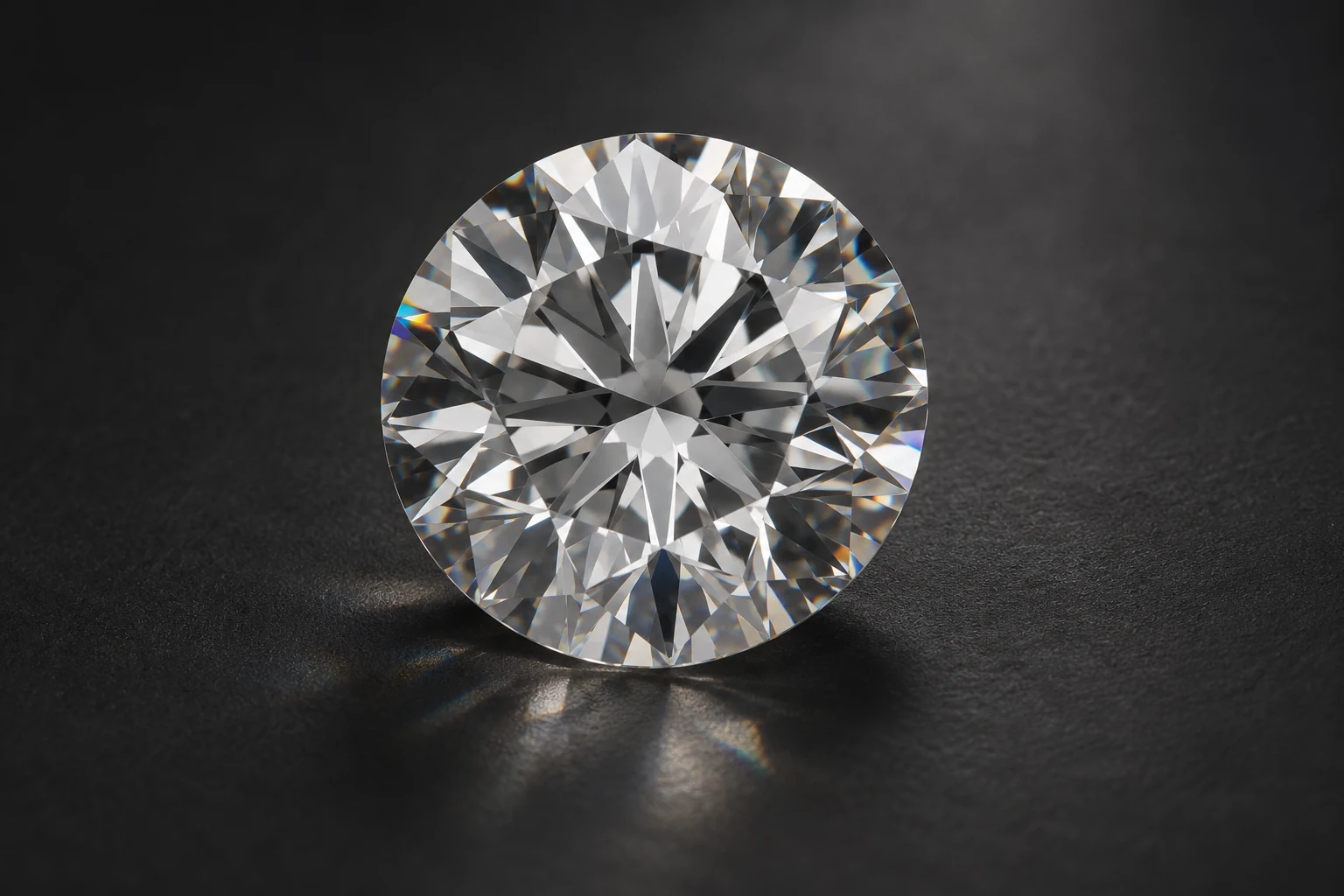
Diamonds sparkle because their optical properties and polished facets redirect incoming light. Refraction bends light, internal reflection sends some paths back through the stone, and dispersion separates colours. As the diamond, light or viewer moves, different paths reach the eye. Gemologists distinguish white-light brightness, coloured fire and the changing flashes and contrast called scintillation.
A diamond can change from a bright white shape to a pattern of dark triangles and tiny coloured flashes with a small movement. The material has not changed its composition between those moments. Its relationship with the surrounding light and the observer has changed.
The explanation begins with an ordinary fact: a diamond is not generally supplying the visible light that makes it sparkle. It is receiving light and sending selected portions toward your eye. The optical material and the cut together determine how that happens.
Brightness, fire and scintillation describe different things
GIA separates three important appearance terms. Brightness concerns reflected white light from the surface and interior. Fire refers to coloured flashes produced by dispersion. Scintillation includes sparkle and the pattern of bright and dark areas seen as the viewing relationship changes. These effects are related, but they answer different questions about appearance. [1]
Imagine watching a stationary stone under a broad white light. It may look bright without producing frequent sharp flashes. Now move it under a smaller light source: a few facets may flash dramatically while others become dark. Calling both observations simply “shine” hides the difference.
The vocabulary is useful even outside jewelry. It helps separate total visible light, colour separation and changes over time. A material can perform strongly in one respect without looking identical in every environment.
Why light bends when it enters diamond
The refractive index describes how light propagates in a material compared with vacuum. GIA lists diamond’s refractive index at approximately 2.42. At a boundary between materials, a ray generally changes direction unless it arrives along the surface normal. This bending is refraction. [2] [3]
A high refractive index is not a synonym for “bright.” It describes an optical property. The light still needs suitable paths through the shaped stone to reach a particular observer.
To see why geometry matters, imagine two transparent objects made from the same material: a flat plate and a faceted stone. Their refractive indices match, but their surfaces direct light along different routes. Composition supplies the material’s behaviour at each boundary; shape arranges the boundaries.
Total internal reflection keeps some light inside
When light travels from diamond toward air, it can be totally internally reflected if its angle of incidence exceeds the critical angle. The angle is measured from the normal, an imaginary line perpendicular to the surface. For diamond and air, the critical angle is about 24.4 degrees. [3]
“Measured from the normal” matters. An angle drawn from the surface itself would use a different reference and can reverse the interpretation of a diagram. A precise drawing should identify the reference line rather than leave the reader to infer it.
Internal reflection does not mean light is trapped forever. A ray can encounter another facet at a different angle and leave the stone. A successful facet arrangement can direct useful light back through the upper portion toward a viewer.
Nor is every encounter a perfect mirror event. Whether light reflects or transmits depends on the boundary and the angle. The phrase total internal reflection describes a particular condition, not every reflection that happens inside a diamond.
What the cut contributes
Cut is more than the outline of the stone. Facet arrangements, proportions, polish and symmetry influence how light is returned. GIA’s standard round-brilliant cut assessment considers appearance alongside design and craftsmanship; it is not simply a count of facets. [1] [4]
Two stones with the same outline can therefore display different patterns. The angles work as a connected system: changing one part can alter which internal paths eventually return light to the eye.
Think of a room with several angled mirrors. Knowing how many mirrors it contains does not tell you whether you can see a lamp from the doorway. Their orientation and position matter. A diamond involves refraction as well as reflection, so the analogy is incomplete, but it shows why adding facets is not automatically an improvement.
This also explains why a large stone is not guaranteed to out-sparkle a smaller one in a particular setting. Size is only one part of what the observer sees. Material, geometry, illumination and viewpoint remain involved.
Where the coloured flashes come from
Diamond is dispersive: its refractive index differs with wavelength. Consequently, different colours can follow slightly different paths. GIA’s research on modelling round-brilliant appearance incorporates this wavelength dependence rather than treating white light as a single undivided ray. [6]
Dispersion is the origin of fire, but a viewer does not necessarily see a neat miniature rainbow in every facet. The source’s size, the facet geometry and the observer’s position determine which colours overlap and which reach the eye separately.
A useful imaginary experiment replaces one broad white lamp with a small white point source while leaving the stone unchanged. The stone can reveal a different mixture of broad brightness and isolated colour flashes because the incoming directions are different. This is an explanation of the variables, not a measurement comparing particular gems.
Other objects make colours by different mechanisms. A CD’s rainbow colours, for example, involve its finely spaced structure. Similar-looking colours do not establish that the underlying optics are identical.
Why movement creates sparkle
As the stone, observer or light moves, the paths connecting a bright source to the eye change. Areas that returned bright light can become dark, while other areas brighten. That variation and contrast are central to scintillation. [4]
A still photograph captures only one arrangement. It may show a very bright reflection but cannot demonstrate the whole pattern over time. A video can show changes, yet its exposure, focus and lighting still shape what is recorded.
Imagine a faceted object in front of a window with a dark wall nearby. Some paths sample the bright window and others the wall. Turn the object and the pattern changes. The dark areas are not necessarily holes, dirt or defects; they can be part of the reflected environment.
This is why contrast matters. A uniformly bright patch and a rapidly changing set of bright and dark patches can have different visual impact even if both return substantial light.
Why the same diamond looks different in different rooms
GIA’s explanation of lighting compares appearances under different sources and surroundings. Diffuse illumination, limited spotlights, dark ceilings and even nearby clothing can alter the light a diamond returns to the viewer. The environment participates in the image. [5]
Consider a simple observation sequence: keep the stone still and change the light, then keep the light still and move the stone. Those are separate interventions. If both are changed at once, it becomes harder to identify which change produced a particular flash.
A dramatic display under multiple small spotlights is not evidence that the stone will have an identical appearance under an overcast sky. Neither setting is “fake” merely because they differ. They provide different incoming light fields.
For a science demonstration, that variability is an advantage. It makes an otherwise invisible system of light paths visible through changing patterns.
Does sparkle prove that a stone is diamond?
No. Sparkle is an optical appearance, not a complete material identification. Several transparent materials can be faceted to produce bright reflections and coloured flashes. GIA specifically cautions that visual impressions alone are not reliable proof of diamond identity. [7]
This is a broader lesson about inference. Observing a property associated with a material does not show that only that material could produce it. A transparent sample, an attractive colour pattern or a sharp flash narrows a description; it does not automatically establish origin or composition.
The article therefore explains the mechanism of appearance. It is not a substitute for gemological identification, a valuation or a test of whether a photographed specimen is natural, laboratory-grown or a simulant.
How scientists study diamond appearance
Researchers can model light paths through specified geometries, including different wavelengths, and compare the predicted appearances with observations. GIA’s modelling work demonstrates why the illumination and the observation setup must be part of the model, alongside the stone itself. [6]
Suppose two computer models use the same diamond geometry but different light-source distributions. Different predicted patterns would not be a contradiction. The models are answering different experimental questions. To compare their output fairly, the inputs need to match.
Frequently asked questions
Do diamonds make their own sparkle light?
Ordinary sparkle uses incoming illumination. It should be distinguished from separate phenomena such as fluorescence under suitable excitation.
Is fire an actual flame?
No. It is the gemological term for the coloured flashes associated with dispersion.
Does a high refractive index guarantee an excellent cut?
No. Refractive index is a material property; cut concerns the geometry and finish of the fashioned stone.
Why can a diamond have dark-looking facets?
Its facets return different parts of the surrounding light field. Dark regions can contribute to the changing contrast pattern rather than indicating a defect.
Keep following light
Explore how rainbows form for another combination of refraction and colour separation, then read why glass is transparent to separate transmission from sparkle.
Sources and further reading
Reference review: November 8, 2026.
- GIA — Diamond cut: brightness, fire and scintillation
- GIA Gem Encyclopedia — Diamond facts and refractive index
- OpenStax, University Physics Volume 3 — Total internal reflection
- GIA — Why cut matters, part 2
- GIA — How light affects a diamond’s appearance
- GIA, Gems & Gemology, Fall 1998 — Modeling the appearance of the round brilliant cut diamond: an analysis of brilliance (PDF)
- GIA — How to tell if a diamond is real
Keep exploring.
One remarkable idea at a time—nature, science, history and beyond.
Sources and further reading
Barnakle uses credible primary and authoritative sources wherever possible.
- GIA — Diamond cut: brightness, fire and scintillation
- https://4cs.gia.edu/interactive-4cs/cut/index.html
- GIA Gem Encyclopedia — Diamond facts and refractive index
- https://www.gia.edu/diamond
- OpenStax, University Physics Volume 3 — Total internal reflection
- https://openstax.org/books/university-physics-volume-3/pages/1-4-total-internal-reflection
- GIA — Why cut matters, part 2
- https://4cs.gia.edu/en-us/blog/why-cut-matters-part-2/
- GIA — How light affects a diamond’s appearance
- https://4cs.gia.edu/en-us/blog/light-affects-diamond-cut-appearance/
- GIA, Gems & Gemology, Fall 1998 — Modeling the appearance of the round brilliant cut diamond: an analysis of brilliance (PDF)
- https://cms.gia.edu/dam/jcr:ef75f29e-e61d-4b31-9916-3f5564c182ed/FA98.pdf
- GIA — How to tell if a diamond is real
- https://4cs.gia.edu/en-us/blog/how-to-tell-if-diamond-is-real/
Last updated November 8, 2026.

Barnakle Editorial Team
Barnakle Editorial Team is the collective byline used for Barnakle’s editorial articles. The contributor profile explains the team identity and links to the publication’s editorial policies.
More from the editorial team →