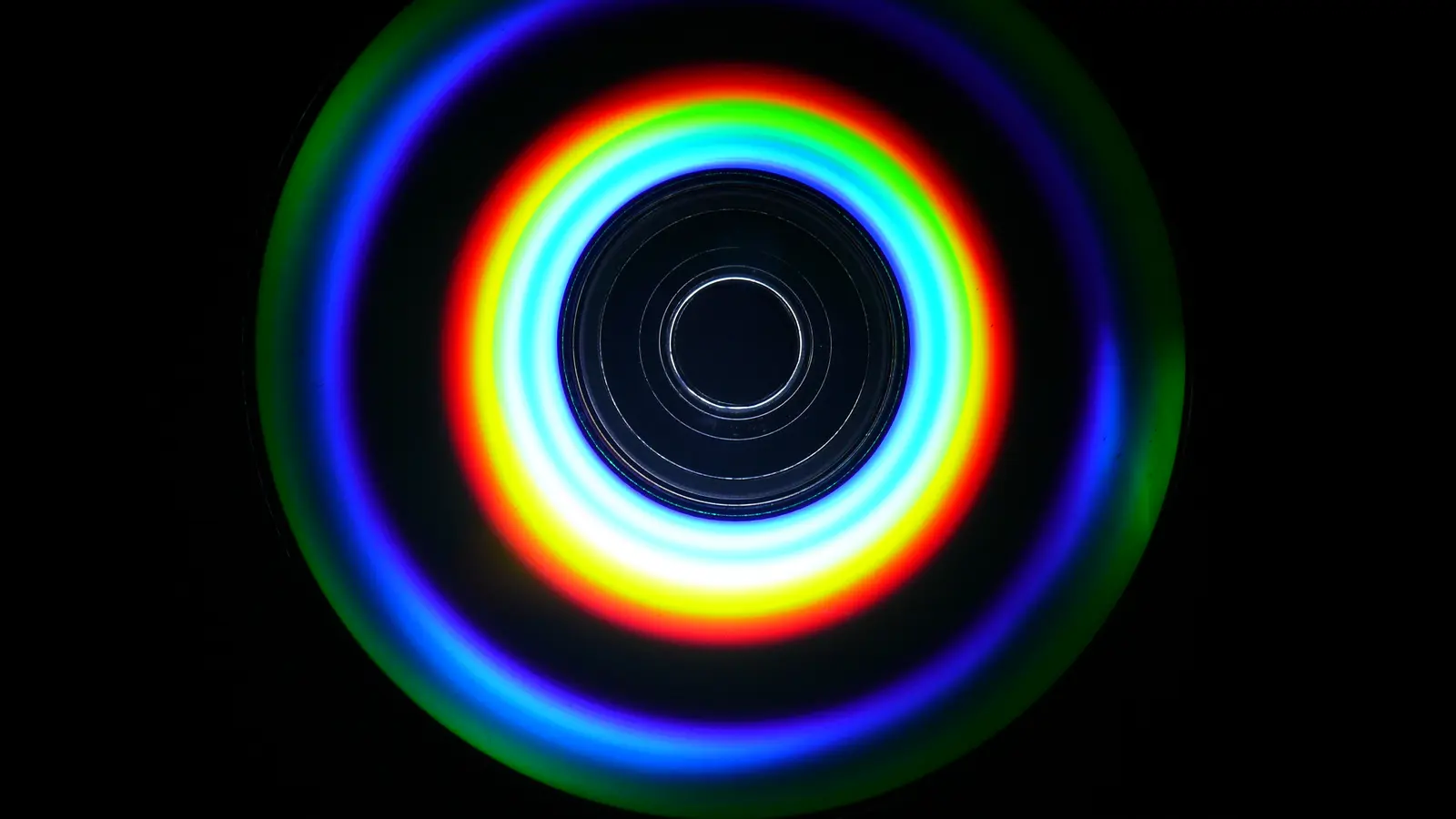
Closely spaced tracks diffract white light
Tilt a disc beneath a white lamp and coloured bands slide across it. Tilt it again and the colours move, although the plastic has not changed. That movement is the clue: a CD's rainbow is an arrangement of light, produced by a repeating microscopic structure. The same wave behaviour lets physicists use a disc as a simple diffraction grating.
A spiral becomes a repeating optical structure
A broad range of visible wavelengths appears white until an optical system separates them.
Data follow a continuous spiral whose neighbouring turns form a regular pattern.
Microscopic track separation is small enough for wave effects to dominate reflection.
The important repetition is the spacing between neighbouring turns of the spiral. Across a small part of the disc, those turns resemble many nearly parallel lines. A beam illuminating that patch meets a regular structure, so the reflected contributions have a systematic relationship rather than the disorder of reflection from an irregular scratch.
Sources: [1]
How reflected waves sort the colours
Reflected waves overlap after travelling distances set by illumination and viewing angles.
Waves arriving in step reinforce; peaks meeting troughs partly cancel.
Red and blue light satisfy reinforcement conditions in different directions.
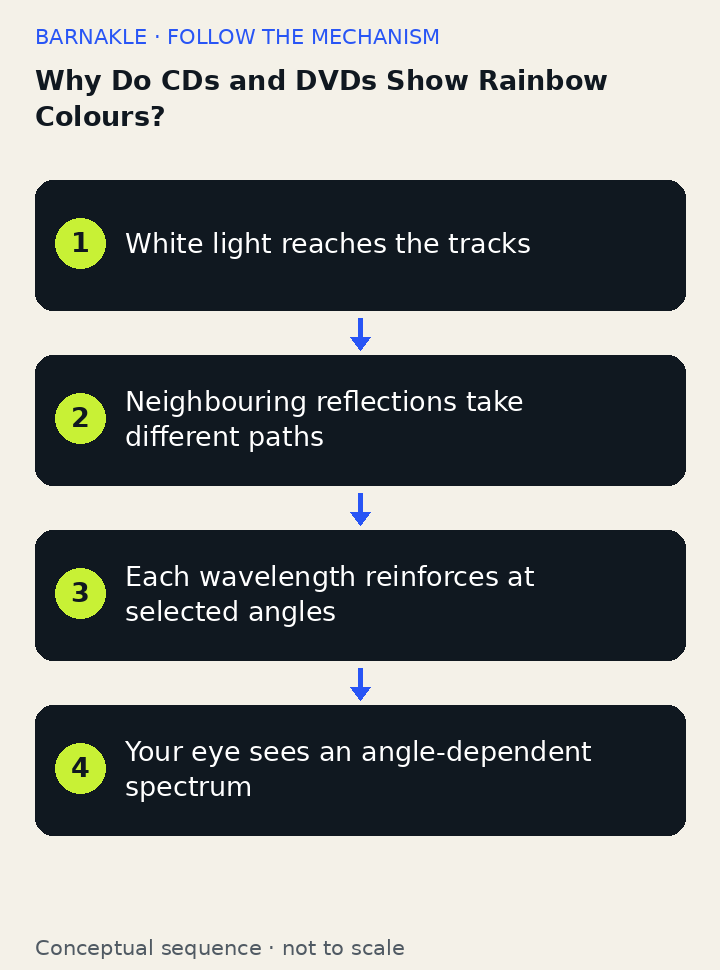
At a particular viewing direction, light returning from neighbouring tracks travels different distances. For one wavelength those contributions may reinforce; another wavelength may reinforce elsewhere. A white source supplies many wavelengths at once. The result is a spread of colours whose position depends on the spacing and the illumination geometry.
Sources: [2]
Why the rainbow moves
Tilting the disc or moving the light changes the path differences between reflected waves and shifts which wavelengths reinforce toward your eye.
DVD tracks are closer together, changing angular separation and pattern.
Changing the angle changes those path differences. That is why the coloured band moves when you tilt the disc or move your head. A flat disc also curves its track direction around its centre, so different patches satisfy the same conditions in different orientations. The visible arcs are a map of that geometry, not a painted pattern.
Sources: [2]
What the pattern does not tell you
A single-colour laser reads reflected changes; the room-light rainbow does not display stored data.
A broad-spectrum lamp and a single-colour source give different displays. A laser supplies a narrow wavelength range, so a grating can make separated bright spots without producing a full rainbow. This is useful for measurement, but lasers require proper eye-safety precautions; ordinary room lighting is enough to observe the disc's colours.
Sources: [2]
Why the same patch changes colour when tilted
A red-looking patch can become blue as you rotate the disc. The patch has not changed its chemical composition. You have changed which reflected wavelengths reinforce in the direction of your eye. A coloured label would tend to retain its basic colour under the same white light; the diffraction pattern follows angle instead. That contrast separates structural colour from a simple pigment explanation.
Pigment colour and diffraction colour compared
| Term or component | What it means here |
|---|---|
| Pigment colour | Selective absorption helps determine reflected colour. |
| Diffraction colour | A repeating structure redirects wavelengths differently. |
| A disc rainbow | Angle-dependent colour is not a display of stored files. |
A disc rainbow does not reveal stored data
The rainbow does not reveal the album or file, and scratches do not create the normal spectrum. Blank patterned discs also diffract light.
How diffraction angles and track spacing are measured
Scientists illuminate gratings with known wavelengths, measure bright angles and compare them with interference equations; microscopy measures track spacing.
CD and DVD rainbow questions
Why is the rainbow clearer under some lights?
A broad-spectrum source supplies many visible wavelengths for the tracks to separate. The viewing and illumination angles also determine which colours reach your eye.
Why do the colours form curved bands?
The spiral track changes direction around the disc. Different patches therefore send reinforcing reflections toward your eye at different orientations, producing curved regions of colour.
Does the rainbow mean a disc is scratched or damaged?
No. The normal rainbow comes from the regularly spaced tracks. Scratches are not required to produce it, and the coloured reflection does not reveal which files or music the disc contains.
Track spacing turns white light into moving colour
The rainbow is a visible consequence of spacing too small to see directly. It links the geometry of a manufactured surface to the wavelengths of light. Once you recognize that connection, the moving colours become a compact demonstration of interference rather than a mysterious property of stored music or computer files.
Continue exploring
Sources and further reading
Keep exploring.
One remarkable idea at a time—nature, science, history and beyond.
Last updated November 6, 2026.

Barnakle Editorial Team
Barnakle Editorial Team is the collective byline used for Barnakle’s editorial articles. The contributor profile explains the team identity and links to the publication’s editorial policies.
More from the editorial team →