Oobleck seems to change its mind about being a liquid. The familiar cornstarch suspension flows under some conditions and strongly resists deformation under others, making it an accessible example of complex material behaviour.
Why does oobleck turn hard when hit? A sudden load can make the dense suspension’s particles interact through a stress-bearing network, producing a solid-like response. Shear thickening and impact-driven jamming describe related parts of that behaviour. The material has not frozen, and its response depends on concentration, loading and boundaries. [4]
It is a suspension, not starch dissolved in water
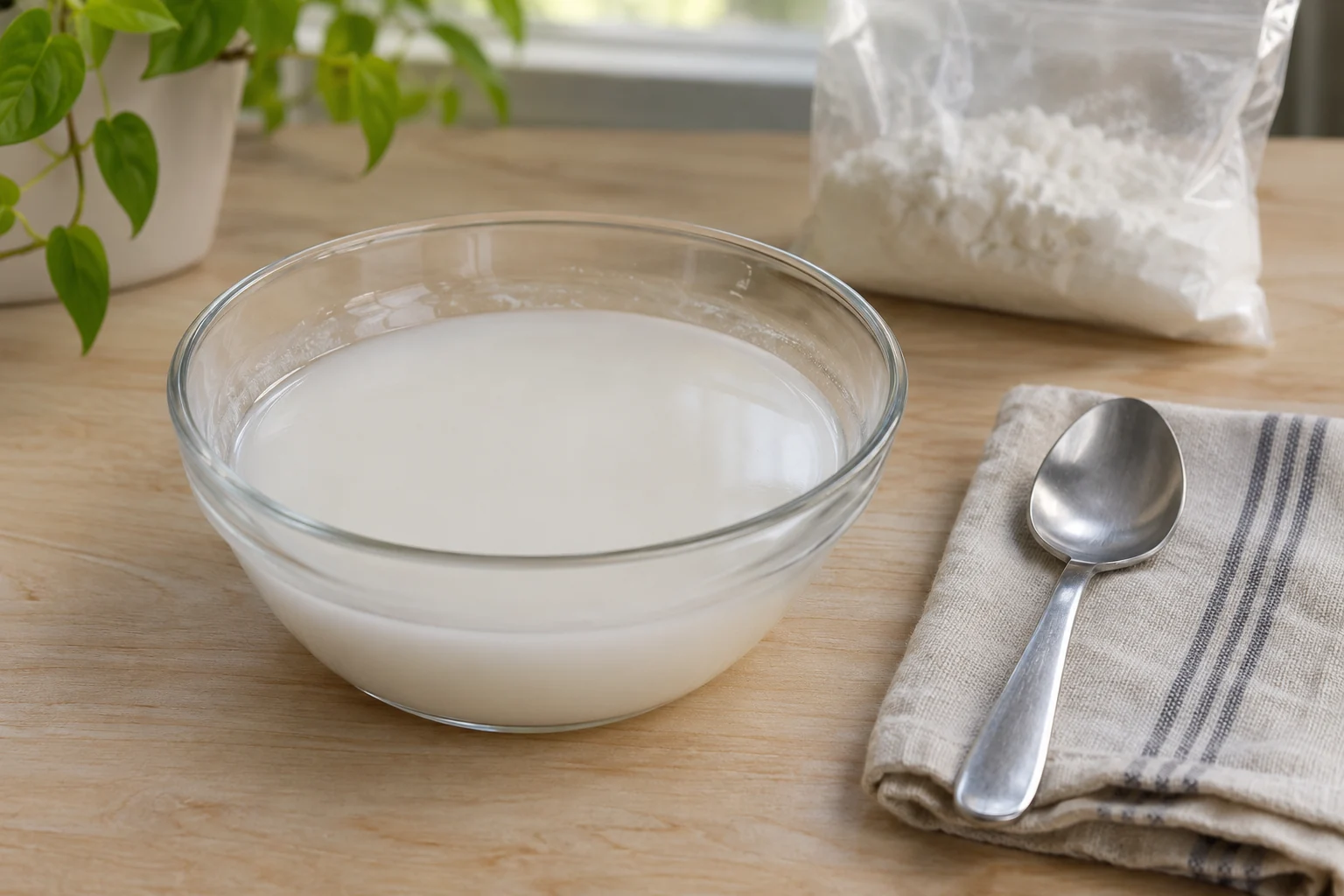
Cornstarch powder contains solid grains. Mixed with water under ordinary demonstration conditions, those grains remain particles suspended in a liquid. Treating the mixture as a completely dissolved substance hides the contacts and rearrangements that make its behaviour interesting.
The University of Utah’s teaching material explains the contrast between grains moving around one another at low deformation rates and a much more resistant response under stronger shear. Its microscopy examples show why particle concentration matters to the material’s structure. [1]
The two ingredients have different roles. The liquid participates in lubrication and fluid forces, while the crowded particles can develop interactions unlike those of water alone. The resulting mixture cannot be understood simply by averaging the feel of dry powder and a glass of water.
What does shear thickening mean?
Shear involves neighbouring parts of a material moving relative to one another. Viscosity describes resistance to flow in a defined measurement. In a Newtonian liquid under fixed conditions, shear stress and shear rate have a simple proportional relationship. A shear-thickening suspension becomes more resistant as the applied conditions move into its thickening regime.
The Utah introduction uses cornstarch to explain this non-Newtonian behaviour. The name does not mean the material violates Newton’s laws. It means its flow cannot be described by one constant viscosity across the relevant conditions. [1]
“Hard” is a useful everyday description of a sudden tactile response, but experiments need more precise quantities. The force, the rate of deformation, the elapsed time and the amount of material all affect what is measured.
Why friction becomes important
Particles separated by liquid can interact through fluid forces. Under sufficiently strong loading, close approaches and contacts can change how the suspension carries stress. Friction between particles is consequently part of the explanation for strong thickening, rather than an irrelevant detail at the microscopic scale.
NIST and Georgetown researchers investigated this relationship using suspensions of tiny silica spheres. Their measurements identified a transition from behaviour dominated by hydrodynamic interactions toward friction-dominated interactions as thickening became more pronounced. The work helped connect mechanisms that had sometimes been presented as competing explanations. [2]
The experiment used a model particle system, not a bowl of irregular cornstarch grains. It provides evidence about an important class of interactions without implying that all dense suspensions have identical particles or exactly the same thresholds.
The stresses are not always spread uniformly
Blair Lab’s research account describes measurements of local boundary stresses in thickening suspensions. Above a critical applied stress, the boundary showed strongly varying, dynamic regions of traction. Those observations connect bulk flow behaviour with changing structures that transmit forces through the material. [3]
This matters because a single overall viscosity value can conceal what is happening locally. A suspension may develop concentrated stress-bearing regions rather than becoming one perfectly uniform block. The interactions between particles and boundaries form part of the mechanical system.
It also explains why researchers use more than one kind of measurement. A force reading, an image of a flow field and a measurement of the material’s shape can reveal complementary aspects of the same response.
Impact can create a moving jamming front
Peters Lab describes dynamic jamming as a process in which an impact creates a jammed region that propagates through a dense suspension. The spreading front is a change in the material’s motion and mechanical state, not a wave of water becoming ice. [4]
Han, Peters and Jaeger used high-speed ultrasound imaging to look inside an impacted suspension. Their 2016 study found strong shear at the moving front and no detectable increase in packing fraction accompanying the solid-like transition. They interpreted the observations as evidence for shear jamming rather than simple densification. [5]
That result improves on the idea that an impact merely squashes every particle into a smaller volume. Rearrangement of the contact network and deformation can matter even without a detectable increase in the fraction of space occupied by particles.
Why the amount of starch changes the result
A dilute suspension gives particles more room than a densely packed one. A 2013 study measured cornstarch mixtures across a range of concentrations using rheology and impact tests. It found a transition between weaker continuous thickening and much more abrupt thickening as concentration increased under its test conditions. [6]
The relevant lesson is the dependence on formulation and method. A threshold from one study is not a universal recipe for every brand of starch, vessel or loading pattern. The material’s response belongs to a combination of composition and conditions.
Two mixtures can therefore look similar at rest but respond differently to a sudden disturbance. Appearance alone does not specify a dense suspension’s mechanical properties.
Does the mixture become a permanent solid?
No permanent curing reaction is required for the familiar reversible demonstration. When the strong loading is removed, the particle network can relax and the mixture can flow again. That is different from a cement setting reaction or a liquid crossing its freezing point.
It is useful to distinguish three observations: resistance to a slow flow, an abrupt response to impact and the behaviour after the load disappears. They are related, but one adjective such as “solid” cannot replace all three descriptions.
The most accurate everyday explanation is therefore conditional: oobleck can behave solid-like under a suitable sudden load while remaining capable of flowing under other conditions.
Why the mechanism matters beyond a classroom
NIST’s research account points to industrial handling of dense suspensions as an important motivation. Thickening can alter how a material moves through equipment, while control of the response can be useful in designed materials. Understanding the transition matters more than simply labelling a mixture strange. [2]
A successful explanation connects particles and liquid with measurable forces. Oobleck is memorable because that connection can change the material’s apparent behaviour dramatically, even though its ingredients remain the same.
Frequently asked questions
Does hitting oobleck freeze its water?
No. The solid-like response discussed here comes from the suspension’s mechanics, not freezing.
Is it always hard under any force?
No. Concentration, loading rate, geometry and boundaries affect the response.
Is shear thickening the same as getting denser?
No. The cited ultrasound study supported shear jamming without a detectable packing-fraction increase.
Why can it flow again afterwards?
The stress-bearing particle arrangement can relax after the load is removed. It need not have undergone a permanent setting reaction.
Keep exploring
Sources and further reading
- University of Utah — Cornstarch suspensions and non-Newtonian flow
- NIST — Friction and hydrodynamics in shear-thickening suspensions
- Georgetown University, Blair Lab — Shear thickening and boundary stresses
- Peters Lab — Dense suspensions and dynamic jamming
- Han, Peters and Jaeger (2016) — High-speed ultrasound imaging of impact-activated solidification; abstract
- Research study (2013) — Shear thickening of corn starch suspensions: does concentration matter?; abstract
Reference review: November 11, 2026.
Keep exploring.
One remarkable idea at a time—nature, science, history and beyond.
Last updated November 12, 2026.

Barnakle Editorial Team
Barnakle Editorial Team is the collective byline used for Barnakle’s editorial articles. The contributor profile explains the team identity and links to the publication’s editorial policies.
More from the editorial team →