Water does not have one fixed boiling temperature. A pressure cooker takes advantage of that fact to make hot, moist cooking conditions that an ordinary open saucepan cannot maintain.
How do pressure cookers cook food faster? They retain steam and regulate an elevated internal pressure. Water then boils at a higher temperature, allowing food to cook in hotter liquid and steam. The main advantage comes from that higher cooking temperature, rather than pressure mechanically squeezing food into softness. [1]
Why water normally boils near 100°C
Picture a bubble forming inside a saucepan. To grow, it must push against the pressure surrounding it. As the water gets hotter, its vapour pressure increases. Boiling becomes possible when that vapour pressure is sufficient to balance the surrounding pressure, with smaller effects from depth and the bubble’s curved surface. The familiar 100°C figure applies approximately to pure water at standard atmospheric pressure. [2]
An open pan stays close to the air pressure in the kitchen. Turning up the burner after the water is boiling mainly makes it boil more vigorously; it does not let the bulk liquid keep climbing to much higher temperatures. Much of the added energy goes into changing liquid water into vapour. A stronger flame and a hotter pot bottom therefore do not necessarily mean hotter boiling water.
Pressure changes the situation. At a higher surrounding pressure, water needs a higher temperature to develop the vapour pressure required for boiling. At a lower surrounding pressure, the reverse happens. That is why altitude matters to boiling, and why a lid that merely rests on a saucepan cannot reproduce the behaviour of a pressure vessel. The University of Iowa uses a pressure cooker to demonstrate this pressure–temperature connection. [3]
What the sealed lid changes
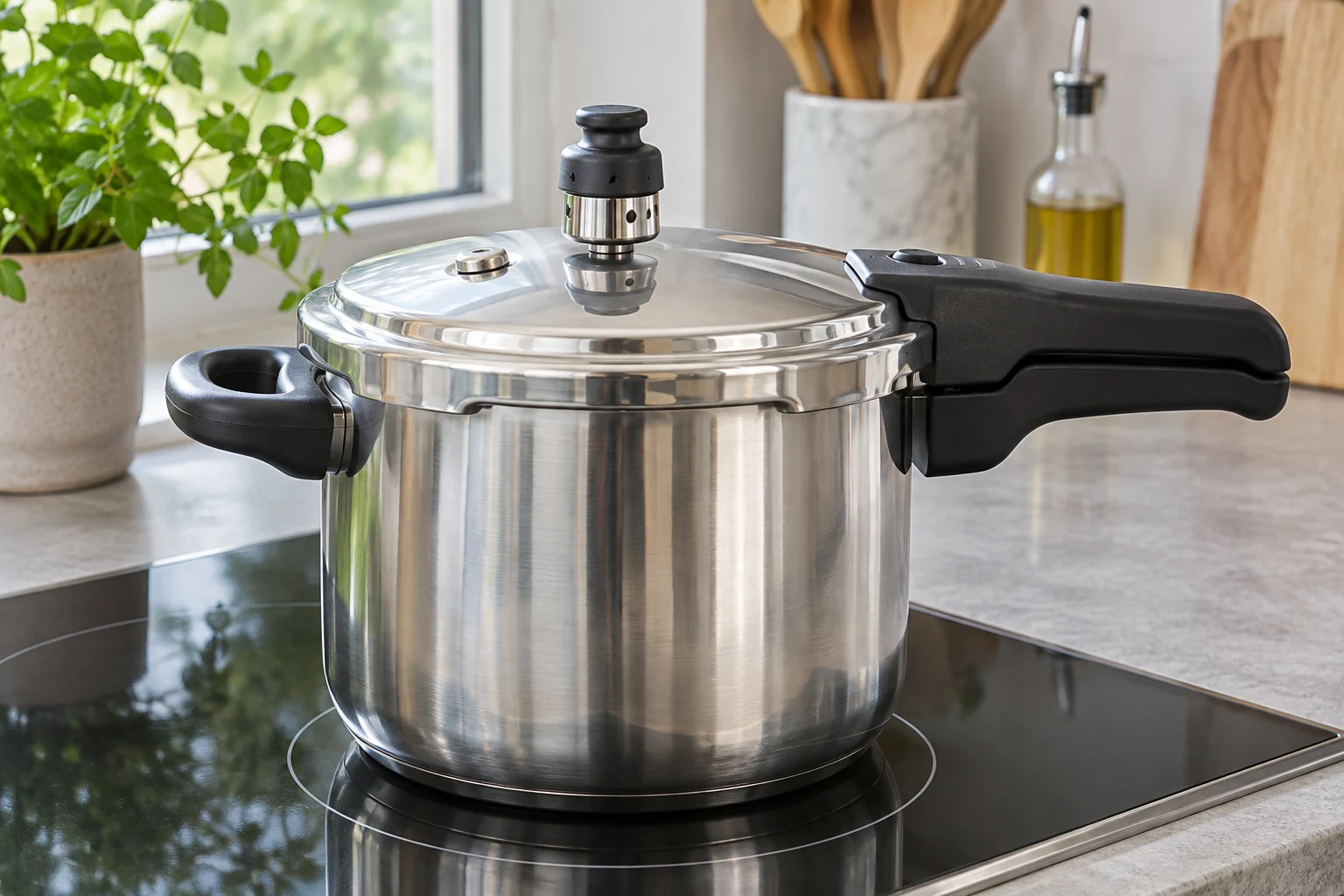
A pressure cooker has a lid and seal designed to retain steam. As the contents heat, steam accumulates and the pressure rises. The appliance then regulates its operating conditions rather than simply allowing pressure to build indefinitely. Its operating pressure is a design feature, not a measurement of how firmly someone has pushed down on the lid.
A useful reference point is about 121°C for saturated steam at roughly 15 pounds per square inch above standard atmospheric pressure. The phrase “above atmospheric pressure” matters: that is a gauge pressure, not the total pressure. Different cookers and programmes use different operating pressures, so 121°C is an illustration of the physics, not the temperature of every pressure-cooking appliance. [1]
Electric models combine a heating element with sensors and control electronics. Manufacturer descriptions explain how the appliance monitors conditions and controls heating during its programme. Stovetop models obtain heat from a separate hob, but the relationship between pressure and boiling temperature is the same. The route by which heat reaches the pot differs; the physical reason for the higher boiling temperature does not. [5]
Why a higher temperature speeds cooking
Cooking involves many changes rather than one universal reaction. Ingredients soften, proteins change structure, and starch-containing foods take up water and change texture. The rate and extent of those processes depend on the ingredient, its temperature and its exposure time. Raising the temperature of the moist cooking environment can make the required changes happen sooner.
The higher temperature is the key difference from an ordinary simmer. Saying that steam is “trapped” describes how pressure is established, but it leaves out the reason this helps. Steam in an unpressurized environment is not automatically hotter than boiling water. The pressure cooker changes the temperature available to both its liquid and vapour phases. [1]
Food still has to heat through. A thick piece does not instantly reach the temperature of the surrounding liquid when the cooker reaches pressure. Heat must move from the outside toward the centre. A recipe’s timing therefore depends on the size and arrangement of the food as well as the appliance’s operating conditions. A higher external temperature changes the driving conditions for heat transfer; it does not remove the distance heat must travel.
Why water or another suitable liquid matters
The liquid supplies the steam that establishes pressure, while also forming part of the cooking environment. Electric pressure-cooking guidance emphasizes that inadequate liquid can prevent normal pressurization or cause scorching. The correct amount depends on the appliance and recipe, including how much liquid the ingredients themselves release or absorb. [4]
This helps distinguish pressure cooking from a dry oven. Both can make food hot, but their moisture conditions and heat-transfer processes differ. A pressure cooker is not simply an oven squeezed into a metal pot. Its design uses a water-rich environment at a pressure that supports a higher boiling temperature.
It also explains why a cooker is not accurately described as making water “boil faster.” Reaching its higher operating temperature can take time. The advantage appears during the cooking stage, when the food is exposed to conditions hotter than an ordinary atmospheric simmer.
The timer does not show the whole elapsed time
An electric cooker’s programmed cooking interval is only part of the process. The appliance first heats the contents and reaches its operating conditions. Afterwards, pressure must fall before the lid can be opened according to the appliance’s instructions. Colorado State University Extension highlights these extra stages when explaining why a short programme can take longer than expected from start to finish. [4]
This is a useful distinction when comparing cooking methods. Five minutes displayed on a programme is not the same as five minutes between taking ingredients out and serving a meal. Likewise, a larger load can change the heat-up stage even if the programmed holding time remains unchanged. The most meaningful comparison uses the complete elapsed process.
Does altitude still matter?
At higher elevations, atmospheric pressure is lower. An open pan therefore boils at a lower temperature. A pressurized cooker raises the pressure above its surroundings, but a gauge-pressure setting should not be confused with a fixed total pressure everywhere. Exact behaviour depends on the appliance’s regulation and instructions.
The broader lesson is that pressure and temperature are connected throughout the process. Water does not “know” an altitude number. It responds to the pressure at its location. That same relationship explains both the lower boiling temperature on a mountain and the higher boiling temperature inside a pressure cooker. [2]
Pressure cooking and pressure canning are different jobs
Cooking a meal and validating a shelf-stable preserved food involve different requirements. Colorado State University Extension distinguishes ordinary electric pressure cooking from pressure canning. A cooker reaching elevated pressure is not, by itself, evidence that it provides an appropriate tested canning process. This article explains the physics of preparing food for eating, not a preservation method. [4]
Frequently asked questions
Does adding more heat always make the water hotter?
Once the cooker is regulating at a particular pressure, additional input does not imply an unlimited temperature rise. The operating controls and pressure regulation determine its conditions. An open boiling pan similarly converts much of its extra heat into more vapour. [3]
Is all steam hotter than boiling water?
No. Steam temperature depends on its pressure and thermal state. Pressure cooking works because its elevated pressure permits a higher boiling temperature, not because the word “steam” guarantees a particular temperature.
Do electric and stovetop models use different physics?
Both use the connection between pressure and boiling temperature. Their heat sources and regulation arrangements differ, so individual settings and timings are not automatically interchangeable. [5]
Why is there no single percentage for the time saved?
Different foods, sizes, loads and programmes respond differently. Heat-up and pressure-release stages also contribute to the total. A general explanation of the mechanism cannot replace a comparison of complete, specific cooking processes.
Keep exploring
Sources and further reading
- Exploratorium — Science of pressure cooking
- Georgia State University, HyperPhysics — Vapour pressure and boiling
- University of Iowa — Pressure cooker physics demonstration
- Colorado State University Extension — Common electric pressure cooking mistakes
- Instant Pot — Pressure cooker technology and controls
Reference review: November 10, 2026.
Keep exploring.
One remarkable idea at a time—nature, science, history and beyond.
Last updated November 12, 2026.

Barnakle Editorial Team
Barnakle Editorial Team is the collective byline used for Barnakle’s editorial articles. The contributor profile explains the team identity and links to the publication’s editorial policies.
More from the editorial team →