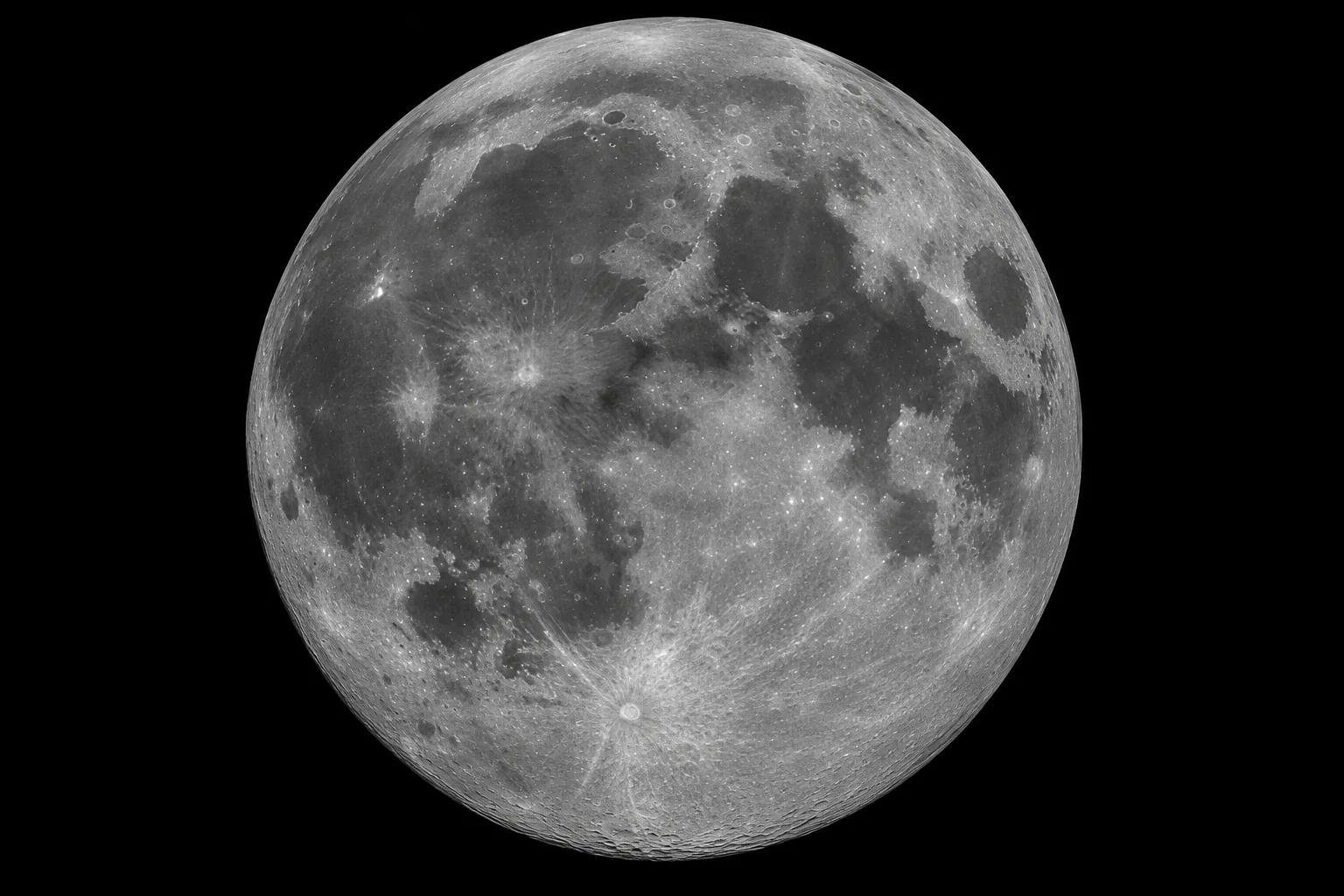
The Moon keeps roughly the same face toward Earth because it rotates once on its axis in the time it takes to complete one orbit around our planet. This synchronized motion is called synchronous rotation, a form of tidal locking. The Moon is turning; its spin is matched to its journey around Earth. [1, 2]
That distinction resolves a familiar puzzle. If the Moon truly did not rotate relative to distant stars, observers on Earth would see different sides during its orbit. Keeping one side inward requires a turn.
One orbit needs one rotation
Imagine a person walking in a circle around a chair while keeping their face directed toward the chair. At each quarter of the circuit, that person faces a different direction in the room. By the end, they have turned through one full rotation even though the chair has continuously faced the same side of their body.
Now imagine the person keeps facing the same wall throughout the walk. At one point the chair sees their face, at another their side and later their back. That second case represents circling without rotating relative to a fixed external direction.
NASA’s rotation visualization contrasts these situations. The first is the useful simplified picture for our Moon: an orbit and an axial rotation occur together. The familiar lunar face is evidence of coordinated turning rather than evidence that turning is absent. [2]
What does “tidally locked” mean?
Tidal forces arise because gravity acts differently across an extended body. Earth pulls more strongly on the near parts of the Moon than on its far parts, contributing to a small distortion. Earlier in the Moon’s history, tidal deformation and internal energy dissipation helped change its rotation. [1]
A deforming body does not respond instantaneously like an ideal mathematical object. A misalignment between the distorted shape and the direction of the gravitational interaction can produce a torque. Over time, the interaction dissipates energy and changes the relationship between spin and orbit. [1]
The present synchronized state is therefore a physical outcome of long-term interaction. It is not a coincidence that must be renewed by the Moon making a fresh aiming decision each month. “Locked” names the relationship, not a rigid connection holding the two worlds together.
How long does the matching cycle take?
The Moon’s orbit relative to distant stars takes about 27.3 Earth days. Its spin relative to that distant reference takes approximately the same time. The Canadian Space Agency describes this synchronization as the reason the same lunar side faces Earth. [6]
The phase cycle takes longer: about 29.5 days from one new moon to the next. During the Moon’s trip, Earth has also moved around the Sun. The Moon must travel farther before the Sun–Earth–Moon arrangement returns to the same phase geometry. [4, 5, 7]
These are different reference cycles, not competing estimates of one badly measured month. A rotation relative to distant stars and the recurrence of the same sunlight pattern answer different questions. Mixing them can make a correct explanation of tidal locking seem inconsistent.
Why the visible face is not perfectly fixed
Careful observers can see a little around the Moon’s edges over time. This apparent rocking is called libration. It means “the same face” is a useful approximation, rather than a claim that exactly the same boundary of terrain remains visible every night. [3, 8]
One major contribution comes from the elliptical orbit. The Moon moves faster along some parts of its orbital path than others, while its spin is much more nearly steady. The mismatch between changing orbital speed and relatively uniform rotation lets us look a little farther around the eastern or western limb at different times. [3]
The tilt of the Moon’s rotation axis relative to the viewing geometry also contributes to changing views near its northern and southern edges. Earth-based viewing location and smaller physical motions add further details. Libration is therefore a combination of effects, not proof that synchronous rotation has failed. [8]
Can we see more than half of the Moon?
At one instant, an observer sees approximately one hemisphere. Across time, libration exposes additional narrow regions near the edges, bringing the total surface accessible from Earth to about 59 percent. That figure is a cumulative total rather than the fraction visible in a single full-moon photograph. [8]
A simple analogy is looking at a ball from slightly different directions. Each view shows roughly half, but the union of several views contains more surface than any one view. Seeing a new strip on one side does not mean the ball has become transparent.
Detail near the lunar limb is also foreshortened. Terrain may be technically visible at a grazing angle without being as easy to examine as features near the center of the disk. Spacecraft supply the much more complete views that Earth-based observing geometry cannot provide.
Is the far side permanently dark?
No. “Far side” describes which side faces away from Earth. “Night side” describes which surface is currently turned away from direct sunlight. Those are different relationships, and the far side receives sunlight as the Moon follows its orbit. [5]
At full moon, the near side is largely illuminated and the far side is largely in darkness. Near new moon, the arrangement reverses. The same face can remain Earthward while the direction of illumination changes around the lunar globe. [4, 7]
Local topography adds exceptions to a simple day-and-night picture, particularly in deeply shadowed polar terrain. But those special locations do not turn the entire far hemisphere into a permanently dark world. The ordinary near/far distinction should never be used as a substitute for an illumination map. [5]
Do phases show different sides of the Moon?
The phases mainly show different fractions of the familiar side lit by the Sun. A crescent does not mean most of the Moon has rotated out of existence or that Earth’s shadow normally covers the missing portion. The viewing angle between Sun, Moon and observer changes through the month. [4, 7]
It helps to separate three questions when looking up: which terrain faces Earth, which terrain is sunlit, and where the Moon appears in the sky. Tidal locking addresses the first. Phases address the second. Neither alone explains every change in apparent position or orientation.
Shadow alignment becomes a different story during an eclipse. See how solar eclipses happen for the geometry of one special alignment.
Is tidal locking unique to our Moon?
No. NASA notes that synchronous tidal locking is common among the solar system’s large moons. The timescale and final behavior depend on the bodies and their histories, so the Earth–Moon example should not be turned into a claim that every orbiting object must already show one side to its companion. [1]
A synchronized lunar spin does not require Earth’s day to match the lunar month. Tidal locking describes the Moon’s rotation relative to its orbit, rather than a requirement that both bodies have identical days.
Questions about the Moon’s familiar face
Does the Moon rotate?
Yes. It rotates approximately once per 27.3-day orbit relative to distant stars. [2, 6]
Why does it look tilted in different photographs?
Viewing orientation and libration can change the presentation of familiar features. A different-looking angle is not automatically a view of the far side. [3, 8]
Could we see the whole surface just by waiting?
No. Libration adds edge regions, but does not reveal the whole far side from Earth. [8]
Is the large-looking horizon Moon related to tidal locking?
That is a separate question about appearance. Read why the Moon looks bigger near the horizon. The reason familiar terrain remains Earthward is the match between the Moon’s spin and orbit.
Sources and further reading
Sources checked November 15, 2026. Abstracts and research syntheses are identified below where used; restricted full texts are not represented as fully reviewed.
- NASA Science — Tidal Locking
- NASA Scientific Visualization Studio — The Moon’s Rotation
- NASA Scientific Visualization Studio — Moon Essentials: Libration in Longitude
- NASA Science — Moon Phases
- NASA Science — Top Moon Questions
- Canadian Space Agency — The Moon: Features and exploration
- U.S. Naval Observatory — Phases of the Moon and Percent of the Moon Illuminated
- NASA Goddard — Libration of the Moon, explanation of the approximately 59 percent visible over time
Keep exploring.
One remarkable idea at a time—nature, science, history and beyond.
Last updated November 16, 2026.

Barnakle Editorial Team
Barnakle Editorial Team is the collective byline used for Barnakle’s editorial articles. The contributor profile explains the team identity and links to the publication’s editorial policies.
More from the editorial team →