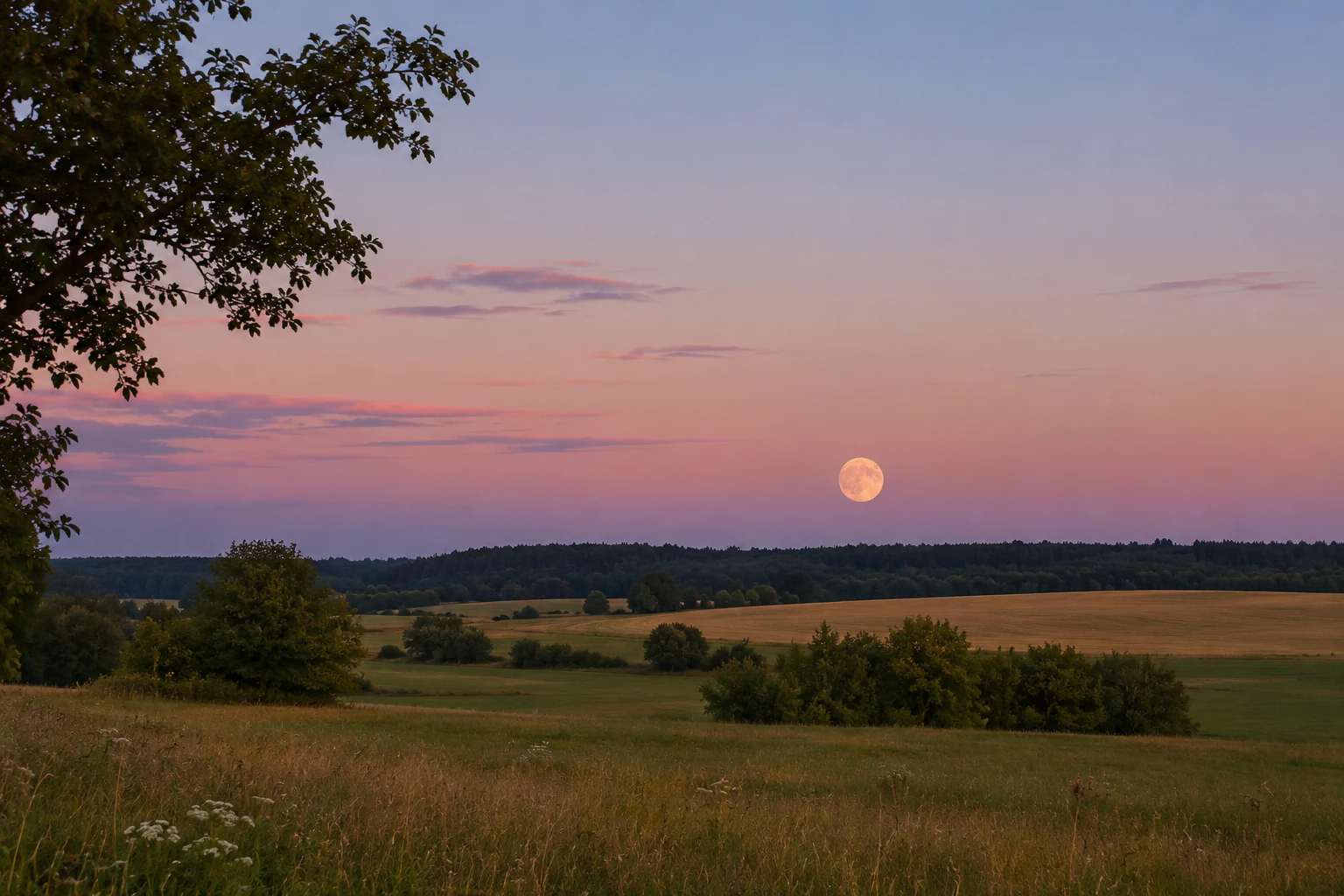
A low Moon can dominate a landscape even when its image is almost the same angular width as it will be later that night. The striking mismatch between measurement and perception is called the Moon illusion.
Why does the Moon look bigger near the horizon? The apparent enlargement is a perceptual illusion. It is not caused by the atmosphere magnifying the lunar disc or by the Moon suddenly moving closer at moonrise. Visual context and size–distance processing feature in proposed explanations, but there is no single fully agreed account of the natural illusion. [3]
Separate the Moon’s diameter from its perceived size
The Moon has a physical diameter. It also occupies an angle in the sky, determined mainly by its diameter and distance. Perceived size is a third concept: the impression a viewer experiences. Confusing those quantities makes the illusion hard to discuss clearly.
NASA’s account points out that a low Moon and a high Moon can have essentially the same width in photographs made at the same scale, despite looking dramatically different to an observer. The visual impression is real as an experience, but it is not an equivalent change in the angular diameter. [1]
Calling something an illusion does not dismiss what people see. It identifies a disagreement between a perceptual judgement and a physical measurement, creating a question that can be investigated.
A camera comparison tests the enlargement
NASA describes a straightforward comparison: photograph the Moon near the horizon and again higher in the sky on the same night, using the same imaging system. Compare the horizontal diameter of the lunar disc while preserving the image scale. Changing zoom, cropping or resizing one photograph would defeat the comparison. [2]
The measured horizontal widths will be very similar. A small difference can arise because Earth’s rotation changes the observer’s distance to the Moon. The low disc may also be vertically flattened by atmospheric refraction. Neither effect supplies the dramatic enlargement suggested by the illusion.
The strength of this test is that it separates a repeatable image measurement from a remembered impression. Memory of how large the Moon seemed is not being asked to do the same job as a comparison of pixel widths.
Why the atmosphere is not a magnifying glass here
Air does bend light, and atmospheric effects can change the Moon’s outline near the horizon. But that does not mean a thicker path through the atmosphere makes the entire disc much wider. NASA’s scientist explanation specifically rejects atmospheric magnification as the cause of the illusion.
It also notes that the horizon Moon is not closer to the observer in the way a simple enlargement story would require. The geometry of observing from Earth places it slightly farther away near the horizon than when it is high overhead under comparable circumstances. [3]
The important distinction is between a genuine optical effect on the image and a perceptual effect on how large the image seems. Both can occur in one view without having the same cause.
One explanation centres on distance cues
On the ground, visual context helps us interpret size. A distant object can cast a small image while still being understood as physically large. The perceptual system uses information about depth and the surrounding scene rather than treating angular width as the only relevant signal.
In experiments reported by Kaufman and Kaufman, artificial moons and controlled depth cues were used to investigate competing explanations. Their results supported an account in which the visual system treats the horizon Moon as being at a greater effective distance and therefore as larger. [4]
That is a research result supporting a particular explanation, not proof that a person consciously calculates the Moon’s distance. The relevant processing can operate without an explicit estimate in kilometres. It is also not a complete demonstration that the same cue determines every natural view of the Moon.
Another experimental approach changes the scene
Researchers have also tested size-scaling and relative-size accounts using pictorial scenes. In one study, participants reproduced the size of a depicted Moon while the surrounding scene suggested a floor-like or an inverted ceiling-like depth arrangement.
The illusion reversed under the inverted condition in a way consistent with size-constancy scaling. The authors discussed how that result related to the natural Moon illusion. Such experiments let researchers change a visual cue while holding other parts of the display more stable. [5]
The advantage of a controlled image is also a limitation: it is a controlled image. A laboratory result helps distinguish predictions, but a flat display is not automatically equivalent to standing outdoors beneath a vast sky. Good explanations have to connect the test conditions with the phenomenon they aim to explain.
Why the question is still open
Showing that the disc is not strongly enlarged does not, by itself, identify a complete perceptual mechanism. Competing accounts can agree on the camera measurement while proposing different reasons for the experience.
A useful way to assess a hypothesis is to ask what else it predicts. Would the effect weaken if context were reduced? Should changing depth cues reverse it? Does it explain variation between scenes? Those questions turn a plausible story into something that can be tested.
The distinction between observation and explanation matters here. The illusion is well established. A universally accepted explanation is a stronger claim. Presenting one popular distance-cue account as settled fact would erase that distinction.
A supermoon is a different size effect
The Moon’s orbit is not a perfect circle, so its distance from Earth changes. A closer Moon has a genuinely larger angular diameter than a farther one. NASA describes a supermoon as a full Moon occurring near its closest orbital approach, or perigee.
Compared with a full Moon near apogee, the farthest part of the orbit, a full Moon near the closest extreme can appear up to about 14 percent wider. The exact comparison depends on the particular distances involved. This is a measurable orbital difference, separate from the horizon illusion. [6]
The two can coincide: a near-perigee full Moon can rise over a horizon. That does not make them the same phenomenon. One changes the physical viewing geometry; the other changes the impression produced by a scene.
Why some photographs show an enormous Moon
A long-lens photograph can frame the Moon with distant landscape features so that the disc appears imposing beside them. NASA notes that such photographs are zoomed views, not evidence that the atmosphere greatly enlarged the Moon. Image scale and the chosen foreground matter. [1]
For a scientific comparison, the same scale has to be maintained. For an expressive landscape photograph, a photographer may deliberately choose a narrow field of view. Those are different purposes, and a dramatic composition should not be mistaken for an angular-size experiment.
Frequently asked questions
Does the Moon physically grow as it rises?
No. The horizon illusion concerns perceived size, not a changing physical diameter.
Does the atmosphere cause the large apparent width?
No. Refraction can flatten the low disc, but it does not explain the dramatic perceived enlargement.
Is every large-looking Moon a supermoon?
No. The horizon illusion can occur without the Moon being especially close to Earth.
Has science completely explained the illusion?
No single account has universal agreement. Researchers can test specific proposals while distinguishing that uncertainty from the well-established illusion itself.
Keep exploring
Sources and further reading
- NASA Science — The Moon illusion
- NASA Science — Photographing the Moon illusion
- NASA — Why the Moon looks larger at the horizon: scientist explanation
- Kaufman and Kaufman (2000) — Explaining the Moon illusion; research paper
- Research study — A test of size-scaling and relative-size hypotheses; abstract
- NASA Science — Supermoons and real orbital size differences
Reference review: November 11, 2026.
Keep exploring.
One remarkable idea at a time—nature, science, history and beyond.
Last updated November 12, 2026.

Barnakle Editorial Team
Barnakle Editorial Team is the collective byline used for Barnakle’s editorial articles. The contributor profile explains the team identity and links to the publication’s editorial policies.
More from the editorial team →