Atmospheric turbulence turns steady starlight into a moving speckle pattern
The short answer
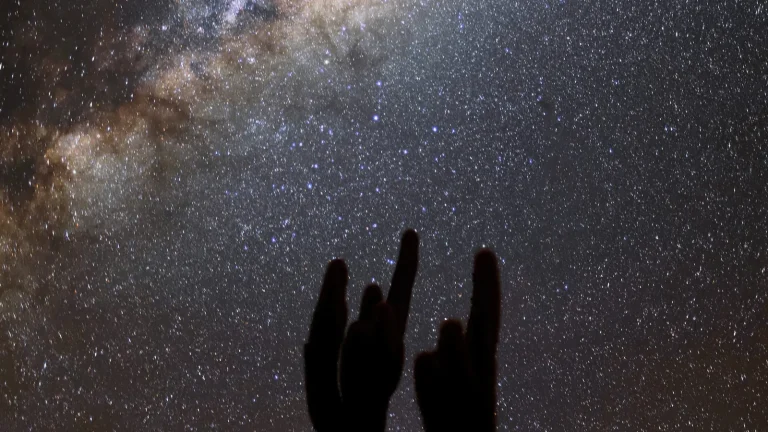
Stars twinkle because their light crosses turbulent layers of Earth’s atmosphere whose temperature and density are constantly changing. Those moving pockets bend the light by slightly different amounts, shifting its apparent position and brightness many times each second. Stars are so distant that they appear point-like, so the distortion is conspicuous; planets usually look steadier because their tiny disks average many distorted rays together.
A star does not normally brighten and dim at the rapid pace seen from the ground. The flicker is created much closer to the observer, in kilometres of restless air above Earth. Astronomers call the effect scintillation. It is related to the shimmering seen above hot pavement, but a star provides an exceptionally sensitive probe because it arrives as an unresolved point of light from an immense distance.
Starlight reaches the atmosphere as an almost plane wave
Light from a distant star has travelled so far that the wavefront arriving at Earth is nearly flat across a telescope or human pupil. In empty space its path would remain stable, apart from changes intrinsic to the star that occur on very different timescales.
The point-like source is crucial. A small change in direction or focus affects nearly all the light seen at once, so atmospheric distortions are not averaged away before reaching the eye.
For evidence about starlight reaches the atmosphere as an almost plane wave within why stars twinkle, the useful test is to separate direct observation from interpretation. Researchers compare repeated measurements, control relevant conditions and ask whether a competing explanation predicts a different result. That approach matters because a familiar experience can still have several interacting causes. The strongest conclusion is the one that fits the mechanism, timing and limits of the available evidence without claiming more precision than the study can support.
The evidence behind “starlight reaches the atmosphere as an almost plane wave” has limits. Scale, variation and observation method can change what is visible, so recording those conditions is essential for reproduction and comparison.
Air has a refractive index
The speed and direction of light depend slightly on the optical density of the medium through which it travels. Air’s refractive index is close to one, but it changes with temperature, pressure, humidity and wavelength. Boundaries between parcels therefore bend incoming starlight by small and changing angles.
No single layer acts like a perfect lens. The atmosphere contains a stack of irregular cells, and their effects accumulate. A ray can be deflected repeatedly before entering the eye or telescope.
For evidence about air has a refractive index within why stars twinkle, the useful test is to separate direct observation from interpretation. Researchers compare repeated measurements, control relevant conditions and ask whether a competing explanation predicts a different result. That approach matters because a familiar experience can still have several interacting causes. The strongest conclusion is the one that fits the mechanism, timing and limits of the available evidence without claiming more precision than the study can support.
The evidence behind “air has a refractive index” has limits. Scale, variation and observation method can change what is visible, so recording those conditions is essential for reproduction and comparison.
Turbulence keeps the optical path moving
Convection, wind shear and airflow over terrain mix parcels of different temperature and density. The sizes of turbulent eddies range from large weather structures to centimetre-scale variations. As those eddies cross the line of sight, the phase of the incoming light changes across the observing aperture.
The rapid evolution creates a moving speckle pattern rather than one stationary blurred dot. The eye integrates part of that pattern and perceives fluctuations in brightness, colour and position.
For evidence about turbulence keeps the optical path moving within why stars twinkle, the useful test is to separate direct observation from interpretation. Researchers compare repeated measurements, control relevant conditions and ask whether a competing explanation predicts a different result. That approach matters because a familiar experience can still have several interacting causes. The strongest conclusion is the one that fits the mechanism, timing and limits of the available evidence without claiming more precision than the study can support.
The evidence behind “turbulence keeps the optical path moving” has limits. Scale, variation and observation method can change what is visible, so recording those conditions is essential for reproduction and comparison.
Scintillation includes brightness and position changes
A twinkling star may appear to jump, swell, fade or flash colours. Focusing and defocusing change intensity, while wavefront tilt moves the apparent centroid. Wavelength-dependent refraction can briefly separate colours, especially when the star is low.
The categories are linked but not identical. Astronomers distinguish scintillation from seeing, the broader loss of sharpness produced by atmospheric wavefront distortion during an exposure.
For evidence about scintillation includes brightness and position changes within why stars twinkle, the useful test is to separate direct observation from interpretation. Researchers compare repeated measurements, control relevant conditions and ask whether a competing explanation predicts a different result. That approach matters because a familiar experience can still have several interacting causes. The strongest conclusion is the one that fits the mechanism, timing and limits of the available evidence without claiming more precision than the study can support.
The evidence behind “scintillation includes brightness and position changes” has limits. Scale, variation and observation method can change what is visible, so recording those conditions is essential for reproduction and comparison.
Stars near the horizon twinkle more
A low star is viewed through a much longer slant path in the atmosphere than a star overhead. Its light also crosses more near-surface turbulence and stronger gradients. For the same reason, refraction changes the apparent altitude of objects most strongly near the horizon.
The longer path offers more opportunities for independent disturbances. This is why Sirius can flash vivid colours on a winter horizon while the same star appears steadier after climbing higher.
For evidence about stars near the horizon twinkle more within why stars twinkle, the useful test is to separate direct observation from interpretation. Researchers compare repeated measurements, control relevant conditions and ask whether a competing explanation predicts a different result. That approach matters because a familiar experience can still have several interacting causes. The strongest conclusion is the one that fits the mechanism, timing and limits of the available evidence without claiming more precision than the study can support.
The evidence behind “stars near the horizon twinkle more” has limits. Scale, variation and observation method can change what is visible, so recording those conditions is essential for reproduction and comparison.
Planets usually look steadier
Even though planets appear tiny, a telescope can treat them as disks rather than mathematical points. Light from different parts of the disk passes through slightly different atmospheric paths. Brightening in one part can be balanced by dimming in another when the signals are combined.
A planet can still shimmer near the horizon or in exceptionally poor seeing. The difference is statistical averaging, not immunity from refraction. Very small apparent disks and small observing apertures reduce that averaging.
For evidence about planets usually look steadier within why stars twinkle, the useful test is to separate direct observation from interpretation. Researchers compare repeated measurements, control relevant conditions and ask whether a competing explanation predicts a different result. That approach matters because a familiar experience can still have several interacting causes. The strongest conclusion is the one that fits the mechanism, timing and limits of the available evidence without claiming more precision than the study can support.
The evidence behind “planets usually look steadier” has limits. Scale, variation and observation method can change what is visible, so recording those conditions is essential for reproduction and comparison.
Colour flashes are atmospheric
Blue light is refracted more strongly than red light. Turbulence can direct one colour toward the observer while another is momentarily displaced. The effect becomes dramatic for bright stars near the horizon, where atmospheric dispersion is already strong.
The flashes do not mean the star is changing surface temperature each second. Spectra and space-based observations show that the fast colour variation is imposed along the terrestrial path.
For evidence about colour flashes are atmospheric within why stars twinkle, the useful test is to separate direct observation from interpretation. Researchers compare repeated measurements, control relevant conditions and ask whether a competing explanation predicts a different result. That approach matters because a familiar experience can still have several interacting causes. The strongest conclusion is the one that fits the mechanism, timing and limits of the available evidence without claiming more precision than the study can support.
The evidence behind “colour flashes are atmospheric” has limits. Scale, variation and observation method can change what is visible, so recording those conditions is essential for reproduction and comparison.
A telescope reveals speckles and blur
Short exposures can freeze multiple bright speckles inside the atmospheric seeing disk. Longer exposures average them into a blurred spot. The characteristic coherence length, often represented by the Fried parameter, describes the aperture scale over which the wavefront remains approximately ordered.
When a telescope diameter exceeds that coherence scale, simply building a larger mirror does not automatically sharpen a ground-based image. Correction or exceptionally stable air is needed to recover the mirror’s theoretical resolution.
For evidence about a telescope reveals speckles and blur within why stars twinkle, the useful test is to separate direct observation from interpretation. Researchers compare repeated measurements, control relevant conditions and ask whether a competing explanation predicts a different result. That approach matters because a familiar experience can still have several interacting causes. The strongest conclusion is the one that fits the mechanism, timing and limits of the available evidence without claiming more precision than the study can support.
The evidence behind “a telescope reveals speckles and blur” has limits. Scale, variation and observation method can change what is visible, so recording those conditions is essential for reproduction and comparison.
Adaptive optics measures and corrects distortion
Modern observatories use a bright guide star or an artificial laser guide star to measure wavefront errors many times per second. A deformable mirror changes shape in response, cancelling much of the atmospheric distortion before the light reaches the science camera.
Correction works best over a limited patch of sky because neighbouring lines of sight do not cross exactly the same turbulence. Multiple guide stars and tomographic methods estimate a three-dimensional profile to widen the useful field.
For evidence about adaptive optics measures and corrects distortion within why stars twinkle, the useful test is to separate direct observation from interpretation. Researchers compare repeated measurements, control relevant conditions and ask whether a competing explanation predicts a different result. That approach matters because a familiar experience can still have several interacting causes. The strongest conclusion is the one that fits the mechanism, timing and limits of the available evidence without claiming more precision than the study can support.
The evidence behind “adaptive optics measures and corrects distortion” has limits. Scale, variation and observation method can change what is visible, so recording those conditions is essential for reproduction and comparison.
Observatory sites are chosen for steady air
High, dry locations reduce water vapour and place telescopes above part of the atmosphere. Smooth airflow, low cloud cover and a stable temperature profile can produce excellent seeing. Mountains are not automatically good: rough terrain can generate local turbulence around a dome.
Site testing measures more than darkness. Astronomers monitor seeing, wind, humidity, cloud, sky brightness and the vertical distribution of turbulence over many seasons before committing to a major facility.
For evidence about observatory sites are chosen for steady air within why stars twinkle, the useful test is to separate direct observation from interpretation. Researchers compare repeated measurements, control relevant conditions and ask whether a competing explanation predicts a different result. That approach matters because a familiar experience can still have several interacting causes. The strongest conclusion is the one that fits the mechanism, timing and limits of the available evidence without claiming more precision than the study can support.
The evidence behind “observatory sites are chosen for steady air” has limits. Scale, variation and observation method can change what is visible, so recording those conditions is essential for reproduction and comparison.
Space telescopes avoid atmospheric twinkling
Above the atmosphere, a telescope receives a steadier wavefront and can reach diffraction-limited performance without adaptive optics. Space also opens ultraviolet, X-ray and much infrared radiation that air absorbs.
Spaceflight introduces other constraints—mirror size, launch vibration, thermal control and servicing—but removing the atmosphere is why Hubble images can be so stable and sharp.
For evidence about space telescopes avoid atmospheric twinkling within why stars twinkle, the useful test is to separate direct observation from interpretation. Researchers compare repeated measurements, control relevant conditions and ask whether a competing explanation predicts a different result. That approach matters because a familiar experience can still have several interacting causes. The strongest conclusion is the one that fits the mechanism, timing and limits of the available evidence without claiming more precision than the study can support.
The evidence behind “space telescopes avoid atmospheric twinkling” has limits. Scale, variation and observation method can change what is visible, so recording those conditions is essential for reproduction and comparison.
Twinkling is useful information too
Scintillation can reveal atmospheric turbulence, and related intensity variations are measured in remote sensing and communications. Astronomers also exploit rapid changes in starlight during occultations to probe planetary atmospheres or small Solar System bodies.
An effect that degrades one measurement can become the signal in another. The key is a model that connects the observed fluctuation to the intervening medium.
For evidence about twinkling is useful information too within why stars twinkle, the useful test is to separate direct observation from interpretation. Researchers compare repeated measurements, control relevant conditions and ask whether a competing explanation predicts a different result. That approach matters because a familiar experience can still have several interacting causes. The strongest conclusion is the one that fits the mechanism, timing and limits of the available evidence without claiming more precision than the study can support.
The evidence behind “twinkling is useful information too” has limits. Scale, variation and observation method can change what is visible, so recording those conditions is essential for reproduction and comparison.
Common misconceptions
A star does not twinkle because it is burning unevenly like a candle. Nuclear and convective processes can make stars genuinely variable, but those changes have characteristic periods and are measured above the atmosphere as well. Ordinary second-to-second flicker is atmospheric. Planets do not completely avoid the effect; their extended disks simply average it more effectively.
Simple explanations are valuable when they preserve the causal chain. They become misleading when they turn a tendency into an absolute rule, confuse correlation with mechanism or extend a laboratory finding beyond the conditions actually tested. In this case, context changes the strength of the effect but does not erase the underlying physical or biological process.
How scientists know
Astronomers use fast cameras, wavefront sensors, scintillometers and turbulence profilers. They compare simultaneous observations from different apertures and heights, measure image motion and test corrections with adaptive-optics systems. Space telescopes provide the decisive control case because the same celestial source is observed without the turbulent path.
No single measurement carries the entire argument. Agreement among anatomy, experiments, field observations and quantitative models is more persuasive because each method fails in a different way. Disagreement is useful too: it can identify an uncontrolled variable, a sampling problem or a mechanism that needs revision.
Frequently asked questions
Why does Sirius twinkle so much?
Sirius is extremely bright and is often viewed low in northern winter skies. Its long atmospheric path makes position, brightness and colour fluctuations easy to notice.
Do stars twinkle in space?
Not because of Earth’s atmosphere. A star can vary intrinsically, and interstellar material can affect its light, but astronauts above the atmosphere do not see ordinary atmospheric scintillation.
Why do planets sometimes twinkle?
Near the horizon or in very turbulent air, even an extended planetary disk can fluctuate. It usually remains steadier than a nearby star.
Does humidity cause twinkling?
Humidity affects refractive index, but temperature and density turbulence across the whole path are central. A humid night is not automatically a strongly twinkling night.
Can twinkling predict weather?
It can reveal turbulent air, yet folk rules linking a particular appearance to a specific forecast are unreliable without meteorological measurements.
Key takeaways
- Twinkling is rapid atmospheric refraction and interference, not rapid stellar change.
- Point-like stars reveal distortion more strongly than the small disks of planets.
- Low-altitude stars twinkle more because their light crosses a longer, rougher path.
- Adaptive optics and space telescopes reduce or remove the atmospheric effect.
Continue exploring
Sources and further reading
Keep exploring.
One remarkable idea at a time—nature, science, history and beyond.
Sources and further reading
Barnakle uses credible primary and authoritative sources wherever possible.
- NASA — Why stars twinkle
- https://science.nasa.gov/image-article/apod-2000-july-25-why-stars-twinkle/
- NASA — Why have a telescope in space?
- https://science.nasa.gov/mission/hubble/overview/why-have-a-telescope-in-space/
- NASA Hubble Glossary — Atmospheric distortion
- https://science.nasa.gov/mission/hubble/multimedia/hubble-glossary/
- NASA — Firing lasers to tame the sky
- https://science.nasa.gov/image-article/apod-2021-february-10-firing-lasers-to-tame-the-sky/
- NASA — Star field in the constellation Cepheus
- https://science.nasa.gov/photojournal/star-field-in-the-constellation-cepheus/
Last reviewed October 3, 2026.

Barnakle Editorial Team
A member of the Barnakle editorial team, exploring remarkable ideas with clarity, curiosity and care.
More from this author →