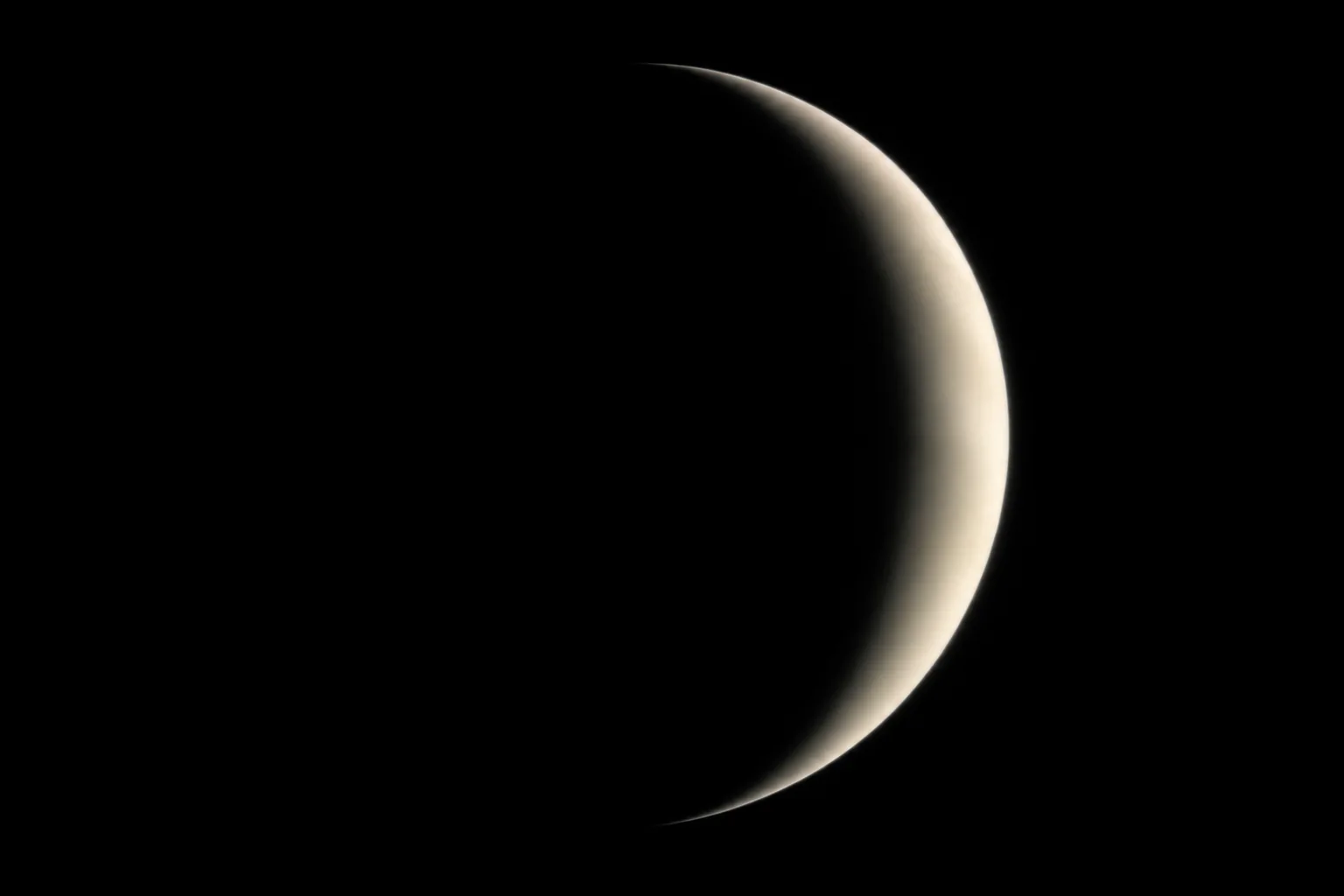
Sketch Venus several times through a telescope at the same magnification, and a curious pair of drawings can emerge. In one, Venus looks like a small, almost round bead. In another, a delicate crescent sweeps around the edge of a much larger circle. The planet has the same physical diameter on both occasions. What changes is how far away it is and how much of its sunlit hemisphere faces Earth.[1, 2]
Venus orbits the Sun inside Earth’s orbit. When it is on the far side of the Sun, much of the daylight side faces us across a long stretch of space. When it swings around to the near side, we see a larger disk because the planet is closer, but most of the hemisphere facing us is dark. The result is a wider apparent outline with a thinner region of reflected light.[1, 2]
Two ways to measure the same crescent
Look at a drawing of a crescent and imagine completing its outer curve with a compass. The diameter of that circle measures the apparent width of the planet. A different measurement would tell you the fraction of the circle occupied by bright material. A circle wide enough to cover a large coin can have a narrow illuminated sliver. A circle that fits on a shirt button can be almost entirely illuminated.
Distance explains the first measurement. For a small object far from the eye, doubling its distance roughly halves the angle its diameter spans. A ten-centimetre ball seen from ten metres away looks about half as wide as the same ball seen from five metres. Its true diameter needs to be measured only once. The difference in apparent size lies in the angles that the edges of the ball make at your eye.
Apply that reasoning to two hypothetical photographs of Venus made with the same equipment. If the reconstructed disk in one spans twice as many pixels across, the planet was about half as far away, provided that the pictures have the same image scale. Cropping each image tightly and resizing both to fill the same square removes that distance clue. Such pictures can still show the phase beautifully while concealing the size difference.[2]
Walk around the orbit on paper
Draw the Sun at the centre of a page and two circles around it. Put Earth near the bottom of the outer circle. Place Venus near the top of the inner one. On Venus, shade the half facing away from the Sun. Now look along the imaginary line from Venus toward Earth. From this direction you can see almost all of the bright half. There is also a considerable gap between the two planets on the page.[1]
Move the Venus marker around to the bottom of its circle, a little to the side so the directions are easy to see. Once again shade the half facing away from the Sun. That shaded half now faces roughly toward Earth. The line between the planets has shortened and only a curved slice of the lit half is visible. There was no need to turn the Sun down, cover it with another object or alter the planet’s size.[1]
At an intermediate point, draw two lines starting at Venus, one to the Sun and one to Earth. When the lines meet at a right angle, Earth sees the day side from the side. Roughly half the visible disk is lit. Notice where the corner of that right angle sits. It is at Venus. The angle an observer measures between Venus and the Sun in Earth’s sky has its corner at Earth. Moving the corner changes which angle the drawing represents.[1]
Why the narrowest and roundest phases are difficult to see
At one end of the sequence Venus passes roughly between Earth and the Sun, an arrangement astronomers call inferior conjunction. At the other end the Sun lies roughly between Earth and Venus, at superior conjunction. Both arrangements put the planet near the Sun in our sky. Glare interferes with an ordinary view of the extreme phases, even though a diagram on a page shows the geometry clearly.[1, 2]
The easiest mental mistake is to bring over the Moon’s timetable. A full Moon appears opposite the Sun in the sky, making its bright face conspicuous at night. A nearly full Venus is across the Sun from Earth and therefore appears in roughly the same direction as the Sun. The Moon orbits Earth while Venus travels on an orbit inside ours. The same words for the fraction illuminated describe quite different places to look.[1]
Nor does a fuller disk automatically mean a brighter point of light to the unaided eye. How much sunlit area we see matters, but so does the apparent area of the whole planet. Double a disk’s apparent diameter and its area in the image grows about fourfold. A smaller fraction of a much larger disk can occupy more sky than a larger fraction of a small disk. Venus can consequently appear especially bright during a crescent phase.[2]
The observation that challenged an old map of the sky
In 1610 Galileo began tracking Venus with a telescope. The changing outline supplied an observational test of competing arrangements of the planets. In the traditional Ptolemaic arrangement, Venus remained on the near side of the Sun. From Earth that geometry could produce a crescent, but it could not account for a Venus that also showed a broad gibbous face. More than one sketch was needed to make the contrast plain.[2, 3, 4]
There is an important historical wrinkle. Tycho Brahe’s system kept Earth stationary while letting Venus circle the Sun. That arrangement could also produce the observed phases. Galileo had acquired powerful evidence about the position of Venus relative to sunlight. Establishing the motion of Earth itself required evidence that could distinguish between models sharing that particular arrangement.[3]
The next time you see a sequence of Venus images, look for a common scale bar. First compare the diameter suggested by each outer arc. Then compare the fraction inside the arc that is bright. One observation carries information about distance, the other about viewing direction. Both pieces were available to an astronomer with a modest telescope, a pencil and enough evenings to watch the geometry change.
Keep exploring
Compare the Moon’s changing phase, then look beneath Venus’s bright cloud cover to learn why the planet is so hot.
Sources and further reading
- NASA Science — Basics of Space Flight, the Solar System
- Royal Belgian Institute for Space Aeronomy — The phases of Venus
- Museo Galileo — Phases of Venus
- NASA Science — Galileo’s Phases of Venus and Other Planets
Keep exploring.
One remarkable idea at a time—nature, science, history and beyond.
Last updated November 19, 2026.

Barnakle Editorial Team
Barnakle Editorial Team is the collective byline used for Barnakle’s editorial articles. The contributor profile explains the team identity and links to the publication’s editorial policies.
More from the editorial team →