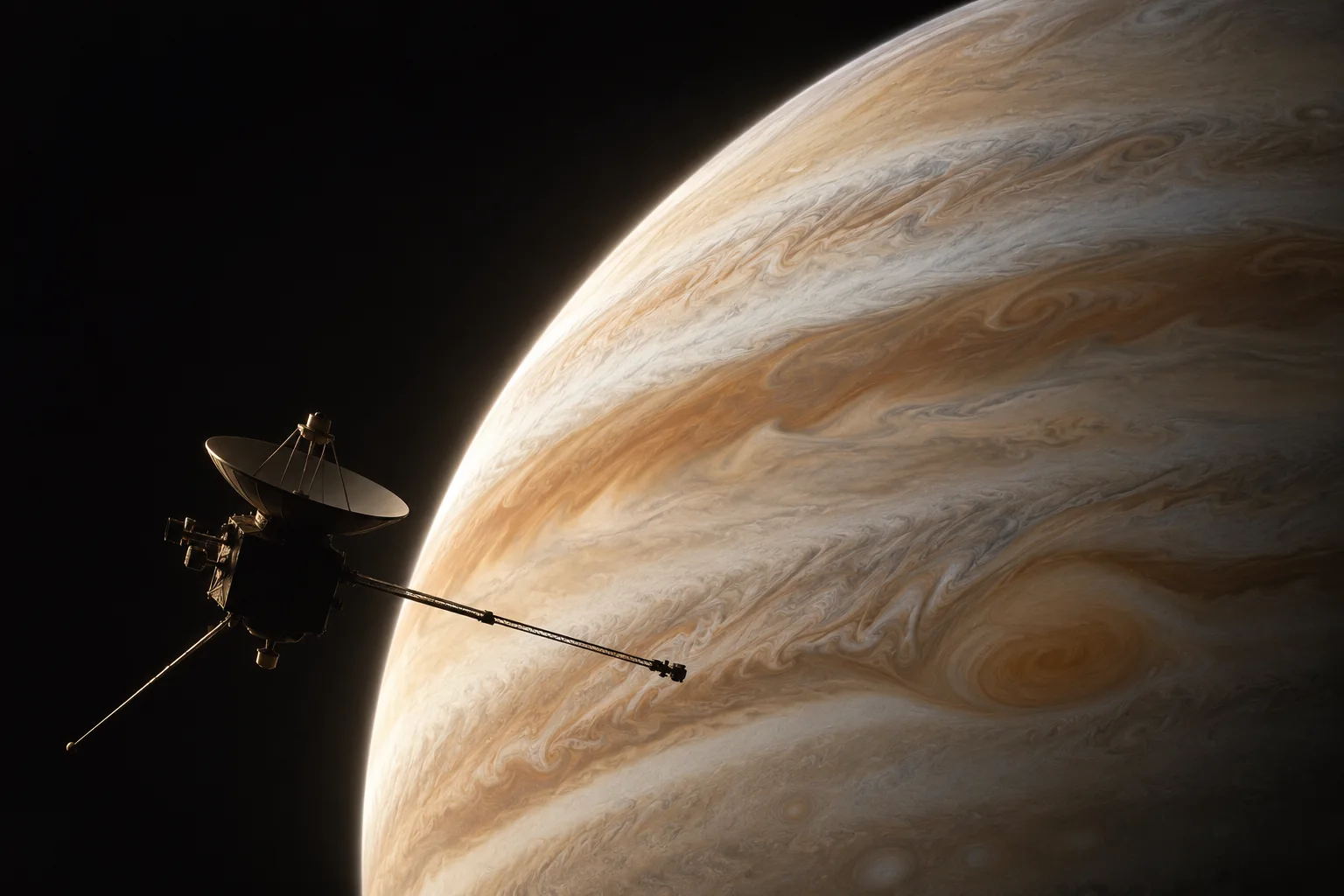
Here is an apparent contradiction in the flight log of a spacecraft. It approaches a planet, falls faster as gravity pulls it inward, rounds the planet and slows on the way out. Far from the planet again, it has regained its original speed relative to that world. Yet mission controllers can report a lasting gain in speed around the Sun. What did the spacecraft gain if the inward fall and outward climb cancelled?[1, 2]
The missing piece is that the planet is moving. A gravity assist turns the spacecraft’s velocity relative to the planet. To obtain the velocity relative to the Sun, add the planet’s own orbital velocity. Turning one arrow before adding it to the other can produce a longer or shorter result. The planet and spacecraft exchange orbital energy, and the much lighter spacecraft experiences by far the more noticeable change.[1, 2, 3]
Ride along with the planet first
Imagine drawing a map that follows the planet through space during the encounter. On this map the incoming spacecraft approaches along one direction, curves around the planet and departs along another. For an ideal unpowered pass, with the planet’s gravity dominating the close encounter, the spacecraft’s speed on the way out equals its speed on the way in when compared at equal distances from the planet. It reaches its highest relative speed near closest approach.[1, 2]
The inward half converts gravitational potential energy into motion. The outward half converts that gain back as the spacecraft climbs away. Gravity has nevertheless accomplished something permanent on this map. The outgoing velocity points in a different direction. A straight line drawn along the departing path would lead somewhere entirely different from the one drawn along the approach. An equal speed is compatible with a very different journey.[1]
There is an easy trap in choosing the two points for comparison. Compare a reading from a distant approach with a reading taken just after closest passage, and you will find a large speed gain even on the moving planet’s map. Some of that gain will disappear during the climb. Referring to the incoming and outgoing speeds far from the encounter avoids including a temporary gain that would occur during an ordinary fall past a stationary mass.
Now draw the same two arrows on the Sun’s map
For a simple numerical example, imagine that a planet moves east at 10 kilometres per second relative to the Sun. A small probe comes in moving north at 5 kilometres per second relative to the planet. To the solar observer its incoming motion has two parts, 10 east and 5 north. The total speed is the diagonal of a right triangle, about 11.2 kilometres per second.
Suppose the encounter turns the probe’s relative velocity through a right angle so that it departs moving east at 5 kilometres per second on the planet’s map. Now its two solar-frame contributions point the same way. The result is 15 kilometres per second east. Both planet-relative arrows still measure five units long. The solar-frame speed increased because the turn lined up the outgoing arrow with the planet’s orbital motion.[1, 3]
Reverse the sense of the turn in this deliberately simplified example. If the outgoing arrow points west at 5 kilometres per second relative to the planet, the solar-frame result is 5 kilometres per second east. The encounter has removed orbital speed from the probe. The numbers illustrate vector addition. An actual mission must work with the turn angles that its approach speed, closest distance and the available planet can physically provide.[1, 3]
Where the extra energy comes from
The probe pulls on the planet while the planet pulls on the probe. Momentum and energy are accounted for across the whole system. When the spacecraft gains orbital energy around the Sun during an assist, the planet gives up a corresponding amount. A planet has so much more mass that the change in its orbital motion is tiny. A small change to a massive body can balance a much more conspicuous change to a light one.[2]
At roughly the same distance from the Sun on the two sides of the brief encounter, a spacecraft with a higher solar-frame speed also has more orbital energy per unit mass. Its new path can carry it farther outward. An encounter configured to remove energy can lower part of an orbit. Direction matters along with energy. Mission planners can use a turn to reshape or tilt an orbit to reach a particular location at a particular time.[1, 2, 3]
That final condition is easy to miss on a static map. The path after an assist must intersect the next destination when the destination is actually there. A large change in speed that sends the spacecraft to an empty part of the orbit a month too late has little value. A smaller turn that adjusts the arrival date and direction can be worth far more propellant than its modest appearance on a diagram suggests.[1, 3]
A moon can provide the assist too
During Cassini’s tour, the moon Titan served as the moving body and Saturn as the centre of the larger orbit. Replace the Sun with Saturn and the planet with Titan in the earlier two-map picture. A pass by Titan turned Cassini’s velocity in the moon’s frame and changed Cassini’s orbit about Saturn. NASA gives roughly 800 metres per second as a typical change in spacecraft speed relative to Saturn for a close Titan flyby.[2]
A sequence of encounters gave the mission more than a collection of close photographs. Each new orbit set the terms of later meetings. Imagine the spacecraft returning to Titan along a different slant after a previous pass. It now offers a new incoming arrow for the moon to turn. Successive passes can progressively rearrange a tour in ways that would be costly if the spacecraft had to make every change using its own engine.[2]
Why a mission heading inward might ask for help slowing down
A spacecraft launched from Earth already shares much of Earth’s sideways motion around the Sun. Reaching the neighbourhood of a planet closer to the Sun requires changing that initial orbit. Falling inward can produce considerable speed, which also complicates an eventual rendezvous. ESA’s BepiColombo mission used Venus flybys on its journey toward Mercury. A carefully chosen encounter can remove orbital energy and reshape the approach to the inner solar system.[3, 4]
The most revealing word in a flyby report may be the one after “relative to.” The speed at closest approach, the distant departure speed relative to the planet and the new speed relative to the Sun each describe a real measurement. Read them on their proper maps and the contradiction in the flight log disappears. The spacecraft has come away with an altered orbit because a moving world turned its path.
Keep exploring
Explore other ways gravity shapes a mission, from useful positions for spacecraft to the outer moons they visit.
- How Lagrange Points Hold Spacecraft in Useful Orbits
- The Hidden Oceans Beneath the Solar System’s Icy Moons
Sources and further reading
- NASA Science — Basics of Space Flight, A Gravity Assist Primer
- NASA Science — Cassini Gravity Assists
- European Space Agency — What are gravity assists?
- European Space Agency — BepiColombo flies by Venus en route to Mercury
Keep exploring.
One remarkable idea at a time—nature, science, history and beyond.
Last updated November 19, 2026.

Barnakle Editorial Team
Barnakle Editorial Team is the collective byline used for Barnakle’s editorial articles. The contributor profile explains the team identity and links to the publication’s editorial policies.
More from the editorial team →