On March 10, 1977, astronomers aboard a flying observatory were waiting for a star to go out. Uranus was about to pass in front of it, a rare chance to probe the planet’s atmosphere with light from far beyond the Solar System. The observers had already started recording when the star briefly dimmed ahead of schedule. It recovered, then dipped again. The most interesting part of the night had begun while the planet was still on its way.[1, 2]
After the star emerged from behind Uranus, a corresponding set of short dips appeared on the other side. James Elliot, Edward Dunham and Douglas Mink reported evidence for at least five rings. They had measured light missing from a distant star rather than photographed sunlight reflected from the rings. The difference between those two ways of seeing explains how narrow, dark bands could announce themselves beside a much brighter planet.[1, 2]
The alignment everyone came to see
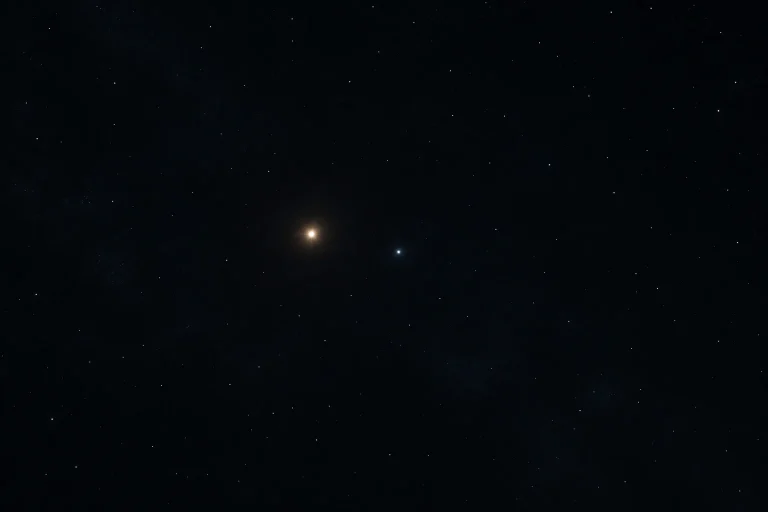
When one celestial object passes in front of another and hides it from a particular observer, astronomers call the event an occultation. The star that night was catalogued as SAO 158687. Its light and light from Uranus had travelled vastly different distances, but for a short time the two directions coincided in our sky. Observers elsewhere on Earth could see a slightly different alignment, just as the view of a distant streetlamp past a nearby post changes when you take a step sideways.[1, 3]
A star seen from Earth supplies something close to a point of light. As the limb of a planet moves across that point, the light can change much faster than the planet’s slow drift across the sky would suggest. A planet with an atmosphere can bend starlight as the line of sight skims different heights of gas. Recording how the brightness changes near disappearance and reappearance can therefore give information about the planet’s outer layers. Knowing the expected time helps, but a prediction is never perfectly exact.[1, 2]
The observing team aboard the Kuiper Airborne Observatory used a 91-centimetre telescope and an instrument that recorded brightness. Because the exact timing and path were uncertain, observers began before the predicted encounter. That margin proved decisive. An instrument switched on just as the planet’s limb reached the star could have captured a good record of the event everyone expected and missed part of the evidence for the discovery now associated with it.[1, 2]
What made the little dips look like rings?
Place a coin on a sheet of paper and draw three larger circles around it. Lay a ruler across the page so that it passes through the coin. Now run a finger along the ruler. You meet the outer circle, the middle circle, the inner circle and then the coin. On the far side the order reverses. If you logged only the moments when your finger touched ink or metal, your record would contain a wide central interruption framed by pairs of short ones.
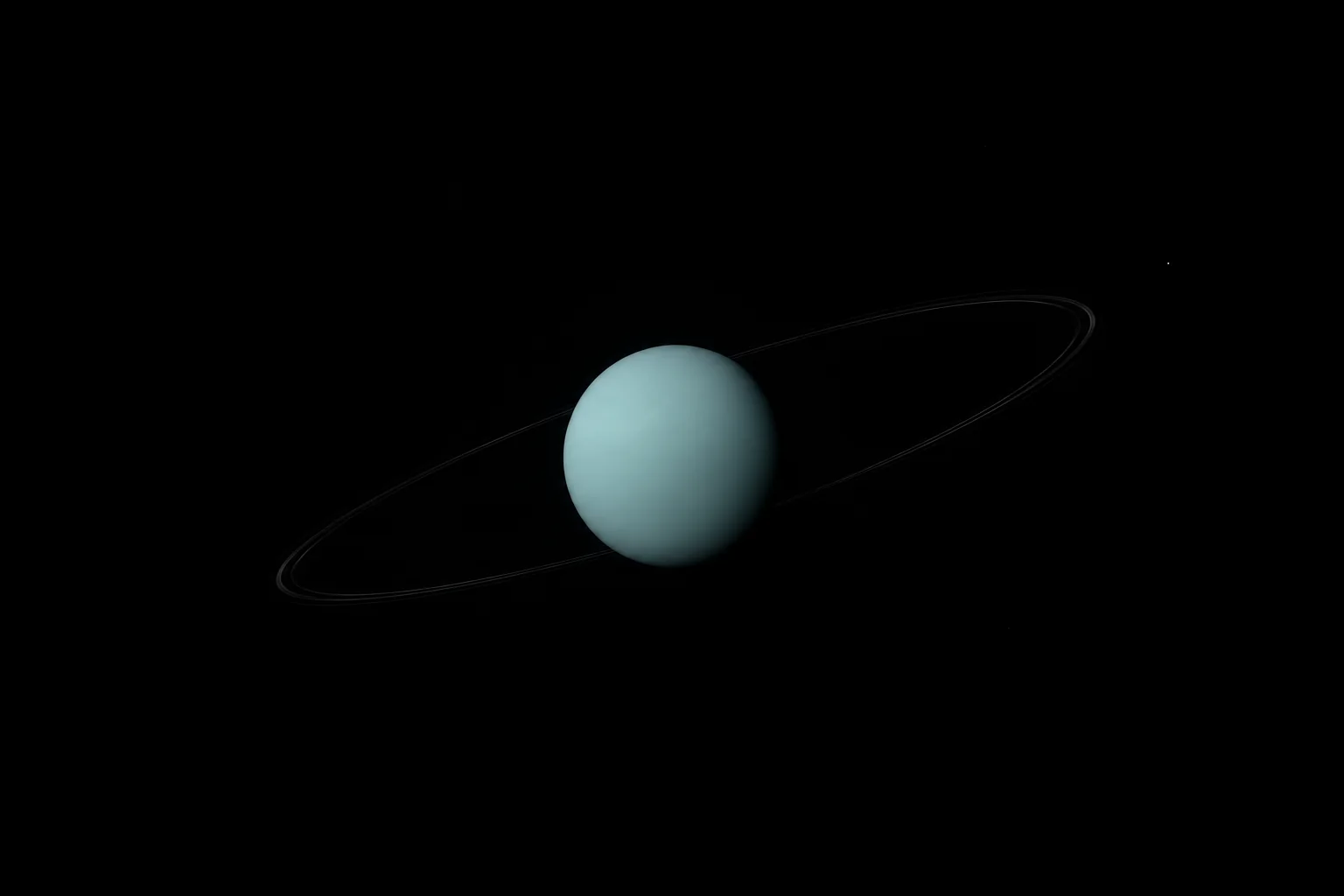
A real ring has width and Uranus presents its ring plane at an angle, so the projected outlines can resemble ellipses. The path need not pass through their exact centre. Even so, narrow bands around a common planet offer a natural reason for brief events to recur in a related sequence on both sides of the main occultation. A single unexplained blink might have been caused by a small satellite. Several paired blinks with a common timing pattern demand considerably more from an explanation involving unrelated moons.[1, 2]
The distinction matters because observers did initially consider satellites. A photometer measures the light that arrives. It cannot label an obstruction as a moon or as a band of orbiting particles. The interpretation comes from the pattern across the full record, including the stretches when the star shone steadily. In the initial report, “at least five” was an important qualification. It counted features supported by that observation, while leaving room for other material the instrument or the particular path could miss.[1, 2]
How a clock measures something too narrow to photograph
Suppose a narrow strip crosses a beam at ten kilometres per second and blocks it for half a second. If the beam crosses straight over the strip, those figures imply five kilometres of material along the track. Let it cross the strip diagonally and the path through the same physical width is longer. Astronomers have to account for that geometry when they translate a measured dip into a ring width. The example uses round numbers to illustrate the calculation, rather than measurements from the 1977 flight.
Another observer can add a different track across the same system. The sky position may differ by a tiny amount, but across the enormous distance to Uranus that can be enough to change what the star crosses. At Perth, an analysis of ground-based data found several brief events consistent with rings even though the planet itself did not occult the star at that observing site. Draw a second ruler line outside your coin but inside some of the circles and the apparent contradiction disappears.[3]
A second track is valuable even if its data look less spectacular than the airborne record. Timings from different locations can help constrain where a band lies and which projected ring shape fits the evidence. Just as importantly, a clouded-out observation cannot supply the same evidence as a clean recording in which no dip appeared. The contemporary report from the ground explicitly describes rain interfering with observations from Mauritius. The weather belongs in the scientific account alongside the timings.[3]
From missing starlight to a family portrait
Voyager 2 flew past Uranus in January 1986. Its visit added two rings to the inventory then known and provided close-up observations of a world that Earth-based astronomers had sampled from afar. Later, Hubble observations revealed two more distant rings, announced in 2005. NASA now lists thirteen. The different totals describe stages of discovery. Five was what the original paired events supported, not a claim that the space beyond those bands was empty.[4, 5]
Direct images and occultations reward different properties. A ring that directs little sunlight back towards us can be hard to pick out beside the planet. Let it pass in front of a bright point and its ability to intercept light becomes an advantage. An image, in turn, can reveal extended structures at many positions at once. A brightness record follows a narrow track with time. The two measurements ask different questions of the same material.[1, 4, 5]
There is a pleasing reversal in that first observation. To study Uranus, the astronomers needed to know when the star was hidden by the planet. To discover its rings, they needed the portions of the record when the star was supposed to be in plain view. Those few unexpected intervals on either side turned a planned atmospheric observation into a map of objects nobody on the aircraft could see directly.
Keep exploring
A solar eclipse makes an alignment visible from Earth. Starlight filtered through an exoplanet’s atmosphere turns another alignment into a measurement.
Sources and further reading
- Elliot, Dunham and Mink — The rings of Uranus, original discovery report
- Physics Today — Contemporary account of the airborne and ground observations
- Nature — Ground observations of the Uranus occultation from Perth and Mauritius
- NASA — Milestones in the exploration of Uranus
- NASA — Uranus and its known rings
Keep exploring.
One remarkable idea at a time—nature, science, history and beyond.
Last updated November 19, 2026.

Barnakle Editorial Team
Barnakle Editorial Team is the collective byline used for Barnakle’s editorial articles. The contributor profile explains the team identity and links to the publication’s editorial policies.
More from the editorial team →