Distance from the Sun is only part of a planet’s temperature
The surprising temperature ranking
Planetary distance sets the sunlight available, not the final surface temperature by itself. Mercury receives far more solar energy per square metre than Venus, yet Venus has the hottest average surface of any planet. The missing variable is what happens to energy after it arrives.
Mercury has almost no insulating atmosphere
Mercury possesses an extremely thin exosphere rather than a substantial atmosphere. Sunlit rock heats intensely, but little gas exists to absorb, circulate and return infrared radiation. After sunset the surface can radiate energy to space efficiently, producing one of the Solar System’s largest day-night temperature ranges.
Venus wears a massive atmosphere
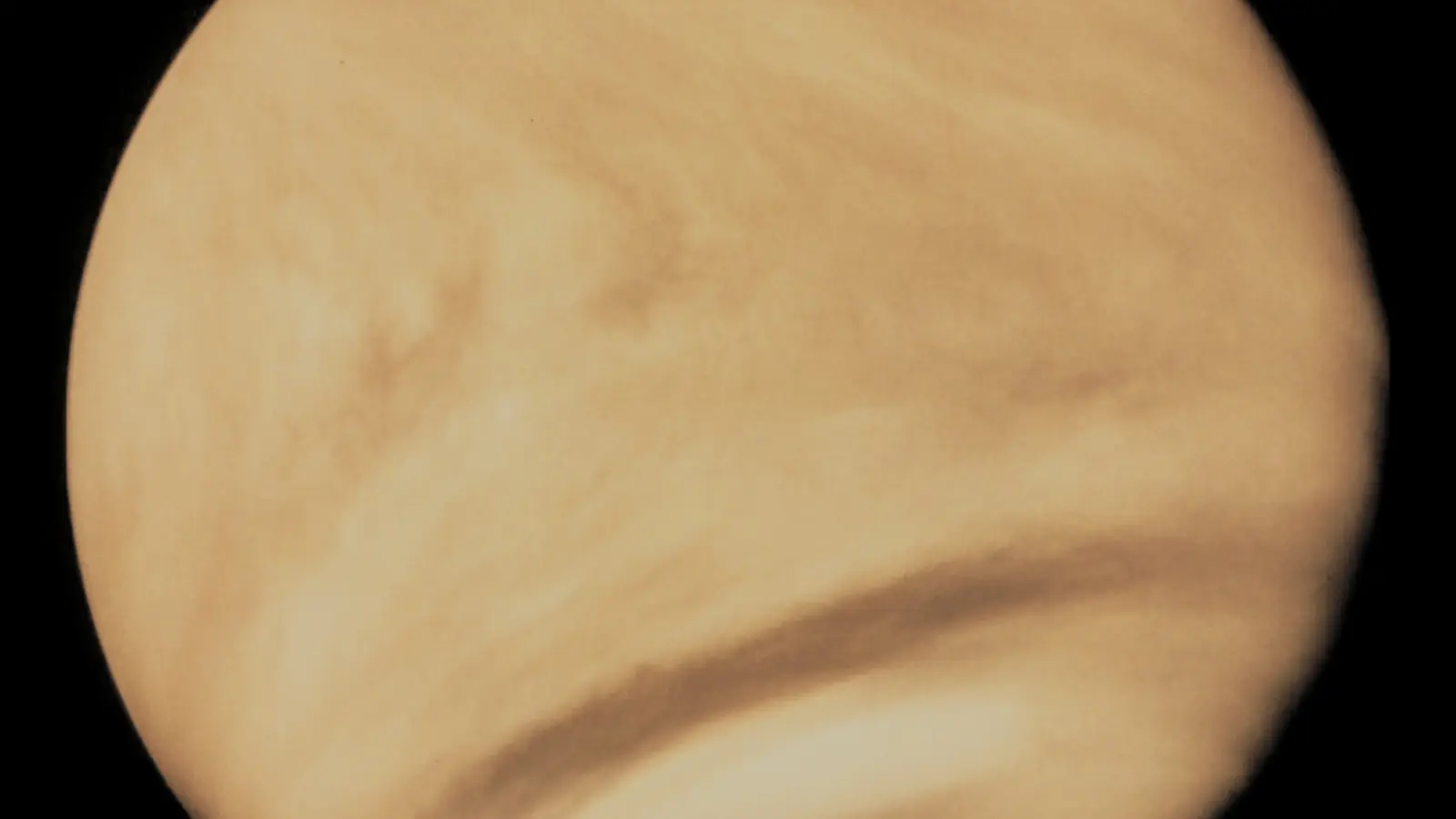
Venus is wrapped in carbon dioxide at a surface pressure roughly 90 times Earth’s sea-level pressure. The atmosphere has enormous mass and optical depth. Incoming sunlight can reach and warm the lower system, while outgoing thermal radiation is repeatedly absorbed and emitted before energy finally escapes from high, cold layers.
The greenhouse effect is an energy bottleneck
A warm surface emits infrared radiation. Greenhouse gases absorb selected infrared wavelengths and emit radiation in all directions. Because the effective level from which Venus loses heat to space is high and cold, the lower atmosphere and surface must become much warmer until outgoing energy again balances absorbed sunlight.
Why pressure alone is not the explanation
Compression and pressure affect temperature profiles, but pressure is not a permanent energy source. The sustained heat requires radiative physics: solar energy enters, thermal energy struggles to escape, and atmospheric circulation redistributes it. A high-pressure atmosphere made of gases transparent to infrared would behave differently.
Clouds both reflect and complicate
Venus’s sulfuric-acid cloud deck reflects most incident sunlight, giving the planet a high albedo. That cooling influence is real. Nevertheless, the thick atmosphere’s infrared opacity overwhelms it at the surface. Clouds also absorb and scatter radiation, making the complete energy balance more complicated than a one-gas slogan.
A nearly uniform furnace
Venus rotates very slowly, yet its dense atmosphere transports heat efficiently. Surface temperatures vary much less between day and night than Mercury’s do. Winds and convection move energy through the atmosphere, while the huge thermal reservoir resists rapid local cooling.
Mercury’s noon is not its average
Some points near Mercury’s equator become extremely hot in daylight, though still generally below Venus’s surface temperature. Polar craters that never receive sunlight can preserve water ice. Quoting one maximum without location and time creates a misleading comparison with Venus’s planet-wide average.
How spacecraft measure temperature
Landers have measured Venus directly for brief periods before failing in the heat and pressure. Orbiters infer atmospheric temperatures and composition using spectroscopy, radio occultations and thermal emission. Mercury missions combine infrared measurements, imaging and models of illumination and surface properties.
Why Venus became so different from Earth
Venus and Earth are similar in size, but their climates diverged. Water availability, solar input, volcanism, atmospheric loss and carbon cycling all matter. Researchers investigate whether early Venus once had milder conditions, but the duration and extent of any temperate interval remain debated.
Runaway greenhouse needs careful wording
A runaway greenhouse occurs when warming increases atmospheric water vapour until outgoing radiation reaches a limit and surface water is lost. Venus is the endpoint of profound greenhouse evolution, but reconstructing each historical step requires models and geochemical constraints that remain uncertain.
Carbon dioxide does not block visible light the same way
A greenhouse atmosphere need not look opaque to human eyes. Molecules interact with particular wavelength bands. Much visible sunlight penetrates, while carbon dioxide and clouds make it harder for the system’s longer-wavelength heat radiation to leave from the warm lower atmosphere.
What the comparison teaches about exoplanets
A planet’s orbit, atmosphere, albedo, rotation, clouds and surface all influence climate. Astronomers cannot rank exoplanet habitability from distance alone. Spectra that reveal atmospheric gases and clouds are essential, and even then degeneracies can allow several climate explanations.
A planetary energy budget
In long-term equilibrium, absorbed solar power must approximately equal outgoing thermal power. Atmospheres change the temperature required at the surface to achieve that balance. Venus demonstrates how the same conservation law can produce radically different surface conditions when radiation escapes from high above the ground.
Key takeaways
- Mercury is closer to the Sun, but Venus is hotter because its massive carbon-dioxide atmosphere traps outgoing infrared energy. Venus averages about 464°C at the surface, while airless Mercury swings between extreme daytime heat and deep nighttime cold.
Continue exploring
Sources and further reading
Keep exploring.
One remarkable idea at a time—nature, science, history and beyond.
Last updated October 29, 2026.

Barnakle Editorial Team
Barnakle Editorial Team is the collective byline used for Barnakle’s editorial articles. The contributor profile explains the team identity and links to the publication’s editorial policies.
More from the editorial team →