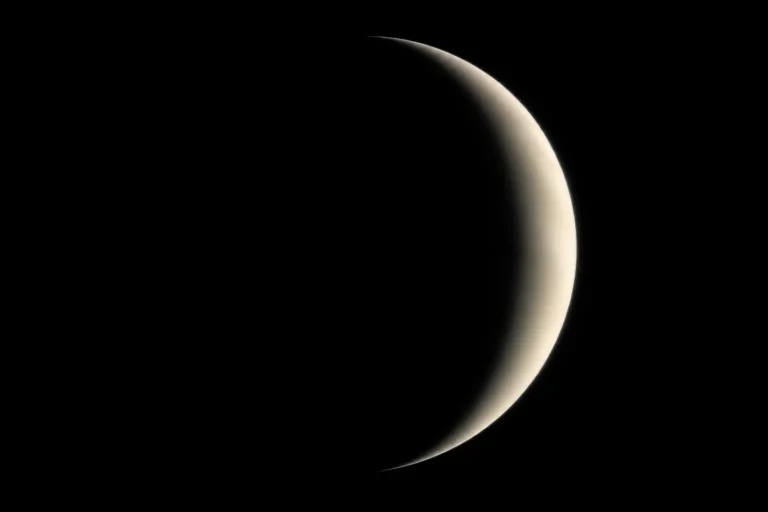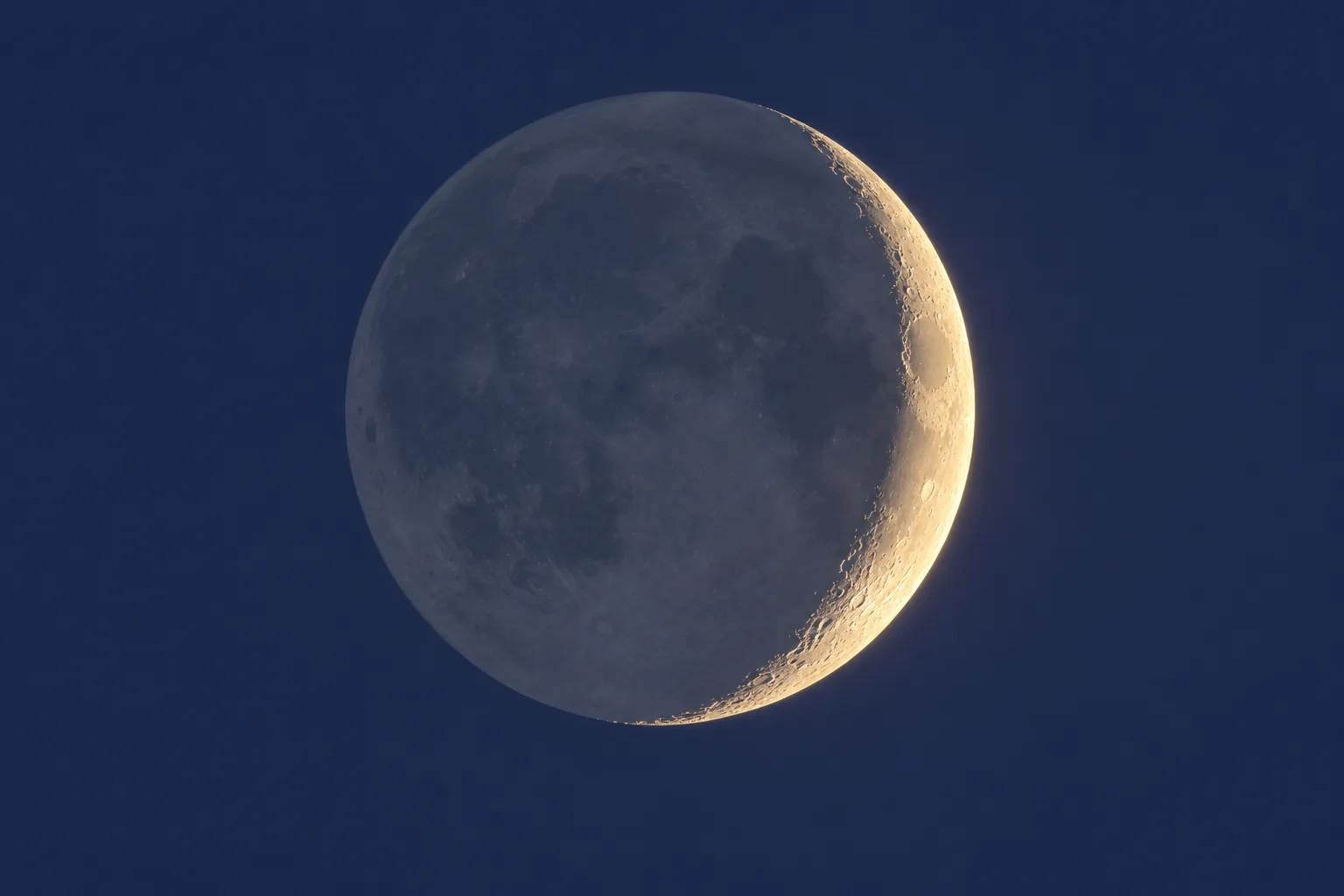
A thin crescent Moon sometimes carries a second, fainter shape inside its horns. Look long enough and you may see the outline of the entire lunar disk, complete with a few dusky patches. That part of the Moon is having a night lit by Earth. Sunlight has reflected off our planet, crossed to the Moon and bounced off the lunar ground back to your eyes. The bright crescent beside it receives sunlight directly. Seeing the two side by side gives you a view of the same landscape under two quite different sources of illumination. [1, 2]
Follow the light from the Sun to your eye
Start with the bright edge. Sunlight strikes the slopes and plains that form the crescent and scatters in many directions. A small share of that light reaches Earth. Now trace the faint part. Sunlight first falls on the sunlit half of Earth. Clouds, the atmosphere and the surface send some of it back to space. The Moon intercepts some of that reflected light, and its ground scatters a fraction toward Earth again. Each extra step reduces the amount available to light up the lunar landscape. [1, 2]
The disk’s faint outer edge and the inner boundary of the bright crescent mark two different things. The outer edge is the lunar limb, where your line of sight just grazes the globe. The curved boundary inside the disk is the terminator, the division between day and night for the Sun. A place just across that inner line from lunar day can still see a brilliant Earth in its sky. Lunar night need not mean a total absence of light.
There is a useful test for anyone tempted to call the faint patch Earth’s shadow. A shadow requires the light source, the obstructing body and the receiving surface to line up. Earth can cast a shadow on the Moon during a lunar eclipse, when the Moon is on the far side of Earth from the Sun. The thin crescent you see near sunset lies in roughly the same direction as the Sun. The geometry for an eclipse is absent, yet the faint disk is plainly there. [2, 3]
What an observer on the Moon would see
Imagine an observer near the middle of the Moon’s Earth-facing hemisphere, looking back at us. When we see only a slim sunlit fraction of the Moon, that observer sees a mostly illuminated Earth. As the Moon waxes toward full in our sky, Earth wanes in theirs. The phases are complementary because the two observers view the same Sun–Earth–Moon arrangement from opposite ends of the line between Earth and the Moon. [1, 3]
Those reversed phases make a crescent an especially good time to notice earthshine. Our planet presents a broad sunlit face to the Moon while the lunar surface facing us has a large area of night to receive the reflected light. From the ground, the other practical advantage is the relatively small bright crescent beside that faint area. At new moon the alignment would favour a very bright Earth as seen from the Moon, but the Moon is then too close to the Sun in our sky for an ordinary view of that dimly lit face. [1, 3]
The sequence works on either side of new moon. A young waxing crescent is an evening sight after sunset. A thin waning crescent can offer a corresponding view in the morning before sunrise. The part of the bright rim facing the Sun changes its orientation in the sky with place and time. The two-reflection path that produces the grey disk works the same way in both cases. [2, 3]
Why a camera can show more than your eye
The bright sliver and the rest of the Moon can pose a difficult exposure choice. A short exposure may show shading in the crescent and leave the night side nearly black. A longer exposure can bring out the faint lunar plains while the sunlit rim washes out. If a camera records only the crescent, it has not established that the darker ground received no light. It may simply have recorded too little of that light to separate it from the background sky.
In May 2024 an astronaut aboard the International Space Station photographed a waxing crescent with the rest of the disk lit by Earth. NASA’s published account gives the date and identifies the contrast enhancement applied to the photograph. That detail is worth looking for when comparing two images. A difference between their shades of grey might reflect image processing or exposure as well as a difference in light arriving at the Moon. The space station view also demonstrates that the glow can be seen from above most of Earth’s atmosphere. [2]
Can moonlight tell us something about Earth?
The amount of sunlight Earth reflects is called its albedo when expressed as a fraction of the incoming sunlight. A bright cloud field and a dark patch of ocean send different amounts and distributions of light back toward space. The part of our planet visible from the Moon changes as Earth rotates. Earthshine consequently carries some information about a large portion of the sunlit planet at once. The lunar surface acts as a distant screen on which light from many terrestrial features is mixed together. [2, 4]
Scientists at Big Bear Solar Observatory used measurements made from 1998 to 2017 to investigate changes in Earth’s reflectance. A measurement of this kind involves more than assigning a brightness to a crescent photograph. The lunar patch chosen, the illumination angle and the observing conditions affect the signal. Comparisons with a directly sunlit portion of the Moon and corrections for the observing geometry help researchers isolate information about Earth. The study considered a time series and compared it with satellite observations. [4]
For a simpler reading of the evening sky, look for the gentle continuation of the Moon’s curve beyond the two bright horns. If the curve closes into a circle, you are looking at a place where it is night, lit in part by the world beneath your feet. The Moon has given some of Earth’s own reflected daylight back to you.
Keep exploring
For two other views of the Moon’s geometry, follow the changing angle of sunlight and the rotation that keeps one hemisphere facing Earth.
Sources and further reading
- NASA Earth Observatory — Earthshine
- NASA Earth Observatory — Earth’s Reflections on the Moon
- NASA Science — Moon phases
- Goode and colleagues — Earth’s Albedo 1998–2017 as Measured From Earthshine
Keep exploring.
One remarkable idea at a time—nature, science, history and beyond.
Last updated November 19, 2026.

Barnakle Editorial Team
Barnakle Editorial Team is the collective byline used for Barnakle’s editorial articles. The contributor profile explains the team identity and links to the publication’s editorial policies.
More from the editorial team →