
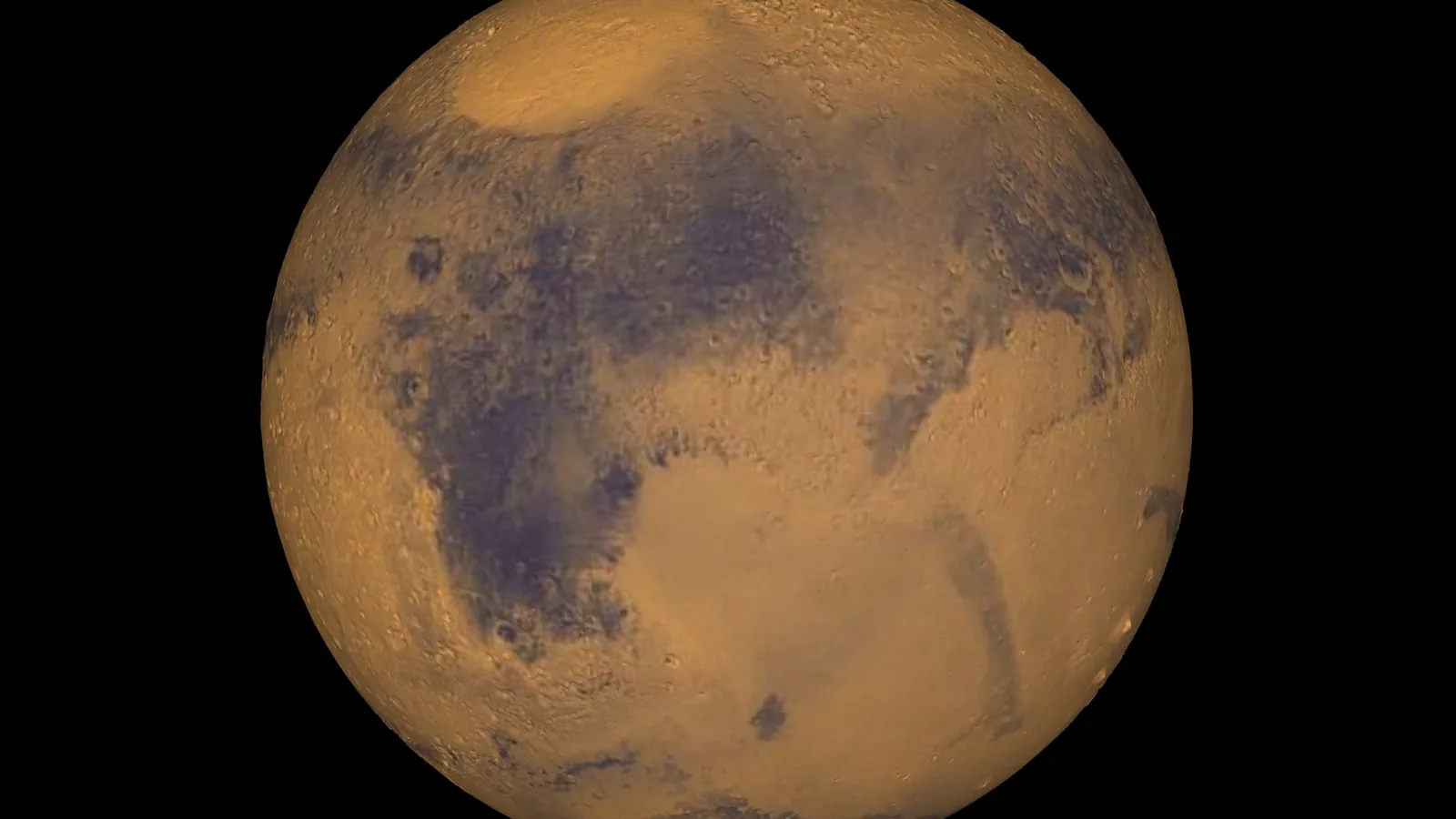
Fine iron-rich dust filters sunlight and coats much of the planet in rusty colour
The short answer
Mars looks red because iron-bearing minerals in its rocks and dust became oxidized. Ferric iron compounds absorb more blue and green light and reflect more red and orange wavelengths. Fine dust spreads globally, coats darker surfaces and hangs in the atmosphere, making the planet appear reddish from Earth and from orbit. The exact minerals and the role of ancient water remain active research questions.
Calling Mars red is useful but incomplete. Spacecraft see ochre plains, dark basalt, pale dust, blue-grey rocks and seasonal frost. The global impression comes from a thin, mobile layer of extremely fine oxidized material. Understanding how that material formed helps reconstruct the chemistry, water and climate of early Mars.
Mars contains abundant iron
Its crust is basaltic and rich in iron-bearing minerals. Weathering, impacts and volcanic processes expose and grind those minerals into particles that can react chemically.
Understanding Mars contains abundant iron requires separating the immediate mechanism from the conditions that make it stronger, weaker or easier to observe. Researchers measure those variables independently, compare natural examples and test whether the same explanation predicts new results. This turns a plausible story into an evidence-based account.
The evidence for Mars contains abundant iron comes from methods that fail in different ways. Direct observation establishes what occurs, instruments quantify timing or structure, experiments isolate candidate causes and models test whether known rules reproduce the pattern. Agreement across methods is more persuasive than repetition of one memorable example.
Context also matters for Mars contains abundant iron. Scale, species, location, temperature, geometry and measurement limits can change the result without overturning the underlying process. Careful reporting preserves that variation, states uncertainty and prevents a useful explanation from becoming an exaggerated universal rule.
Oxidation changes reflected light
Iron atoms in ferric minerals interact with visible light in ways that absorb shorter wavelengths and leave stronger red and orange reflection. This is related to rust but not identical to one household compound.
Understanding Oxidation changes reflected light requires separating the immediate mechanism from the conditions that make it stronger, weaker or easier to observe. Researchers measure those variables independently, compare natural examples and test whether the same explanation predicts new results. This turns a plausible story into an evidence-based account.
The evidence for Oxidation changes reflected light comes from methods that fail in different ways. Direct observation establishes what occurs, instruments quantify timing or structure, experiments isolate candidate causes and models test whether known rules reproduce the pattern. Agreement across methods is more persuasive than repetition of one memorable example.
Context also matters for Oxidation changes reflected light. Scale, species, location, temperature, geometry and measurement limits can change the result without overturning the underlying process. Careful reporting preserves that variation, states uncertainty and prevents a useful explanation from becoming an exaggerated universal rule.
Dust spreads the colour globally
Winds lift micron-scale particles and carry them across enormous distances. Dust settles on rocks, crater floors, ice and spacecraft, masking the darker material beneath.
Understanding Dust spreads the colour globally requires separating the immediate mechanism from the conditions that make it stronger, weaker or easier to observe. Researchers measure those variables independently, compare natural examples and test whether the same explanation predicts new results. This turns a plausible story into an evidence-based account.
The evidence for Dust spreads the colour globally comes from methods that fail in different ways. Direct observation establishes what occurs, instruments quantify timing or structure, experiments isolate candidate causes and models test whether known rules reproduce the pattern. Agreement across methods is more persuasive than repetition of one memorable example.
Context also matters for Dust spreads the colour globally. Scale, species, location, temperature, geometry and measurement limits can change the result without overturning the underlying process. Careful reporting preserves that variation, states uncertainty and prevents a useful explanation from becoming an exaggerated universal rule.
The atmosphere can look butterscotch
Suspended dust scatters sunlight and often gives the daytime sky a tan or salmon appearance near the surface. Particle size changes which wavelengths dominate.
Understanding The atmosphere can look butterscotch requires separating the immediate mechanism from the conditions that make it stronger, weaker or easier to observe. Researchers measure those variables independently, compare natural examples and test whether the same explanation predicts new results. This turns a plausible story into an evidence-based account.
The evidence for The atmosphere can look butterscotch comes from methods that fail in different ways. Direct observation establishes what occurs, instruments quantify timing or structure, experiments isolate candidate causes and models test whether known rules reproduce the pattern. Agreement across methods is more persuasive than repetition of one memorable example.
Context also matters for The atmosphere can look butterscotch. Scale, species, location, temperature, geometry and measurement limits can change the result without overturning the underlying process. Careful reporting preserves that variation, states uncertainty and prevents a useful explanation from becoming an exaggerated universal rule.
Martian sunsets can appear blue
Along the long path toward the setting Sun, fine dust scatters light forward differently from Earth’s molecules. Images often show a bluish glow near the Sun within the dusty sky.
Understanding Martian sunsets can appear blue requires separating the immediate mechanism from the conditions that make it stronger, weaker or easier to observe. Researchers measure those variables independently, compare natural examples and test whether the same explanation predicts new results. This turns a plausible story into an evidence-based account.
The evidence for Martian sunsets can appear blue comes from methods that fail in different ways. Direct observation establishes what occurs, instruments quantify timing or structure, experiments isolate candidate causes and models test whether known rules reproduce the pattern. Agreement across methods is more persuasive than repetition of one memorable example.
Context also matters for Martian sunsets can appear blue. Scale, species, location, temperature, geometry and measurement limits can change the result without overturning the underlying process. Careful reporting preserves that variation, states uncertainty and prevents a useful explanation from becoming an exaggerated universal rule.
The surface is not uniformly red
Fresh rock, volcanic sand and exposed bedrock can be dark grey or nearly black. White frost, salts and varied minerals add more colours that enhanced spacecraft images reveal clearly.
Understanding The surface is not uniformly red requires separating the immediate mechanism from the conditions that make it stronger, weaker or easier to observe. Researchers measure those variables independently, compare natural examples and test whether the same explanation predicts new results. This turns a plausible story into an evidence-based account.
The evidence for The surface is not uniformly red comes from methods that fail in different ways. Direct observation establishes what occurs, instruments quantify timing or structure, experiments isolate candidate causes and models test whether known rules reproduce the pattern. Agreement across methods is more persuasive than repetition of one memorable example.
Context also matters for The surface is not uniformly red. Scale, species, location, temperature, geometry and measurement limits can change the result without overturning the underlying process. Careful reporting preserves that variation, states uncertainty and prevents a useful explanation from becoming an exaggerated universal rule.
Rust does not require modern rain
Oxidation can proceed through several pathways involving ancient liquid water, atmospheric oxidants, ice, brines or reactions created by impacts and ultraviolet radiation.
Understanding Rust does not require modern rain requires separating the immediate mechanism from the conditions that make it stronger, weaker or easier to observe. Researchers measure those variables independently, compare natural examples and test whether the same explanation predicts new results. This turns a plausible story into an evidence-based account.
The evidence for Rust does not require modern rain comes from methods that fail in different ways. Direct observation establishes what occurs, instruments quantify timing or structure, experiments isolate candidate causes and models test whether known rules reproduce the pattern. Agreement across methods is more persuasive than repetition of one memorable example.
Context also matters for Rust does not require modern rain. Scale, species, location, temperature, geometry and measurement limits can change the result without overturning the underlying process. Careful reporting preserves that variation, states uncertainty and prevents a useful explanation from becoming an exaggerated universal rule.
Ferrihydrite is a leading clue
Recent laboratory and orbital comparisons support iron-rich ferrihydrite as an important component of Martian dust. Its formation would point toward water-related chemistry in the ancient past.
Understanding Ferrihydrite is a leading clue requires separating the immediate mechanism from the conditions that make it stronger, weaker or easier to observe. Researchers measure those variables independently, compare natural examples and test whether the same explanation predicts new results. This turns a plausible story into an evidence-based account.
The evidence for Ferrihydrite is a leading clue comes from methods that fail in different ways. Direct observation establishes what occurs, instruments quantify timing or structure, experiments isolate candidate causes and models test whether known rules reproduce the pattern. Agreement across methods is more persuasive than repetition of one memorable example.
Context also matters for Ferrihydrite is a leading clue. Scale, species, location, temperature, geometry and measurement limits can change the result without overturning the underlying process. Careful reporting preserves that variation, states uncertainty and prevents a useful explanation from becoming an exaggerated universal rule.
Hematite records chemical conditions
Hematite occurs in several Martian settings and can form through multiple processes. Its presence motivated rover exploration because some pathways involve water.
Understanding Hematite records chemical conditions requires separating the immediate mechanism from the conditions that make it stronger, weaker or easier to observe. Researchers measure those variables independently, compare natural examples and test whether the same explanation predicts new results. This turns a plausible story into an evidence-based account.
The evidence for Hematite records chemical conditions comes from methods that fail in different ways. Direct observation establishes what occurs, instruments quantify timing or structure, experiments isolate candidate causes and models test whether known rules reproduce the pattern. Agreement across methods is more persuasive than repetition of one memorable example.
Context also matters for Hematite records chemical conditions. Scale, species, location, temperature, geometry and measurement limits can change the result without overturning the underlying process. Careful reporting preserves that variation, states uncertainty and prevents a useful explanation from becoming an exaggerated universal rule.
Spectrometers identify minerals remotely
Orbiters and rovers measure which wavelengths a surface absorbs or reflects. Laboratory spectra of candidate minerals help scientists interpret those fingerprints.
Understanding Spectrometers identify minerals remotely requires separating the immediate mechanism from the conditions that make it stronger, weaker or easier to observe. Researchers measure those variables independently, compare natural examples and test whether the same explanation predicts new results. This turns a plausible story into an evidence-based account.
The evidence for Spectrometers identify minerals remotely comes from methods that fail in different ways. Direct observation establishes what occurs, instruments quantify timing or structure, experiments isolate candidate causes and models test whether known rules reproduce the pattern. Agreement across methods is more persuasive than repetition of one memorable example.
Context also matters for Spectrometers identify minerals remotely. Scale, species, location, temperature, geometry and measurement limits can change the result without overturning the underlying process. Careful reporting preserves that variation, states uncertainty and prevents a useful explanation from becoming an exaggerated universal rule.
Rovers test the dust directly
Instruments determine elemental composition, mineral structure and grain properties. Grinding or brushing a rock can reveal a less altered interior beneath the red coating.
Understanding Rovers test the dust directly requires separating the immediate mechanism from the conditions that make it stronger, weaker or easier to observe. Researchers measure those variables independently, compare natural examples and test whether the same explanation predicts new results. This turns a plausible story into an evidence-based account.
The evidence for Rovers test the dust directly comes from methods that fail in different ways. Direct observation establishes what occurs, instruments quantify timing or structure, experiments isolate candidate causes and models test whether known rules reproduce the pattern. Agreement across methods is more persuasive than repetition of one memorable example.
Context also matters for Rovers test the dust directly. Scale, species, location, temperature, geometry and measurement limits can change the result without overturning the underlying process. Careful reporting preserves that variation, states uncertainty and prevents a useful explanation from becoming an exaggerated universal rule.
Colour calibration is essential
Cameras respond differently from human eyes, and lighting changes throughout the day. Calibration targets allow teams to distinguish real geology from camera processing or dusty illumination.
Understanding Colour calibration is essential requires separating the immediate mechanism from the conditions that make it stronger, weaker or easier to observe. Researchers measure those variables independently, compare natural examples and test whether the same explanation predicts new results. This turns a plausible story into an evidence-based account.
The evidence for Colour calibration is essential comes from methods that fail in different ways. Direct observation establishes what occurs, instruments quantify timing or structure, experiments isolate candidate causes and models test whether known rules reproduce the pattern. Agreement across methods is more persuasive than repetition of one memorable example.
Context also matters for Colour calibration is essential. Scale, species, location, temperature, geometry and measurement limits can change the result without overturning the underlying process. Careful reporting preserves that variation, states uncertainty and prevents a useful explanation from becoming an exaggerated universal rule.
Common misconceptions
Mars is not a solid ball of bright red rust, and its colour does not require oceans of oxygen like modern Earth’s atmosphere. The surface contains varied rocks and minerals beneath mobile dust. “Rust” is a useful analogy, not a complete description of Martian geochemistry.
A concise explanation is useful only when it preserves the causal chain. It becomes misleading when it substitutes a familiar label for a mechanism, confuses association with cause or extends evidence beyond the conditions actually studied.
How scientists know
Planetary scientists combine telescope spectra, orbital imaging, rover cameras, X-ray and laser instruments, drilled samples and laboratory simulations. They reproduce dust candidates, measure optical fingerprints and compare them with observations at different scales and lighting conditions.
No single measurement carries the conclusion. Observations, experiments, physical theory and repeated records provide independent checks, while disagreement points to an uncontrolled variable or a question that still needs a better test.
Frequently asked questions
Is Mars actually red to human eyes?
It commonly appears ochre or reddish brown, although local surfaces and lighting show a much broader palette.
What oxidized the iron?
Ancient water and several atmospheric or surface oxidants may have contributed; the relative roles are still investigated.
Why is Earth not equally red?
Earth’s active water cycle, vegetation, oceans, soils and plate recycling create and expose a much wider range of surfaces.
Are Mars photos colour corrected?
Mission teams calibrate cameras carefully, but products may use natural, approximate or enhanced colour for different scientific purposes.
Will Mars stay red forever?
Its dust cycle continues, while future weathering and human activity could expose or redistribute different material locally.
Key takeaways
- Ferric iron minerals create Mars’s reddish spectral signature.
- Fine dust distributes that colour across the planet.
- Mars contains many non-red surfaces beneath or between dusty regions.
- Dust mineralogy preserves clues about ancient water and climate.
Continue exploring
Sources and further reading
Keep exploring.
One remarkable idea at a time—nature, science, history and beyond.
Sources and further reading
Barnakle uses credible primary and authoritative sources wherever possible.
- NASA Science — Mars Facts
- https://science.nasa.gov/mars/facts/
- NASA — New study on why Mars is red
- https://www.nasa.gov/solar-system/nasa-new-study-on-why-mars-is-red-supports-potentially-habitable-past/
- NASA Science — Martian soil colour variations
- https://science.nasa.gov/resource/martian-soil-color-variations/
- NASA JPL — Exploring the Colors of Mars
- https://www.jpl.nasa.gov/edu/resources/lesson-plan/exploring-the-colors-of-mars/
Last reviewed October 2, 2026.

Barnakle Editorial Team
A member of the Barnakle editorial team, exploring remarkable ideas with clarity, curiosity and care.
More from this author →