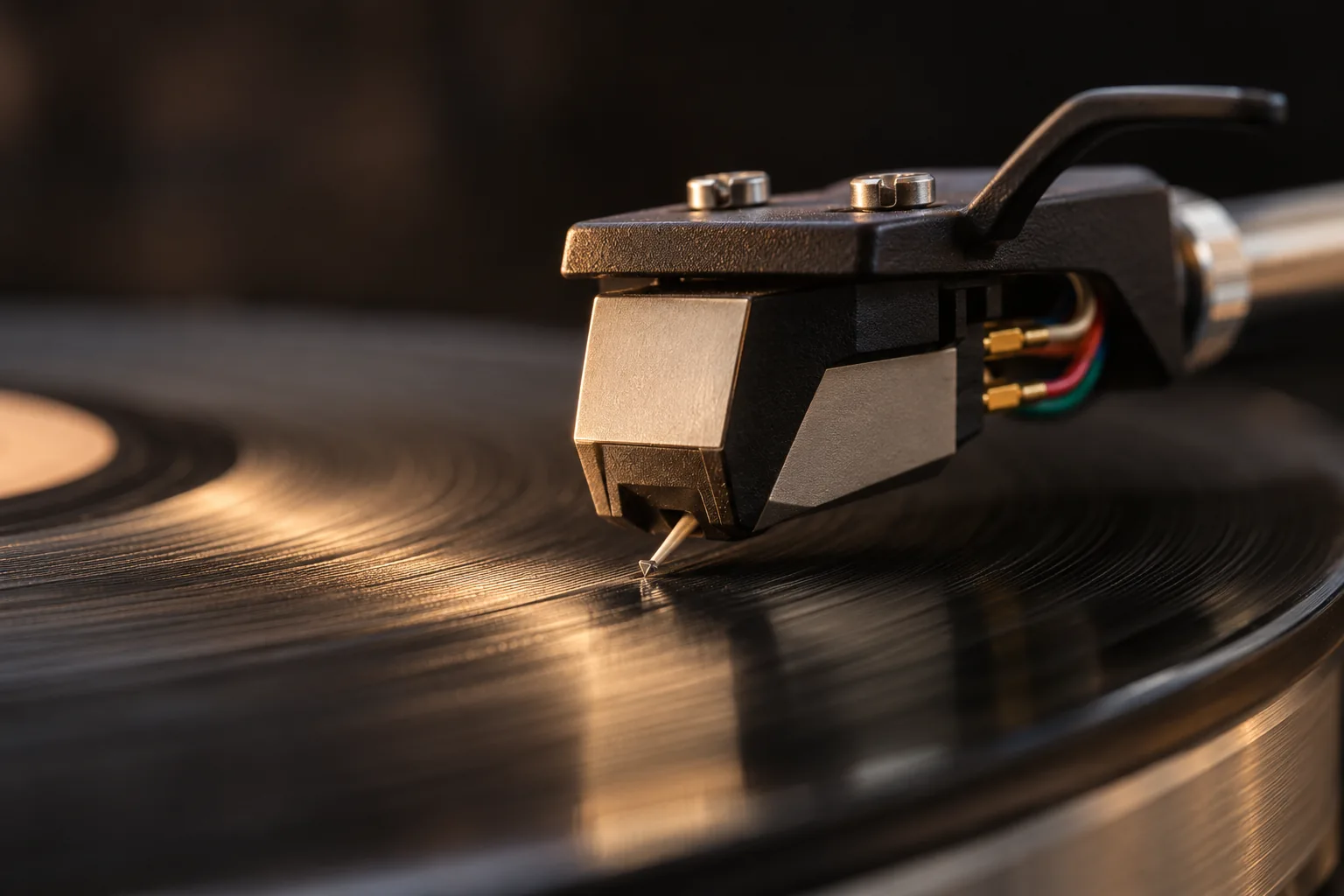
A vinyl record makes recorded music playable by storing a changing physical pattern in a groove. As the disc turns, a stylus follows that pattern. Its tiny movements drive a cartridge, which produces an electrical audio signal for the rest of the playback system. [1]
The black disc is therefore a sound-storage medium. In a modern amplified system, the music you hear across the room comes from loudspeakers reproducing a signal recovered from that storage. Between the plastic surface and the air reaching your ears lies a sequence of mechanical and electrical transformations. [5]
What is actually stored in a record groove?
What looks like a collection of separate rings is normally one continuous spiral on each playable side. The spiral progresses inward. Along its length, small variations encode the changing recorded waveform, rather than a set of written instructions telling a machine which instrument to imitate. [5]
That physical representation is why vinyl is called an analogue format. The geometry varies continuously with the recorded signal. A digital recording instead represents its signal as numerical information. Neither description, by itself, establishes which particular release a listener will prefer.
The visible spacing between adjacent turns of the spiral is not a musical note. The sound information lies in the groove's fine modulation. Looking at the broad bands of an album can reveal changes in the layout, but it does not let an unaided eye read a singer's voice.
How does recorded music become a plastic groove?
In a common manufacturing route, a mastering system sends the prepared audio to a cutting lathe. Its cutting tool forms a modulated spiral in a lacquer-coated master. Metal stampers made from that master carry the inverse pattern, allowing a press to reproduce the grooves in vinyl. [1]
This separates recording from playback. The cartridge on a home turntable does not cut the album as it plays. It traces a pattern already present in the disc. The manufacturing chain makes many playable copies from an earlier mastered recording, rather than requiring musicians to perform for every new record.
How can one groove carry stereo sound?
A stereo groove has two sloping walls. The two channels are encoded in directions associated with those walls, commonly described as a 45/45 system: the channel directions sit at right angles to one another and at 45 degrees to the disc surface. [2]
The stylus contacts both walls, and the cartridge responds to the resulting motion. It is not a case of two needles playing neighboring tracks. Both channels occupy the same spiral, recovered at the same moment by one stylus assembly. The cartridge's internal arrangement preserves the distinction between their electrical outputs. [2]
What do the stylus and cantilever do?
The stylus is the small contact tip, often diamond, that meets the groove. A slender cantilever carries its movement into the cartridge. The tonearm supports the assembly while allowing it to travel across the record as playback proceeds. These parts must respond to extremely small, rapidly changing motions. [2]
Contact matters. A stylus that fails to follow the groove faithfully cannot recover the intended pattern accurately. Audio-Technica specifies tracking-force ranges for its cartridges; reducing the force indefinitely is not a reliable way to protect a record, because inadequate contact can itself produce damaging mistracking. [2]
How does that movement become electricity?
Two familiar cartridge designs use electromagnetic induction. In a moving magnet cartridge, a small magnet moves with the cantilever relative to fixed coils. In a moving coil cartridge, the coils move while the magnets remain fixed. Relative motion changes the magnetic conditions at the coils, creating an electrical signal. [3]
The names describe which component moves, not whether one cartridge contains magnetism and the other does not. Both are ways of translating mechanical vibration into an electrical representation of the recording. Their output characteristics differ, which matters for the input stage receiving the signal. [3]
A cartridge is thus a transducer: it changes information carried in one physical form into another. The record has already supplied the pattern. The cartridge recovers it; the amplifier and loudspeaker later supply the powered reproduction that fills a room.
Why is a phono preamp needed?
A conventional magnetic cartridge does not provide the same output as a typical line-level audio source. A phono stage raises the signal and applies the playback equalization needed for standard modern records. That stage may be built into a turntable or amplifier, or provided by a separate unit. [4]
During standard RIAA record mastering, bass is reduced and high frequencies are emphasized. Playback applies the complementary correction. This helps accommodate recorded sound within the mechanical limits of a groove; the phono stage is doing frequency-dependent correction as well as amplification. [1]
The signal path depends on where that correction already occurs. Pro-Ject distinguishes an unprocessed phono signal from the output of a phono preamplifier, which feeds a line input. Passing an already corrected output through another phono stage would apply an extra stage of processing. [4]
Why does playback speed change the music?
A groove is a pattern spread along a moving surface. The intended rotation rate determines how quickly that pattern passes the stylus. Play it at another rate and the timing changes: faster playback compresses the performance in time and raises pitch; slower playback stretches it and lowers pitch. [5]
Common record formats use rates such as 33⅓ or 45 revolutions per minute. Record diameter alone is not a complete speed instruction. Archives distinguish multiple disc materials and formats, including older shellac records with wider grooves; not every historical disc belongs to the same playback system as a modern vinyl LP. [7]
Why do scratches and dust make noise?
The pickup responds to physical disturbances at the surface. Dirt, abrasion and groove damage can interfere with faithful tracing, adding unwanted sound or reducing the quality of the recovered recording. Preservation specialists therefore treat surface contamination and physical condition as meaningful parts of a disc's history. [6]
A click is not necessarily a sound captured at the original recording session. It can enter the playback chain because the stylus encounters something other than the intended modulation. A damaged groove also cannot be assumed to return to its original shape simply because visible dirt has been removed. [6]
That vulnerability follows from the same feature that makes vinyl tangible: the recording exists as a delicate physical surface. The stylus reads its motion, the cartridge produces a signal, and powered electronics turn that recovered pattern into audible music.
Keep exploring
Follow two other stages of musical electricity: how a guitar string generates a signal and how a loudspeaker turns a signal back into moving air.
Sources and further reading
Record-playback sources checked November 16, 2026. Manufacturer explanations cover cartridge and phono-stage operation; the university references address recording physics and preservation.
- Yamaha — How Does a Vinyl Record Make Sound?
- Audio-Technica — Cartridge-making Dictionary (PDF)
- Cambridge Audio — Moving magnet and moving coil cartridges
- Pro-Ject Audio Systems — FAQ: phono stages and line inputs
- Mark Newman, University of Michigan — Sound recording and reproduction, section 7.4.2 (PDF)
- University of Illinois, Preservation Self-Assessment Program — Phonograph Record
- U.S. National Archives — Audio Guidance: Identifying Audio Formats
Keep exploring.
One remarkable idea at a time—nature, science, history and beyond.
Last updated November 16, 2026.

Barnakle Editorial Team
Barnakle Editorial Team is the collective byline used for Barnakle’s editorial articles. The contributor profile explains the team identity and links to the publication’s editorial policies.
More from the editorial team →