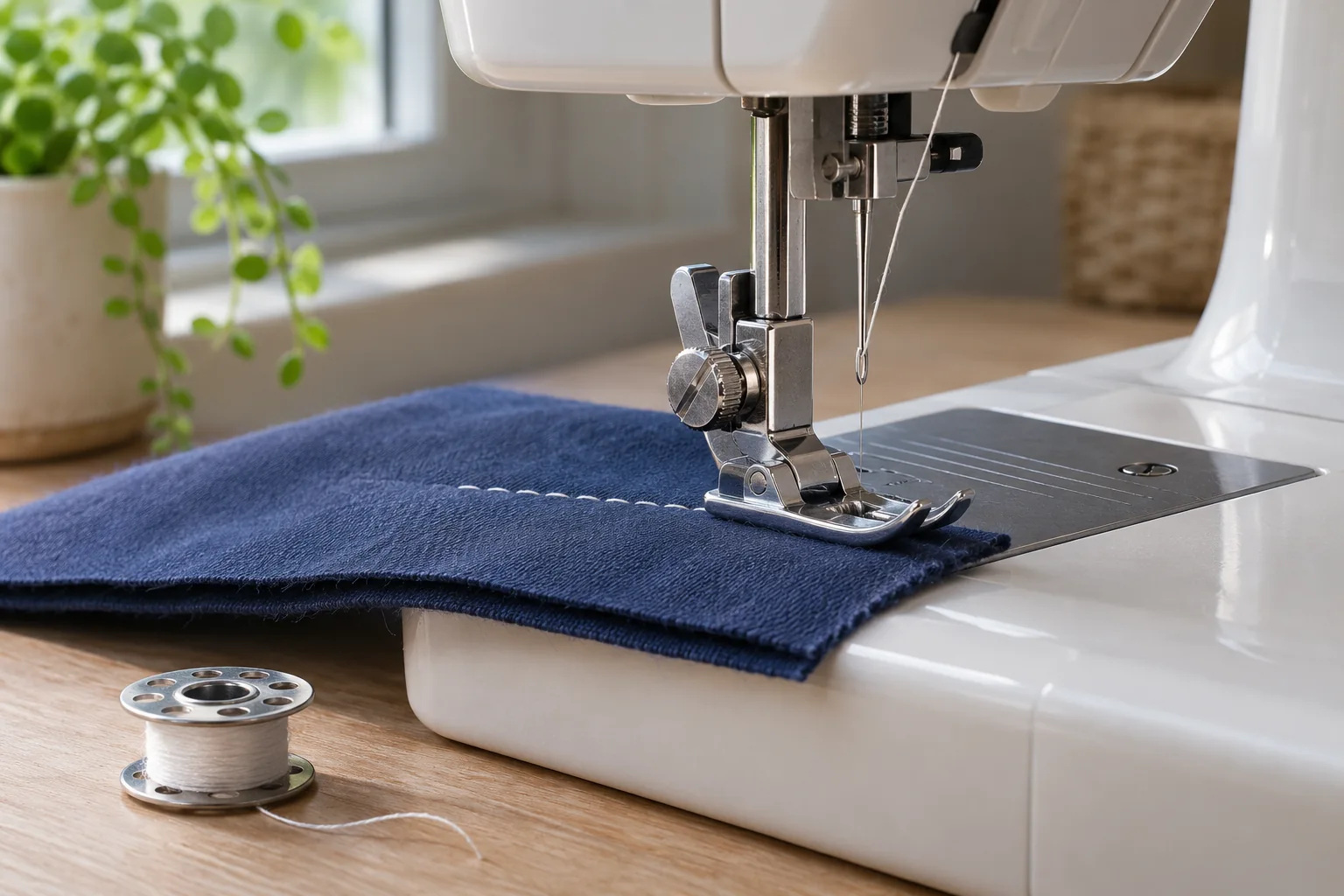
A common sewing machine forms a lockstitch by interlocking an upper thread with a lower thread supplied by a bobbin. The needle takes upper thread through the fabric. Beneath the needle plate, a hook catches a loop and carries it around the lower-thread assembly. The loop is then tightened into a stitch. [2, 6]
Meanwhile, a feeding mechanism advances the fabric so the next stitch forms in a new place. Needle motion, thread handling and fabric movement must stay synchronized. The visible up-and-down motion is therefore only one part of a coordinated cycle happening above and below the cloth. [1, 3]
Why does the machine need a bobbin?
The upper thread begins on a spool and passes through the needle's eye. The bobbin holds a separate supply below the fabric. In a lockstitch, these two threads meet and interlock, rather than one thread simply traveling back and forth through the cloth as a person might sew by hand. [6]
When the stitch is balanced, the interlocking point sits between the fabric layers. The seam can consequently look neat on both surfaces. The visible thread along the top is connected through each penetration to the other thread underneath, holding the layers together along the line of stitching. [6]
Two thread supplies are not a universal requirement of every sewing technology. SFO Museum's collection includes historical machines that produced a chain stitch using one thread. Understanding the bobbin's role starts with identifying the stitch being made, rather than assuming all machines use the same arrangement. [7]
What happens beneath the needle?
The upper thread must become a loop large enough for the hook mechanism to engage. The rotary-hook patent describes guiding this needle-thread loop around the bobbin housing, with carefully arranged clearances so it can pass and be withdrawn without unnecessary resistance. [2]
The hook's task is therefore more demanding than simply touching a loose thread. It must capture the loop, guide it through the required path and release it at the right time. The bobbin housing and surrounding parts must allow the thread to travel while the mechanism maintains its alignment. [2]
Different machines can accomplish this with different hook or shuttle arrangements. Smithsonian's description of Allen Wilson's patent model explains an early rotary-hook approach with a stationary bobbin. That historical object shows how the basic problem of interlocking the threads could be solved through a distinctive mechanical design. [8]
How is the loose loop pulled tight?
The loop needs slack while it travels around the lower-thread assembly. Afterward, the take-up mechanism withdraws that slack. In the patent's described cycle, the take-up lever pulls the needle-thread loop back after its expansion around the bobbin housing. [2]
Thread handling is one of several linked systems. JUKI's training outline treats the needle bar, hook, thread take-up, feeding mechanism, presser foot and thread-tension control as separate elements contributing to a seam. A stitch depends on their relationship, not on one component acting alone. [1]
This also explains why tension is not merely a measure of how tightly the cloth is squeezed. It concerns how thread is supplied and restrained as the stitch forms. The top and lower paths must cooperate so the interlock reaches an appropriate position rather than leaving conspicuous loops on a surface. [1, 6]
What moves the fabric between stitches?
On a typical domestic machine, serrated feed dogs work through openings in the needle plate. The presser foot holds the fabric against the feed area so the mechanism can advance it. Brother's parts guide distinguishes these components from the nearby needle, bobbin cover and thread guides. [3]
This turns a repeated stitch-forming cycle into a seam. Without controlled advance, the needle would keep returning to approximately the same location. The feeding mechanism gives successive interlocks their spacing and helps determine the pattern traced across the material. [1, 3]
SINGER's troubleshooting guidance emphasizes that feed dogs are intended to draw the fabric through while the operator guides it. Pushing or pulling the material can distort stitches and deflect the needle. That guidance makes sense once feeding is recognized as an active part of the machine's work. [4]
How does the whole mechanism keep time?
The hook must encounter the loop while it is available, and the fabric must move in coordination with the needle's cycle. JUKI's training outline includes both hook requirements and feed timing, reflecting how closely these motions depend on each other. [1]
Mechanical linkages can coordinate repeated movement, while some industrial systems add independent drives and electronic control. JUKI describes a system that drives the hook independently and synchronizes it with needle and fabric travel. The manufacturer associates that control with consistent stitch formation as sewing direction changes. [5]
More electronics do not eliminate the physical requirements of making a stitch. Thread must still be captured and drawn through a real path, and the material must be positioned for the next penetration. Automation changes how those movements are controlled and monitored. [5]
Is an overlocker doing the same thing?
An overlocker, often called a serger, uses loopers to form stitches around a fabric edge and may trim as it sews. A standard lockstitch machine can also sew within a panel, for pockets or topstitching. [6]
The distinction is about stitch formation as well as appearance. Historical chain-stitch machines provide another alternative: SFO Museum describes single-thread examples that dispensed with the bobbin. The finished stitches may all join fabric, but the thread paths and mechanical requirements differ. [7]
Why can one small problem affect the seam?
The thread passes through a narrow needle eye, around moving parts and into repeated interlocks. SINGER lists worn or unsuitable needles, obstructed thread paths and feeding difficulties among causes of stitching problems. A seam records the combined behavior of the materials and mechanism. [4]
The machine is best understood as a sequence: present the thread, form and capture a loop, interlock it, remove slack and advance the cloth. Watching only the needle hides much of that work. The smooth line of stitches is evidence that several small movements have repeated in the right relationship. [1, 8]
Keep exploring
Follow the motor that drives many modern sewing machines, then compare another small mechanism that advances material in controlled steps.
Sources and further reading
Lockstitch mechanism checked November 17, 2026, using manufacturer explanations, a patent description and museum collections. This article explains the mechanism; settings and servicing remain model-specific.
- JUKI — Basic Knowledge of Sewing: Lockstitching course outline
- US4691650A — Lockstitch sewing-machine rotary-hook patent description
- Brother — Sewing-machine parts: needle, presser foot and feed area
- SINGER — Troubleshooting Tips
- JUKI — Core Technologies: independent drive and synchronous control
- JUKI UK — Overlocker vs Sewing Machine
- SFO Museum — Threading the Needle: Sewing in the Machine Age
- Smithsonian National Museum of American History — Allen Wilson’s 1852 sewing-machine patent model
Keep exploring.
One remarkable idea at a time—nature, science, history and beyond.
Last updated November 20, 2026.

Barnakle Editorial Team
Barnakle Editorial Team is the collective byline used for Barnakle’s editorial articles. The contributor profile explains the team identity and links to the publication’s editorial policies.
More from the editorial team →