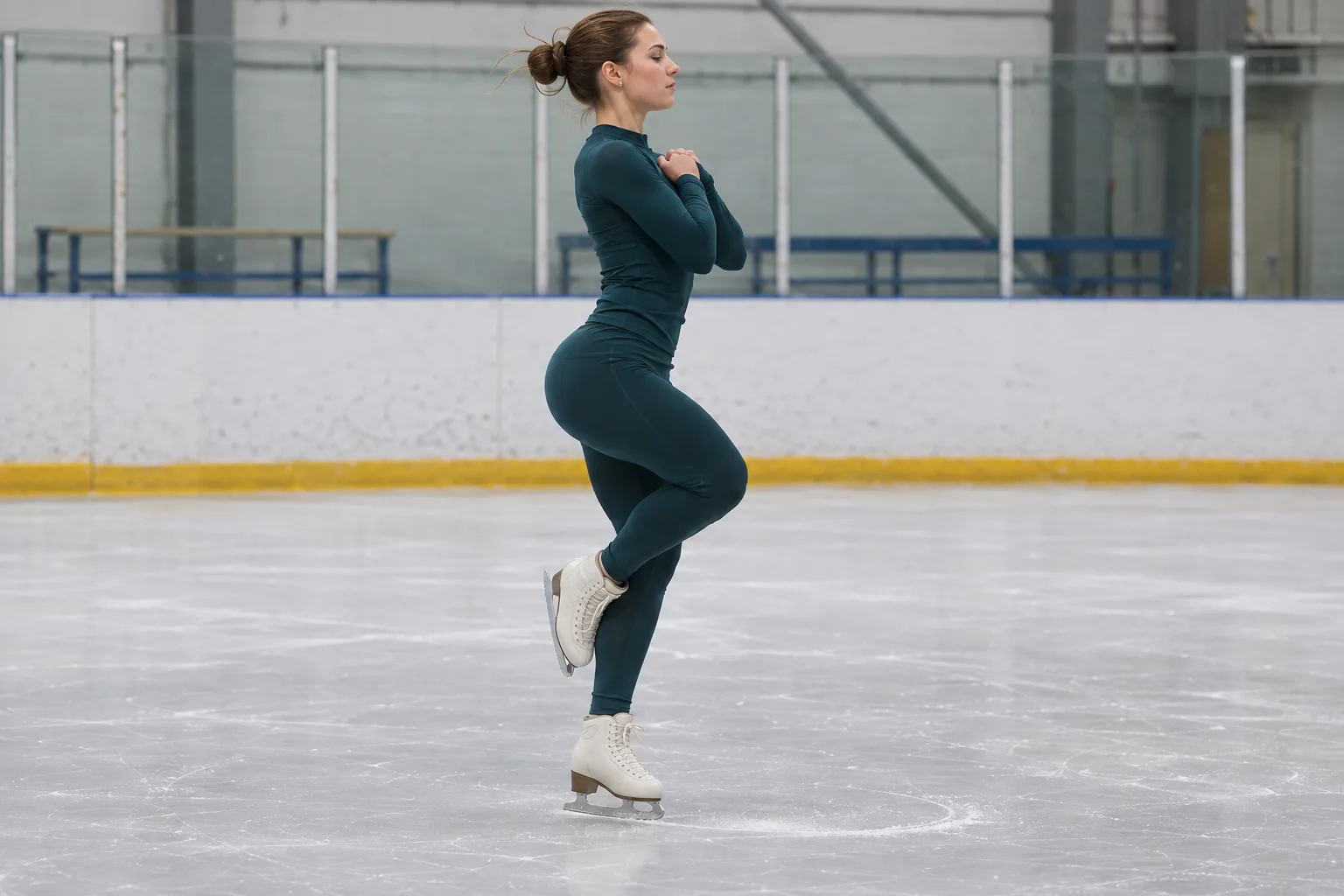
A figure skater opens her arms wide, settles into a spin and then folds them against her chest. The turn suddenly looks much faster, even though you never see her take another push. Bringing mass closer to the spin axis reduces her moment of inertia. If the turning effect of outside forces is small during that change of pose, her angular momentum stays nearly constant. She must complete each revolution more quickly. The increase in rotational energy comes from the work she does in drawing herself into the tighter position. [1, 2]
What changes when the arms come in?
Try following the skater’s shoulder and hand for one revolution while the arm is extended. Both come back to their starting direction at the same instant. The hand travels farther because it describes the bigger circle. Distance from the axis therefore matters even when two parts of the body share the same number of turns per second. A pose with limbs spread out distributes some of the skater’s mass much farther from the axis than a compact, upright pose does. [1, 2]
Physicists call the relevant measure of mass distribution the moment of inertia. Each small piece of mass contributes in proportion to the square of its perpendicular distance from the axis. Move a small object from 20 centimetres to 40 centimetres away and its contribution becomes four times as large. Move it back and that contribution falls to a quarter. These changes apply to the small object you moved. A skater’s torso, head and supporting leg also contribute, so moving her hands halfway in will not generally reduce the moment of inertia of her entire body to a quarter. [1, 3]
That squared distance explains why the free leg can matter as much as the arms in a performance. Watch the difference between an extended leg sweeping a broad circle and a leg drawn in close to the support leg. The relevant measurement is how far each part lies from the line of spin. Simply holding the hands higher over the head, while keeping them the same distance from that line, would have a different effect from sweeping them inward from shoulder width. [1, 2]
Where the turn came from in the first place
During entry the skater interacts with the ice. Forces acting away from the spin axis can give her angular momentum. Once she is rotating around a fairly steady axis, gravity acts downward and the ice supports her. There can still be friction at the blade and resistance from the air. Over the brief interval in which she pulls in, the net external torque about the vertical axis can be small enough to treat her angular momentum about it as conserved. [1, 2]
The “about the axis” qualification matters. A force can be large without supplying much twist around a particular line. Think of pushing a door near its hinges and then near its handle with the same force in the same direction. The different turning effect comes from where the push acts. The blade supports the skater’s weight throughout the spin, but support by itself tells you very little about how much that force changes her rotation about a vertical line. [1]
One turn in half the time
For a steady spin around one axis, angular momentum is the product of moment of inertia and angular speed. Imagine a simplified skater who starts at two turns each second. If a change of shape cuts her total moment of inertia in half and the external torque is negligible, four turns each second gives the same product. One revolution then takes a quarter of a second in place of half a second. These numbers illustrate the relation. Measuring a real skater’s change in pose would be needed to predict an actual rate. [1]
The reverse is visible as well. When the skater extends limbs away from the axis, the larger moment of inertia allows the same angular momentum at a lower rotation rate. A video can show the change without any special sensor. Choose a recognizable orientation, such as the skater facing a fixed camera, and count frames between successive appearances of that orientation. Compare intervals from two stretches in which the pose is reasonably steady. A moving camera or a replay slowed to a different speed halfway through would spoil the comparison.
Why speeding up takes work
There is a seeming puzzle in the faster spin. How can the skater gain rotational energy when no one has given her another push? Her muscles are doing work. Drawing extended limbs inward while spinning takes effort, and some of the body’s stored chemical energy becomes kinetic energy. Angular momentum can stay the same during this transfer because the forces that pull the arms inward are internal to the skater. Conservation of angular momentum and an increase in rotational energy describe different aspects of the same movement. [1, 2]
In the simplified half-inertia example, the energy accounting is especially neat. Rotational kinetic energy equals one half of the moment of inertia times the square of angular speed. Halving the first factor and doubling the speed multiplies the energy by one half times four, giving twice the original rotational energy. The skater’s mass has not changed, and the result does not require the ice to act like a motor. A change in how the mass moves accounts for the extra kinetic energy. [1]
How to see the effect away from the rink
Simon Fraser University demonstrates the principle with a person on a rotating stool holding weights. Moving the weights closer to the centre makes the person and stool turn faster. The stool supplies a fixed bearing and the weights make the redistribution easy to see. The same idea is used in a University of Wisconsin demonstration. Each removes much of what makes figure skating difficult, including balancing on a narrow moving blade, while keeping the change in mass distribution visible. [3, 4]
When watching a spin, pick two details in succession. First look at how the skater moves the free leg and hands relative to the centre of the body. Then time a turn by following the shoulders past a fixed mark on the boards. If the shoulders pass more often after the limbs come in, you have seen a speed change independently of how dramatic the new silhouette looks. The pose sets the moment of inertia, and the timing shows its consequence on the ice.
Keep exploring
Explore the contact between blade and ice, then follow angular momentum in a spinning gyroscope.
Sources and further reading
The physics sources distinguish torque, rotational energy and angular momentum. The university demonstrations isolate the change in mass distribution.
- OpenStax University Physics — Conservation of Angular Momentum
- Davidson Institute of Science Education — The physics of the figure skater’s spin
- Simon Fraser University Physics — Rotating stool and weights demonstration
- University of Wisconsin–Madison, The Wonders of Physics — Can you spin like an ice skater?
Keep exploring.
One remarkable idea at a time—nature, science, history and beyond.
Last updated November 18, 2026.

Barnakle Editorial Team
Barnakle Editorial Team is the collective byline used for Barnakle’s editorial articles. The contributor profile explains the team identity and links to the publication’s editorial policies.
More from the editorial team →