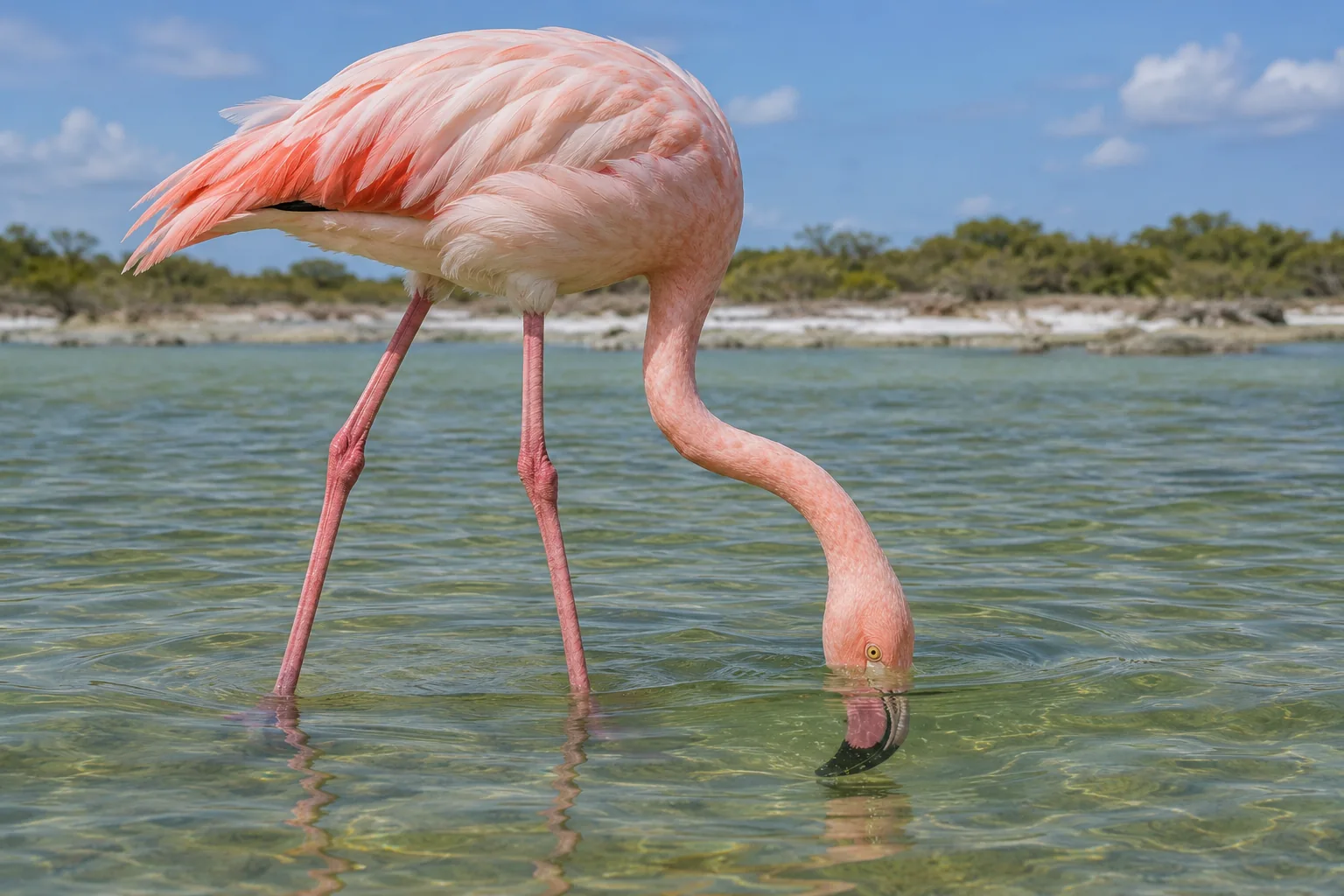
The easiest part of a feeding flamingo to see is the part doing very little. Its back stays almost level above the lagoon while the curved neck disappears into the water. Below the surface, the bird can pump water through its bill, stir the bottom with a foot and draw a swirl of water upward with a quick movement of its head. For a brine shrimp, the meal begins well before it reaches the bird’s mouth.[1, 3]
Flamingos have rows of comb-like plates, called lamellae, inside the bill. Water can flow through the narrow spaces between them while suitable food stays behind. The tongue helps move water through the apparatus. The bent shape of the bill puts its working surfaces in position when the bird lowers and inverts its head. It can process water containing many small organisms during a single feeding bout.[1, 2]
A mouth that works upside down
Look at the head first while the bird is standing upright. The lower half of its bill is particularly deep, with room for the muscular tongue. The two halves bend distinctly along their length. Follow that same bill as the neck curves down. What an anatomist calls the lower jaw can now be physically above the upper one. The names of the bones follow the animal around, however thoroughly the feeding posture turns the view upside down.[2]
The posture brings a substantial length of the bill into contact with shallow water. The bird can sweep its head across a patch while the tongue travels back and forth inside the bill. Water entering the mouth carries suspended material. As water is expelled through the filtering margins, some particles remain available to swallow. The tongue keeps the water moving even when a gentle current alone would deliver relatively little food.[1, 2]
Think of three things travelling together toward the opening. A small crustacean can be retained, a much smaller particle may escape with the water, and most of the water itself must leave if the next mouthful is to come in. The effective gaps in the filter influence which particles take each path. Greater and lesser flamingos have different filtering structures. The finer apparatus of a lesser flamingo suits much smaller food than the coarser filter of a greater flamingo.[2]
Getting food within reach
A filter handles only what arrives at it. A shrimp resting at the bottom, several centimetres to one side, is outside the mouth’s reach until either the head or the shrimp moves. An animal that can swim away adds a further complication. For a flamingo, controlling the water around its bill can therefore matter just as much as having a good filter inside it.
In a study published in 2025, researchers watched Chilean flamingos feed and investigated what happened around their heads and feet. A rapid upward movement of the inverted head generated a rotating flow that lifted material from the bottom. The swirl carried sediment as well as live brine shrimp. The bill’s bent profile helped organize the flow, giving a head movement that might look like the end of a dip a further role in gathering prey.[3]
A separate movement took place while the beak remained submerged. The birds opened and closed the bill in a rapid chattering motion. The researchers recorded a rhythm of about twelve cycles per second and a directed flow near the beak. Imagine watching a one-second clip frame by frame. What appears to be one brief pause at the bottom of the dip can contain a dozen movements too quick to distinguish from the bank.[3]
Why stamp in the shallows?
One webbed foot can present a relatively large surface as it pushes through water, then change shape as it returns. Different parts of the stroke displace water in different ways. In the experiments, foot movements produced eddies that swept up bottom material and concentrated prey. A person standing above the water might see a cloud of disturbed sediment spread out. Within that cloud, some material can be travelling around a much more organized local current.[3, 4]
There is a difference between disturbing food and delivering it. Picture stirring loose leaves in a shallow tray. A vigorous movement might send everything away from the place you intend to collect it. A different motion can draw leaves up from the floor and keep several circulating nearby. Watching the grey cloud alone would tell you how much sediment had lifted. Tracking the paths of individual particles tells you whether the flow also gathers them.[3]
How to see water that is otherwise transparent
The research team filmed feeding birds and used illuminated bubbles to reveal the paths of the water. They also studied physical models. A model foot allowed the researchers to repeat a movement under controlled conditions. A beak attached to a mechanical actuator could chatter while a pump supplied suction. By changing one action at a time, they could investigate which movement brought more prey toward the opening.[3, 4]
In one beak experiment, adding chattering produced a roughly sevenfold increase in brine shrimp passing through the collection tube. The last few words matter. The researchers counted shrimp in a particular experimental setup. Turning that result into a claim that a wild bird always eats seven times as much would require observations of whole feeding bouts, the prey available and how much the bird actually swallows.[4]
What you can tell from the bank
A sideways sweep widens the patch sampled by the bill. A footstep can bring near-bottom prey into suspension. A head lifting quickly can leave a rotating flow behind. Each movement changes what the next pass of the mouth has to work with. Their effects help explain how a feeding bird can stay over one small patch while continuing to encounter fresh particles of food.[1, 3]
Different species and feeding grounds also place different demands on that machinery. A flamingo taking very small suspended food faces a different collection problem from a Chilean flamingo pursuing mobile brine shrimp. The evidence for pumping and filtering helps explain the family resemblance. The experiments with live shrimp show what a particular bird can accomplish when the water contains prey capable of swimming away.[2, 3]
The next time a flamingo raises its head from a patch of cloudy water, watch what happens in the spot it has just left. For a moment the water can carry on moving after the bird has changed position. In that brief interval, the feet and the bill have already done part of the work of gathering the next mouthful.
Keep exploring
See how a flamingo rests on one leg and compare its feeding method with another filter feeder that sweeps food from moving water.
Sources and further reading
- San Diego Zoo Wildlife Alliance — Flamingo
- Stanford Birds — Flamingo Feeding
- Ortega-Jimenez and colleagues — Flamingos use their L-shaped beak and morphing feet to induce vortical traps for prey capture
- Berkeley News — Flamingos create water tornados to trap their prey
Keep exploring.
We’ll email you when the first edition is ready.
Last updated November 25, 2026.

Barnakle Editorial Team
Barnakle Editorial Team is the collective byline used for Barnakle’s editorial articles. The contributor profile explains the team identity and links to the publication’s editorial policies.
More from the editorial team →