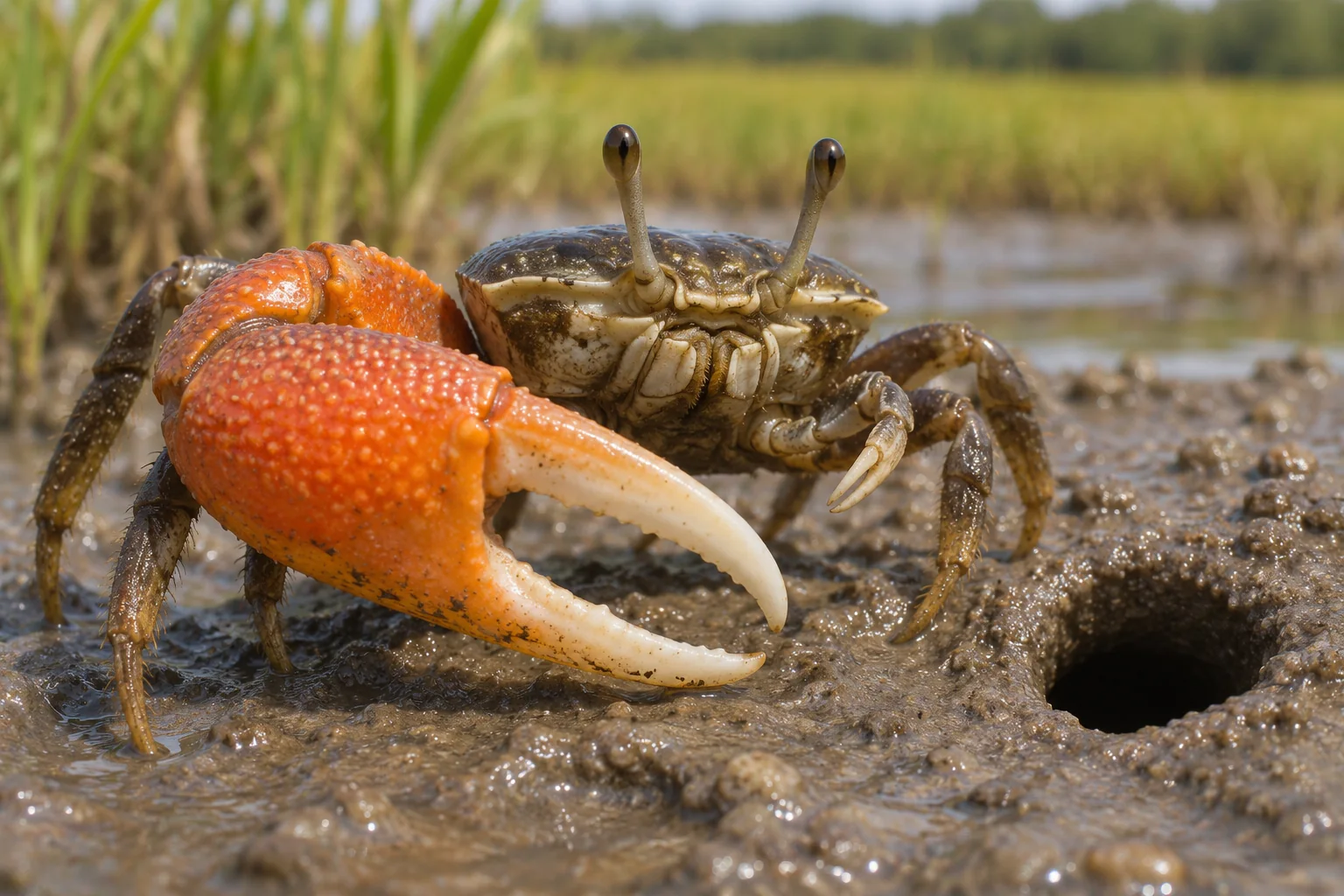
At low tide a male fiddler crab can appear to have brought the wrong utensil to dinner. One claw is big enough to draw the eye from several paces away. The other repeatedly lifts pinches of sediment to the mouth. Wait for another crab to approach and the oversized claw starts to earn its keep. Its owner can lift it into view, time a wave against a neighbour’s display, or use it when a dispute over a burrow turns physical.[1, 2]
The big claw serves both as a courtship signal and in contests between males. It is the smaller claw that does the delicate feeding. The familiar name makes more sense once you have seen the animal moving. A photograph preserves the remarkable difference in size. A few seconds of watching reveal two limbs doing strikingly different jobs.[1]
The little claw at mealtime
To a person looking across a mudflat, the food may be nearly invisible. A fiddler crab collects sediment and extracts small food particles from it. The fine movements of the feeding claw make sense at that scale. A female with two small claws can gather material from either side. An adult male with one greatly enlarged claw has only the small one available for this kind of feeding. Whether the large claw is raised or folded away, its owner still has to make a living one small scoop at a time.[1, 2]
The burrow helps explain why so much of the action takes place on one patch of mud. It offers shelter, including a quick retreat from danger. In some fiddler species it also plays a part in courtship and mating. A male displaying outside a burrow is therefore advertising from a place worth defending. A passing female and a neighbouring male can approach the same entrance with quite different consequences for the resident.[1, 2]
Imagine trying to interpret the scene from a silent clip that ends the moment the male lifts his claw. Calling it a challenge or an invitation would be premature. Watch which animal approaches, which one withdraws and whether either enters the burrow. Those extra seconds can change what the gesture means. The long claw makes a conspicuous signal at a distance long before the crabs are close enough to touch.
Why a bigger signal need not give a stronger pinch
Length is useful for a visual display. A long claw lifted above the body changes the animal’s outline against the mud. Pinching presents a different mechanical problem. The movable finger of a claw pivots at a joint. For a given turning effect at that joint, contact far out along the finger produces less force than contact closer in. Think of the jaws of a pair of pliers. A stubborn piece of wire is easier to squeeze near the pivot than at the very tips.
Where two males actually grip each other is therefore more revealing than which one has the longest claw tip. Observations described by Smithsonian researcher John Christy show males gripping with toothlike projections along the inside edge of the claw. Contact there allows a long display claw to apply force closer to the hinge. A single measurement from the hinge to the tip would miss that important detail of how the animal uses it.[1]
A replacement claw changes the experiment
Male fiddler crabs can lose a major claw and grow another. That natural event offers researchers a way to separate two things that otherwise tend to go together, the apparent size of a signal and its actual performance. In a study of the species identified in the paper as Uca annulipes, a regenerated claw could match an original claw in length while carrying less mass. Its owner could display an impressive outline with a less effective claw in a contest.[3]
The researchers found that males with original claws did not preferentially challenge opponents with regenerated ones, even though they were likely to win against them. Females searching for mates also did not discriminate against the regenerated form in that study. In the language of animal behaviour this is sometimes called a dishonest signal. It describes a mismatch between the visible trait and what it usually predicts. It tells us nothing about a crab consciously deciding to bluff.[3]
Consider what an observer would learn by measuring only photographs. Two silhouettes could have the same length. A scale might detect a difference in mass, a mechanical measurement a difference in force, and a record of encounters a difference in outcome. The female approaching a distant burrow does not get to run any of those laboratory comparisons. Which features are available to the receiver is part of the biology of a signal.[1, 3]
Why researchers made robotic crabs wave
On a crowded flat, the timing of the display matters as well. Neighbours of one Australian fiddler crab species can wave almost together. From a distance the movement looks like a group performance. One explanation would be that females are drawn to males performing in unison. Another would be that each male benefits from starting just before his neighbour, causing competing displays to bunch together. The same view of the mudflat fits both stories.[4, 5]
Researchers tested the difference with robotic displays whose movements they could schedule. They could present a leading wave, a following wave or coordinated movements while holding other features of the artificial males consistent. Females in that experiment strongly preferred the leader. The tests did not find a preference for synchrony itself. A crowd that looks as though it has rehearsed a routine can emerge from individuals competing to go first. That result belongs to the species and circumstances tested. Other kinds of fiddler crabs have their own display patterns.[4, 5]
Next time you catch a whole patch of claws waving, pick out just two neighbours and watch their beginnings. Then wait for the display to subside and look for the much smaller movements down by the sediment. The conspicuous claw starts the story, but it takes the feeding claw, the nearby burrow and a second crab to explain what you are seeing.
Keep exploring
Watch how crabs move across the shore, then compare the fiddler’s display with a honeybee’s dance.
Sources and further reading
- John Christy, Smithsonian Ocean — The design and use of the major claw
- North Carolina Coastal Reserve — Fiddler crab feeding, burrows and behaviour
- Backwell and colleagues — Dishonest signalling in a fiddler crab
- Reaney and colleagues — Testing the timing of courtship with robotic crabs
- Synchronous waving in fiddler crabs — A review
Keep exploring.
One remarkable idea at a time—nature, science, history and beyond.
Last updated November 19, 2026.

Barnakle Editorial Team
Barnakle Editorial Team is the collective byline used for Barnakle’s editorial articles. The contributor profile explains the team identity and links to the publication’s editorial policies.
More from the editorial team →