


The hidden sense that makes coordinated movement possible
What to know
- Proprioception is a family of signals, not one sensor or one brain region.
- Muscle spindles are especially important for sensing muscle length and change.
- The brain combines sensory feedback with predictions based on motor commands.
- Vision can compensate for poor proprioception, but does not replace it completely.
Close your eyes, lift one hand and touch your nose. You can usually complete the movement without watching your arm. The nervous system knows something about where the shoulder, elbow, wrist and fingers are, how quickly they are moving and how much effort the movement requires. That capacity is called proprioception: the sense of the body’s position and movement.
A sense that usually stays in the background
Vision and hearing arrive in consciousness as obvious sights and sounds. Proprioception often feels invisible because it is continuously folded into action. It helps you stand without staring at your feet, adjust a grip before an object slips and place one foot after another while walking. When the system works smoothly, the result is experienced as coordination rather than as a separate sensation.
Proprioception is not one receptor or a single “body map” stored in one place. It is a distributed process. Sensory endings in muscles, tendons, joints and skin send information toward the spinal cord and brain. Copies of outgoing motor commands supply predictions about the consequences of movement. Vision and the vestibular organs of the inner ear add further evidence. The nervous system continually combines these streams.
Muscle spindles measure change in muscle length
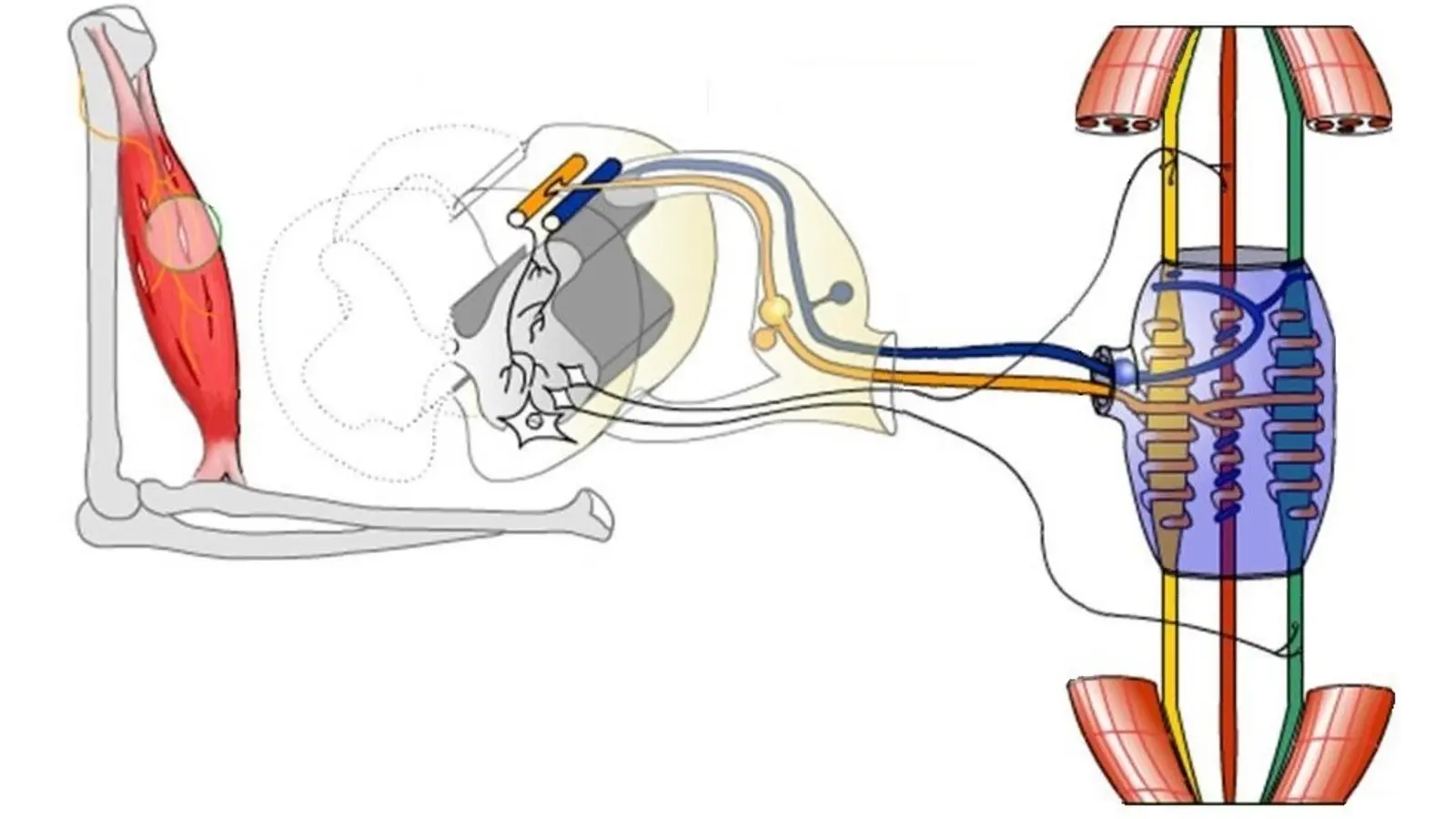
Muscle spindles are specialised sensory structures embedded among ordinary muscle fibres. Their sensory endings respond to muscle length and to changes in length. When a muscle is stretched, the pattern of signals travelling through sensory nerves changes. This gives the nervous system rapid information about limb motion.
Spindles are not passive tape measures. Small motor neurons adjust their sensitivity as the surrounding muscle contracts, helping the sensory apparatus remain informative across different movements. Their signals contribute to spinal reflexes as well as conscious and unconscious estimates of position.
A familiar reflex test illustrates one pathway. A brief tendon tap stretches a muscle, spindle signals enter the spinal cord and motor neurons rapidly activate the same muscle. The resulting movement does not require a slow conscious decision. Yet the same broad class of sensory information also ascends to brain systems that support perception and planned control.
Tendon organs, joints and skin add evidence
Golgi tendon organs lie near the junction between muscle and tendon and are especially sensitive to muscle force. Their information helps regulate force and contributes to the sense of effort. Receptors in and around joints can signal movement or position, particularly near the limits of a joint’s range. Stretch across the skin also changes systematically as fingers or limbs move.
No single source provides a perfect coordinate. Muscle signals can be ambiguous because several muscles cross a joint and because the same joint angle can occur under different loads. Skin stretch varies with contact. Joint receptors have different response ranges. The nervous system gains reliability by combining partially overlapping cues.
The spinal cord turns sensation into rapid control
Proprioceptive sensory neurons enter the spinal cord, where some branches connect into short reflex pathways. These loops can oppose unexpected stretch and help stabilise posture. Other pathways coordinate groups of muscles or carry information upward. Rapid spinal processing lets the body respond before a detailed conscious perception would be useful.
Reflex does not mean rigid. The brain can tune spinal circuits according to the task. Holding a full cup, landing from a step and writing with a pencil require different balances between stability and flexibility. Descending commands change the gain of sensory-motor pathways so that the same incoming signal can have different effects in different contexts.
The cerebellum compares prediction with feedback
The cerebellum receives rich information about intended movement and sensory consequences. It helps compare what the motor system expected with what actually happened. Differences between prediction and feedback can adjust an ongoing movement and drive learning over repeated attempts.
This is one reason a new movement may begin awkwardly and become smoother with practice. The nervous system refines internal models linking commands to outcomes. If someone wears prism glasses that shift the visual world, reaching initially misses the target. With repeated attempts, the brain adapts. When the glasses come off, the temporary after-effect reveals that the movement system had recalibrated.
The cortex supports conscious body position
Ascending proprioceptive pathways reach the thalamus and somatosensory regions of the cerebral cortex. Cortical activity contributes to conscious judgements about position and movement and connects body information with planning. Parietal regions help relate the body to nearby space, while motor areas use current-state estimates to prepare action.
The popular picture of a tiny person drawn across the cortex—the sensory homunculus—captures the idea that body regions have organised representations. It should not be mistaken for one complete body map. Representations overlap, change with experience and interact across many regions.
Prediction fills the gaps
Sensory signals take time to travel and be processed. Fast action would be unstable if the brain waited for delayed feedback before every adjustment. Motor commands therefore generate an internal prediction, often called an efference copy or corollary discharge. The system estimates what the movement should feel like and then compares that estimate with incoming evidence.
Prediction also helps explain why self-produced sensations can feel different from identical external events. The nervous system anticipates some consequences of its own commands. Unexpected discrepancies receive greater weight because they may indicate a changed load, obstacle or error.
What rare sensory loss reveals
Unusual neurological cases have helped scientists understand proprioception. People with profound loss of large-fibre sensory input may retain muscle strength yet struggle to control limbs without vision. Looking at a hand can partly substitute for missing position information, while darkness makes movement far harder. These observations show that motor commands alone are not enough for ordinary effortless coordination.
Genetic research has added another line of evidence. Variants affecting the mechanosensitive ion channel PIEZO2 can disrupt touch and proprioception, producing distinctive difficulties with joint position and coordinated movement. Such findings connect a molecular sensor to whole-body behaviour, while also showing that development and compensation can produce varied experiences.
Why balance is not the same as proprioception
Balance draws on proprioception, but the terms are not synonyms. The vestibular system senses head movement and orientation relative to gravity. Vision provides information about motion of the surroundings. Pressure under the feet and signals from muscles and joints describe contact and body configuration. Postural control integrates all of them.
When one source becomes unreliable, the nervous system can reweight the others. On a stable floor with eyes open, visual and somatic cues may agree. On a moving surface or in darkness, the system must place more trust elsewhere. This flexibility is why a simple “balance sense” cannot be assigned to one organ.
Proprioception can be trained, but claims need care
Practice can improve task-specific coordination and the use of sensory cues. Athletes, musicians, dancers and rehabilitation patients learn precise relationships between movement and feedback. Exercises that challenge position, force and stability may support performance in particular settings.
However, a broad claim that one drill universally “boosts proprioception” can hide important differences. Improvement may reflect strength, attention, confidence, strategy or familiarity with the test. Clinical programmes need to match the cause of difficulty and the individual’s needs. Persistent changes in sensation or coordination deserve professional assessment rather than self-diagnosis.
An estimate, not a perfect internal photograph
The brain does not carry a flawless real-time picture of the body. It maintains a useful estimate assembled from noisy, delayed and sometimes conflicting information. Illusions can expose that process. Vibration of a tendon can alter spindle activity and create a compelling sense that a stationary limb is moving. The experience shows that perception follows interpreted signals, not direct access to physical truth.
Every ordinary movement depends on this estimation system. Receptors convert stretch and force into neural signals; spinal circuits provide speed; the cerebellum compares prediction with outcome; cortical networks support awareness and planning. Proprioception is quiet precisely because these levels cooperate so well. It is the background calculation that lets the body become an instrument rather than a collection of parts.
Common questions
Is proprioception a sixth sense? It is often described that way, but human sensation cannot be divided neatly into only five or six categories. Balance, temperature, pain, internal-body signals and touch contain multiple specialised pathways. “Sixth sense” is a useful reminder that sight, hearing, smell, taste and touch are not the whole list.
Why does closing your eyes make some tasks harder? Vision provides an independent estimate of limb and environmental position. Removing it forces the nervous system to rely more heavily on proprioceptive, vestibular and tactile signals, exposing uncertainty that vision normally helps correct.
Does proprioception stay fixed? The receptors and pathways have biological constraints, but their use is adaptable. Growth, injury, fatigue, practice and changes in tools or surroundings can all alter calibration and strategy.
Sources and further reading
- Proske and Gandevia, The proprioceptive senses
- NCBI Bookshelf, Proprioception
- Tuthill and Azim, Proprioception
- Chesler et al., PIEZO2 and human mechanosensation
- National Institute of Neurological Disorders and Stroke
How Barnakle selects and verifies sources · Corrections and updates
Keep exploring.
One remarkable idea at a time—nature, science, history and beyond.
Last reviewed September 16, 2026.

Barnakle Editorial Team
A member of the Barnakle editorial team, exploring remarkable ideas with clarity, curiosity and care.
More from this author →