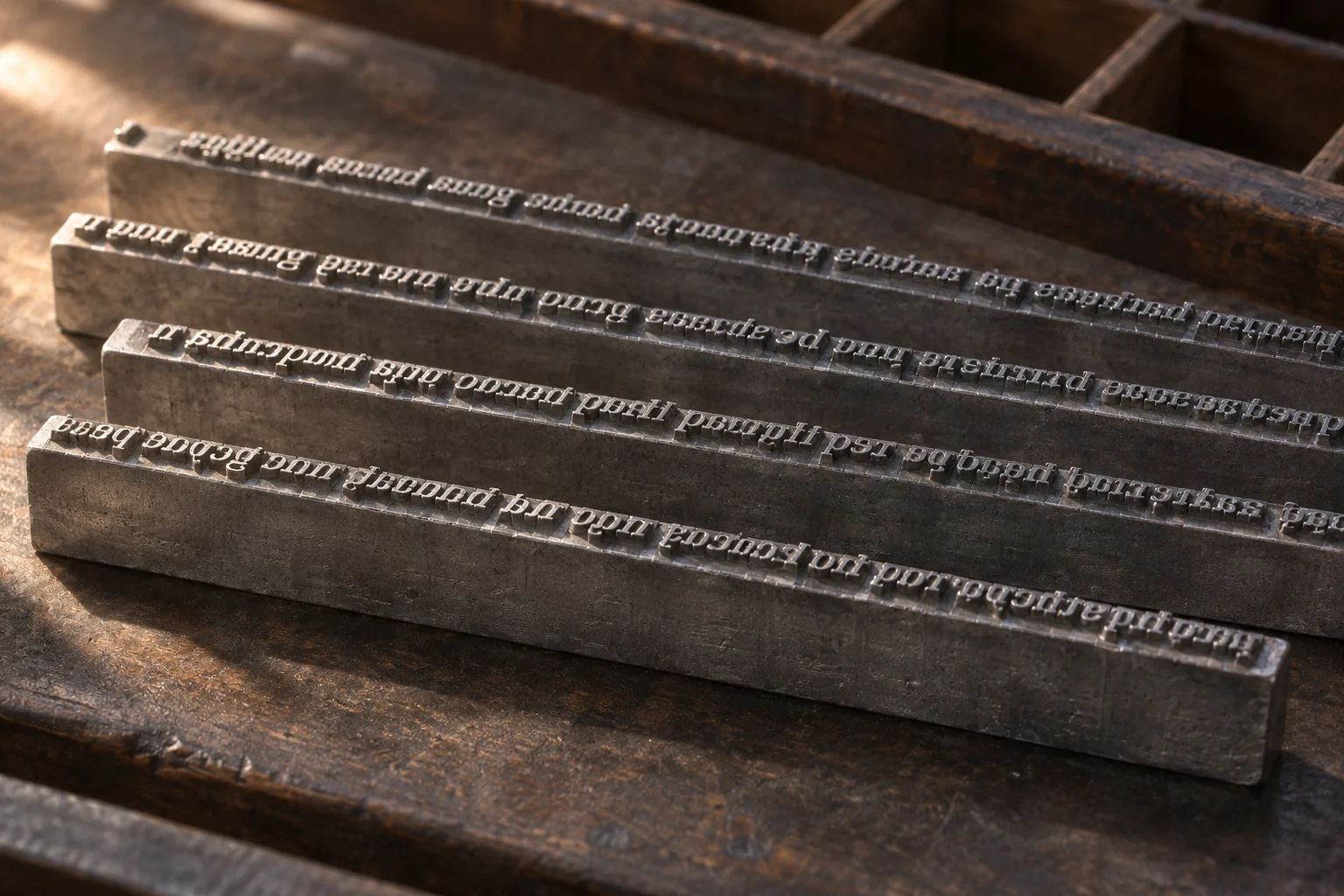
A compositor spots a spelling error in a newspaper proof. The mistake is one letter wide, but the replacement piece of metal is the width of the whole column. That was an ordinary consequence of setting copy on a Linotype. Pick up one of its finished pieces and you can hold a full line of raised, backwards letters between finger and thumb. Printers called this piece a slug.[1, 2]
The machine began with a keyboard, but pressing a key didn’t make a mark on paper. It released a small brass mould for a letter. Once the operator had assembled enough letters and spaces, the machine cast their impressions together as one line of type metal. The slug went to the printer. The letter moulds travelled back into the machine, ready to spell something else. Following those two journeys explains how a newspaper office could set column after column of fresh copy.[1, 2]
Two different pieces for the same letter
In hand composition a printer selected individual pieces of type from a case. Each carried a raised letter on its printing face. If a line needed five copies of e, the compositor needed five physical pieces of e type. The Linotype also needed to supply repeated characters, but the parts waiting above the keyboard were matrices. A matrix carried a recessed character along one edge. It supplied the shape into which metal would flow.[1, 2]
Imagine an operator setting the word “letter.” Pressing t twice released two matrices bearing the same character. Both had to be present when that line was cast. The machine could stock many copies of common matrices in channels in a magazine overhead. A mechanism at the foot of a channel released one when called for and held back the rest. That humble counting job was crucial. A key that released the entire supply of t’s would have been little use on a deadline.[1, 2]
The matrices arrived in sequence in an assembler. By this stage the operator had composed a word, but still had no piece of metal from which that word could be printed. The distinction was useful. Characters could be examined and an error caught while the line was still a collection of separate pieces. Once the metal was cast, a corrected line would generally have to be set and cast again.[1, 2]
How does a line come out exactly the right width?
Newspaper columns present an awkward arithmetic problem. Even if an editor chooses short words, successive lines of words and punctuation rarely add up to the same width. A compositor can even out the right-hand edge by distributing a little surplus room among the spaces. Imagine a line that comes up two millimetres short with four gaps between words. Sharing the shortfall among the gaps makes a smaller visual interruption than leaving a two-millimetre hole in one place.[1, 2]
The Linotype put a mechanism in each gap. Pressing the space key dropped a spaceband into the line. Each band contained sliding wedge-shaped parts. When the line went to the casting position, the machine pushed the bands upward. As the wedges slid against one another, the spaces between words widened until the line filled the chosen measure. The operator still had to choose a sensible break between words. The mechanism could distribute available room only within its range.[1, 2]
This explains a small pleasure of looking at old justified newspaper columns. Run your eye down the right margin and it can seem ruled. Run your eye through the lines and the spaces vary. Those two observations are connected. The even edge is partly the result of many small adjustments out in the middle, where nobody was supposed to notice them while reading the news.[1, 2]
The metal takes an impression
For casting, the assembled matrices and spacebands were clamped against a mould. Molten type metal entered the cavity and filled the shallow letter impressions along one face. As it solidified, the type in a line became one piece. The machine trimmed and ejected the slug. If you could turn that slug toward a mirror, the raised letters would read the way they would appear after a printing press transferred ink from their faces to a sheet.[1, 2]
A printer could arrange successive slugs in order and move whole lines during page makeup. The solid strip also explains why correcting the spelling error in our opening example meant replacing a line. With separate hand type, a compositor might exchange one letter and adjust its neighbours. On a slug the wrong letter and the two correct letters beside it are part of the same casting. Once the printer had finished with the metal, it could be melted down for future lines.[1, 2]
The alphabet sorts itself
At the end of the casting cycle, the machine faced an entirely different job. The brass matrices were too valuable to travel away with the slugs. An elevator carried them to a distributor near the top of the machine. Each matrix had teeth arranged in a particular pattern. As it travelled along a specially shaped bar, that pattern determined where it lost support and fell into its proper magazine channel. The spacebands followed their own return route.[1, 2, 3]
Think about a name that appears six times in a news report. The machine doesn’t need a compartment for the whole name. It needs enough copies of each matrix, a way to deliver them in the order selected by the operator, and a way to put them away for the next call. One sequence of pieces could spell a town, a time or an election result. A few moments later those same pieces could be back in alphabetic service while the printed lines remained together.[2, 3]
Why the newspaper was a natural home
Ottmar Mergenthaler’s machine entered commercial newspaper service at the New York Tribune in 1886. Narrow columns of continuous text gave the machine exactly the work at which it excelled. Later Linotype models enlarged the range of sizes and styles a shop could set. Some carried multiple magazines. A newspaper could call on different faces for editorial copy, subheadings and other work while retaining the principle of the cast line.[1, 4, 5]
A page from that era gives little hint of all this movement. The reader meets a quiet row of ink marks. At the print shop, each row had existed first as a temporary gathering of brass parts and then as a solid strip of metal. One version of the sentence was dismantled almost as soon as it was made. The other lasted just long enough to deliver the news.[1, 2]
Related reading
Sources
- Letterpress Commons — Linotype and Intertype
- Linotype Machine Principles — Matrices, spacebands and the casting cycle
- CircuitousRoot — Linotype and Intertype history and mechanics
- Amalgamated Printers’ Association — The Linotype at the New York Tribune
- Linotype archive — Development of Linotype models and magazines
Keep exploring.
One remarkable idea at a time—nature, science, history and beyond.
Last updated November 22, 2026.

Barnakle Editorial Team
Barnakle Editorial Team is the collective byline used for Barnakle’s editorial articles. The contributor profile explains the team identity and links to the publication’s editorial policies.
More from the editorial team →