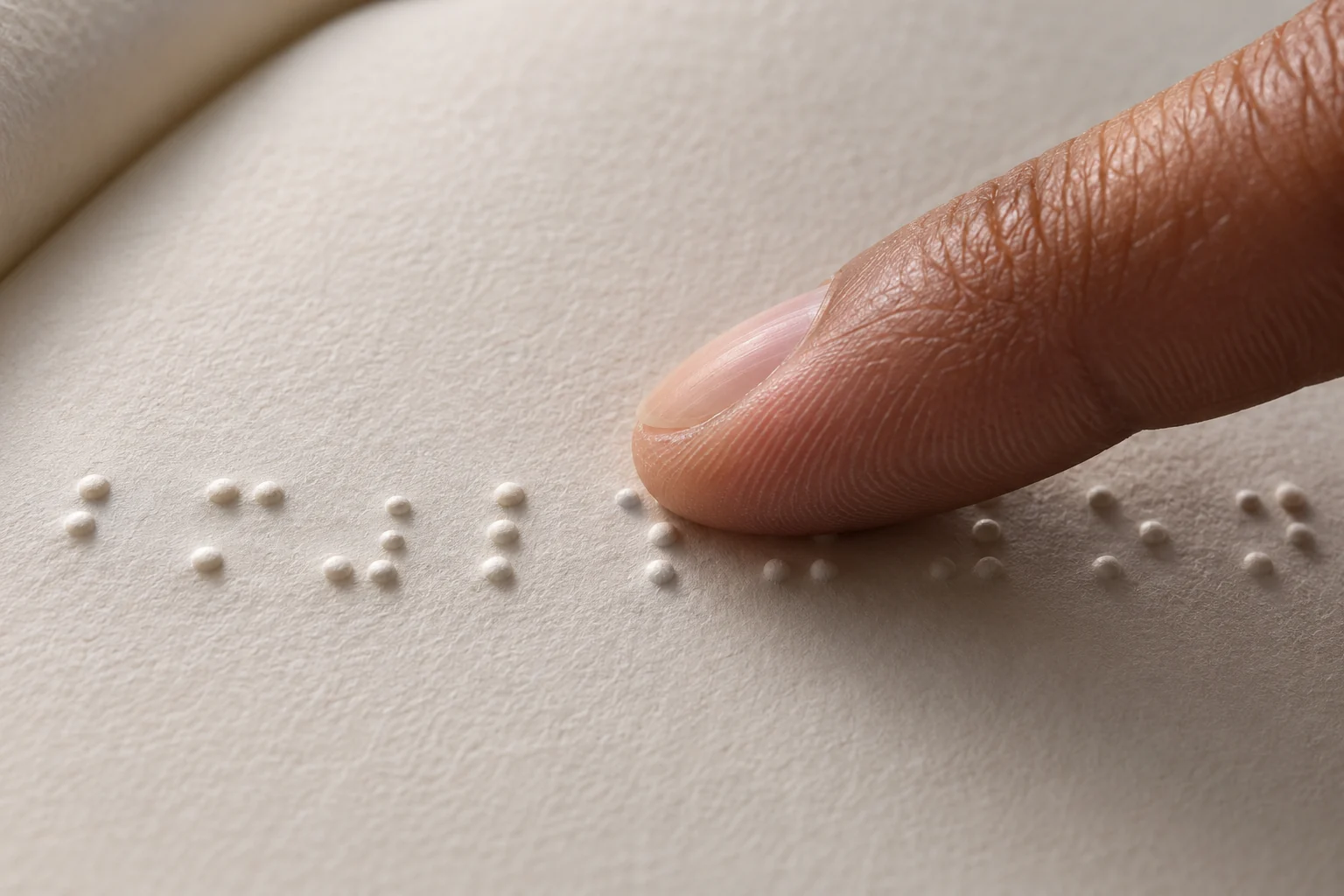
A single raised dot near the upper left corner of a braille cell can mean the letter a. Put a particular four-dot sign in front of it and that same dot can mean the number 1. The paper under the reader’s fingertip hasn’t changed at that spot. What changed is the instruction the reader encountered one cell earlier. It is a neat way to get an alphabet, numbers and much more out of a space just two dots wide.[1, 2]
In ordinary six-dot braille, each cell has two columns of three possible dot positions. Some positions are raised, others left flat. A reader moves along a line feeling the arrangements in sequence. Each has a reliable orientation and a place in a writing system with spelling, punctuation and spacing. Once you know where the positions are, you can describe a character precisely over the phone without the other person ever seeing your page.[1, 2]
Where dot four lives
Picture two narrow columns beside each other. On the reading side of the page, the positions in the left column are numbered 1, 2 and 3 from top to bottom. The right column runs 4, 5 and 6 in the same direction. The letter b has dots 1 and 2, a short vertical pair on the left. The letter c has dots 1 and 4, the two top corners. Both letters use two dots. It is their location, including the empty space around them, that makes the difference.[1, 2]
Six positions, each either raised or flat, give 64 possible combinations. One of those is completely blank, leaving 63 with at least one raised dot. Print has an apparently inexhaustible supply of shapes, including lower- and uppercase letters, digits and punctuation. Braille gets comparable range by combining cells and giving certain signs a special role. A single uppercase letter, for example, can be introduced with a capital indicator. The shape of the letter itself can stay familiar.[1, 2]
Read the same two cells twice
In uncontracted English braille, try a sequence with the shape for a followed by the shape for b. In ordinary letters it reads ab. Put the numeric indicator before that pair and the same two shapes stand for 12. The numeric sign uses dots 3, 4, 5 and 6. Its job is to tell the reader how to interpret what follows. The first ten letter shapes can then do a second job as the digits 1 through 9 and 0.[2]
This makes a number like 100 particularly instructive. It begins with one numeric indicator, followed by the shape for a and twice the shape for j. There is no reason to interrupt the reader with another indicator before each zero. The rules specify where numeric mode continues and where it ends. Writing conventions do similar work in print whenever a shared sign changes meaning in context. A decimal point and a full stop can put the same mark to quite different uses.[2]
Contractions extend the system in a different direction. In contracted English braille a sign can stand for a common group of letters or a whole word under specified conditions. That saves room on a page where every cell must remain physically large enough to distinguish by touch. Uncontracted material spells words out letter by letter. Someone can therefore transcribe the same English sentence in more than one appropriate form, depending on the edition and its readers.[1, 2]
How do you write on the back of a page?
A traditional slate holds paper between a guide and a grooved backing. The writer presses a stylus into selected positions, creating a bump on the far side. Imagine pushing a dent into a piece of foil and turning it over. A hollow on the working side becomes a raised point on the reading side. With an ordinary downward-writing slate, the writer progresses from right to left so the line reads from left to right when the page is turned.[1, 3]
A braillewriter changes that experience. Its six main dot keys correspond to the six positions. To write c, a person presses the keys for dots 1 and 4 together, rather like playing a two-note chord on a piano. The machine embosses the cell in one action. A space key moves on without adding any dots. Someone taking notes can work directly along the reading line and check the last character without removing and turning over the sheet.[1, 3]
A student who wanted to write
Louis Braille developed his six-dot method as a young blind student in nineteenth-century France. Earlier systems let readers trace the shapes of raised print letters. The ability to produce one’s own notes or correspondence was another matter. Braille acknowledged Charles Barbier’s contribution to writing with raised dots in the preface to his first publication in 1829. He made a compact system that gave a writer control of spelling and supplied a practical way to put it on the page.[3, 4]
The same grid has travelled far beyond French or English. An exhibition at the Library of Congress includes braille used to write Karen in Southeast Asia, as well as examples of music notation. Two readers can recognize the same physical arrangement under a finger yet need different knowledge to interpret the surrounding text. Learning the dot positions is like learning how letters are formed. Fluency also means learning the conventions of the language or notation being read.[1, 5]
When the page is a row of pins
On a refreshable braille display, small pins rise or fall to present characters supplied by a computer or other device. Move to the next passage and the same strip of hardware forms a fresh line. The surface can change while a reader keeps a hand in place. A file can also go to an embosser to produce a paper copy. The same passage can therefore travel in a pocket and later take up several pages on a desk.[1, 5]
Think back to that solitary raised dot. On paper it might belong to a shopping list. Under a fingertip on a display it might be part of the price of an item. In either place, the reader can recover the exact letter or digit from its position and its neighbours. Six small places leave enough room for a writer to say precisely what they mean.[1, 2]
Related reading
Sources
- Library of Congress, National Library Service — About braille
- CNIB — Reading Uncontracted Braille, including numeric mode
- Perkins School for the Blind — How the brailler changed writing
- Perkins School for the Blind — Louis Braille, Charles Barbier and the historical record
- Library of Congress — Objects from the Louis Braille exhibition
Keep exploring.
One remarkable idea at a time—nature, science, history and beyond.
Last updated November 22, 2026.

Barnakle Editorial Team
Barnakle Editorial Team is the collective byline used for Barnakle’s editorial articles. The contributor profile explains the team identity and links to the publication’s editorial policies.
More from the editorial team →