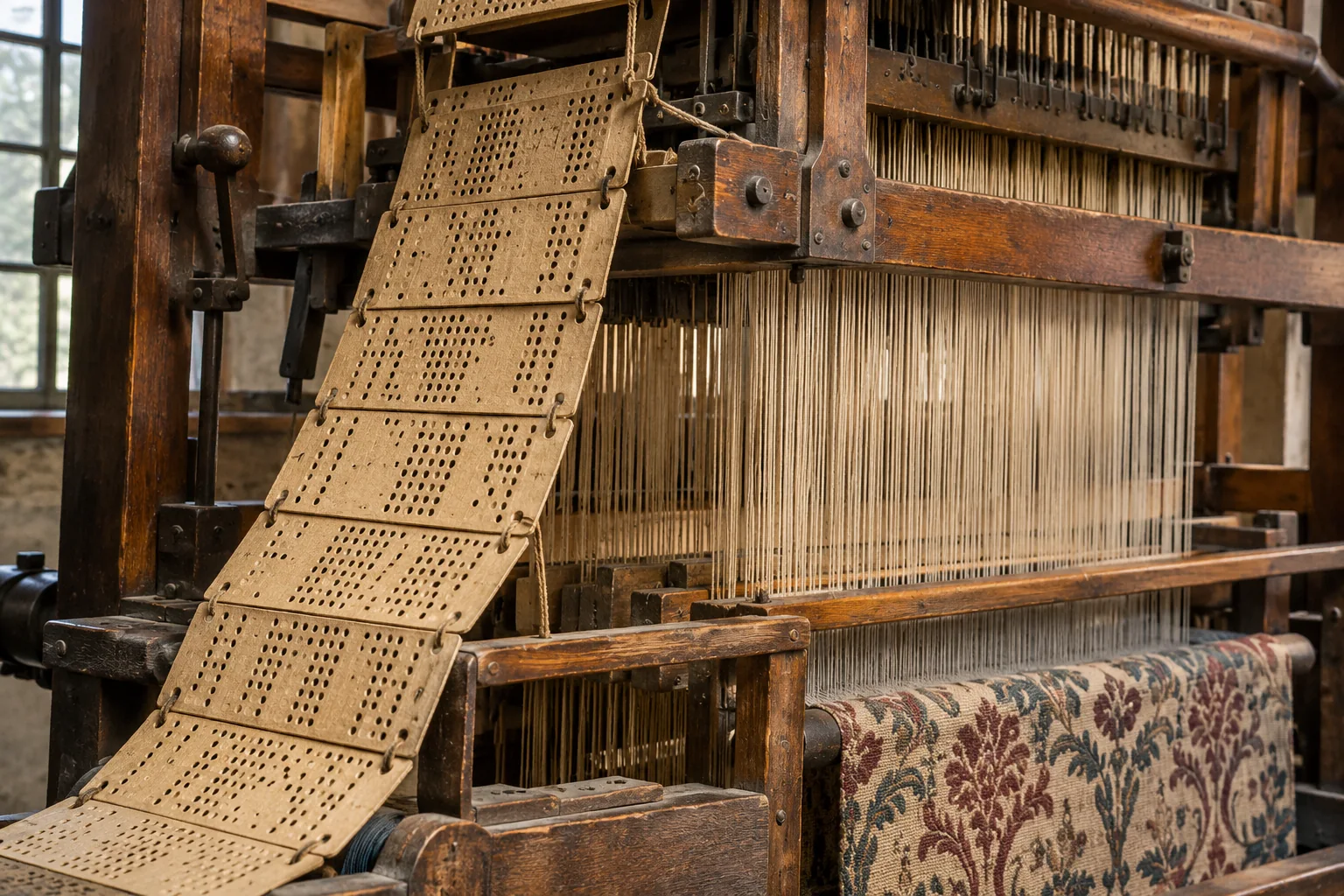
Watch the chain of cards on a Jacquard loom and one detail gives the mechanism away. The cards advance a step at a time. Each card makes a selection for one passage of the crosswise yarn. Holes allow some sensing needles through while solid card pushes others back. The mechanism translates that difference into a choice of lengthwise threads to lift. Across the width of a cloth, and over many successive passes, those choices turn a stack of perforated rectangles into a woven flower, stripe or portrait. [1, 2]
The decision behind one line of cloth
A loom holds a set of lengthwise threads called the warp under tension. A weaver needs a gap, called a shed, between raised and lowered warp threads so that the weft can pass across. After each pass, or pick, the weft is beaten into place. The next opening determines which lengths of warp will lie above or below the next pick. At every crossing, the yarn on top helps determine what the eye sees on the face of the cloth. [1, 2]
Think of cream warp and dark blue weft. Where cream warp lies above the blue yarn it covers some of the blue. In an adjacent area the weft may lie on top for a longer stretch and show a darker patch. A flower can emerge from many such local differences. Exactly how it looks depends on yarn thickness, colour, sheen and the underlying weave. A diagram of the thread crossings can specify the arrangement precisely while giving only a rough idea of the finished surface.
From a hole in a card to a lifted warp
On the historic hand loom described by the Science Museum Group, a card is presented against an array of needles. Where a hole lines up, the corresponding needle can enter it. At a solid position the card displaces the needle, moving the associated hook out of reach of the lifting mechanism. The hooks that remain in position are caught and lifted. Cords carry the movement down through the harness to the selected warp ends. The work of lifting comes from the loom. The thin card only has to make the selection. [1]
Follow one position through three picks. Suppose the first card selects its hook, the next card also selects it, and the third moves it out of reach. In a simple direct arrangement, the associated warp stays on the raised side for the first two weft passes and changes sides on the third. Now follow the neighbouring position through the same three cards. It can have a completely different sequence. That independence across the width is what allows a leaf to taper to a point while the adjoining ground continues in its own weave.
Why the cards are tied in a chain
The position on a card and the position in the chain answer different questions. The first identifies which hook is being addressed. The second says when its selection applies. Cards lace together through separate fastening holes so the loom can present them in the intended order. Registering each one accurately matters because a correctly punched pattern shifted sideways would give instructions to the wrong set of hooks. Surviving chains in museum collections make both the pattern holes and the physical sequence visible. [3]
Consider a pattern that repeats every twelve picks. If its twelve cards cycle in order, the loom can repeat the sequence as the cloth grows longer. Double the number of picks in a repeat and the chain needs twice as many steps for that design. Widening the repeat raises a different problem. It calls for enough independently selected positions across the warp, or a harness arranged to repeat the motif across the width. Adding more cards to the end of a chain alone cannot create more independently controlled hooks.
The design work happened before the loom started
A designer could lay the motif out on squared paper, translating a curved outline into decisions at thread crossings. Card preparation transferred the planned selections to a durable series of holes. The Science Museum Group holds a tool made specifically for punching Jacquard cards. Seen beside the cards themselves, it explains an easily missed part of the work. Before a single pick of a new design could be woven, someone had to plan the pattern, punch it, assemble the chain and check the sequence. [2, 4]
Imagine an error on a single card in a repeated border. If one hole is misplaced, the same wrong crossing may reappear at regular intervals down the finished fabric. A broken yarn, by comparison, can leave a fault running along the warp after the break. Those different signatures suggest different places to look for a problem. One leads back to a step in a stored repeat. The other leads to a physical thread on the loom.
What a loom contributed to the history of computing
The connection runs through the portability of the instructions. A new set of cards could direct the same selection mechanism through a different design. Charles Babbage drew on the punched-card principle for his proposed Analytical Engine, where cards would direct mathematical work. National Museums Scotland traces that connection through both textile machinery and the people who developed accounts of the engine, including Ada Lovelace. [2, 5]
A surviving piece of patterned cloth is a particularly good way to see how far that comparison goes. The chain can order the warp selections, yet the same chain used with different coloured yarns can produce quite different cloth. Likewise, changing the yarn tension can change the spacing of a design without altering any of its holes. The old machinery divided a complicated job into decisions that could be saved on cards and physical adjustments that stayed with the weaver. Look at the lacing on a museum chain and you can see where two kinds of expertise met. [1, 3]
Keep exploring
Explore two other physical ways of representing information, from printed bars to a mechanism that tracks cycles in the sky.
Sources and further reading
The collection records show the loom, cards and punch as separate objects. The museum histories trace the route from textile design to Babbage’s proposed engine.
- Science Museum Group Collection — Jacquard hand loom
- National Museums Scotland — The Jacquard loom and its place in textiles and computing
- Science Museum Group Collection — Jacquard cards
- Science Museum Group Collection — Hole punch for making Jacquard cards
- Computer History Museum — Punched cards control a Jacquard loom
Keep exploring.
One remarkable idea at a time—nature, science, history and beyond.
Last updated November 18, 2026.

Barnakle Editorial Team
Barnakle Editorial Team is the collective byline used for Barnakle’s editorial articles. The contributor profile explains the team identity and links to the publication’s editorial policies.
More from the editorial team →