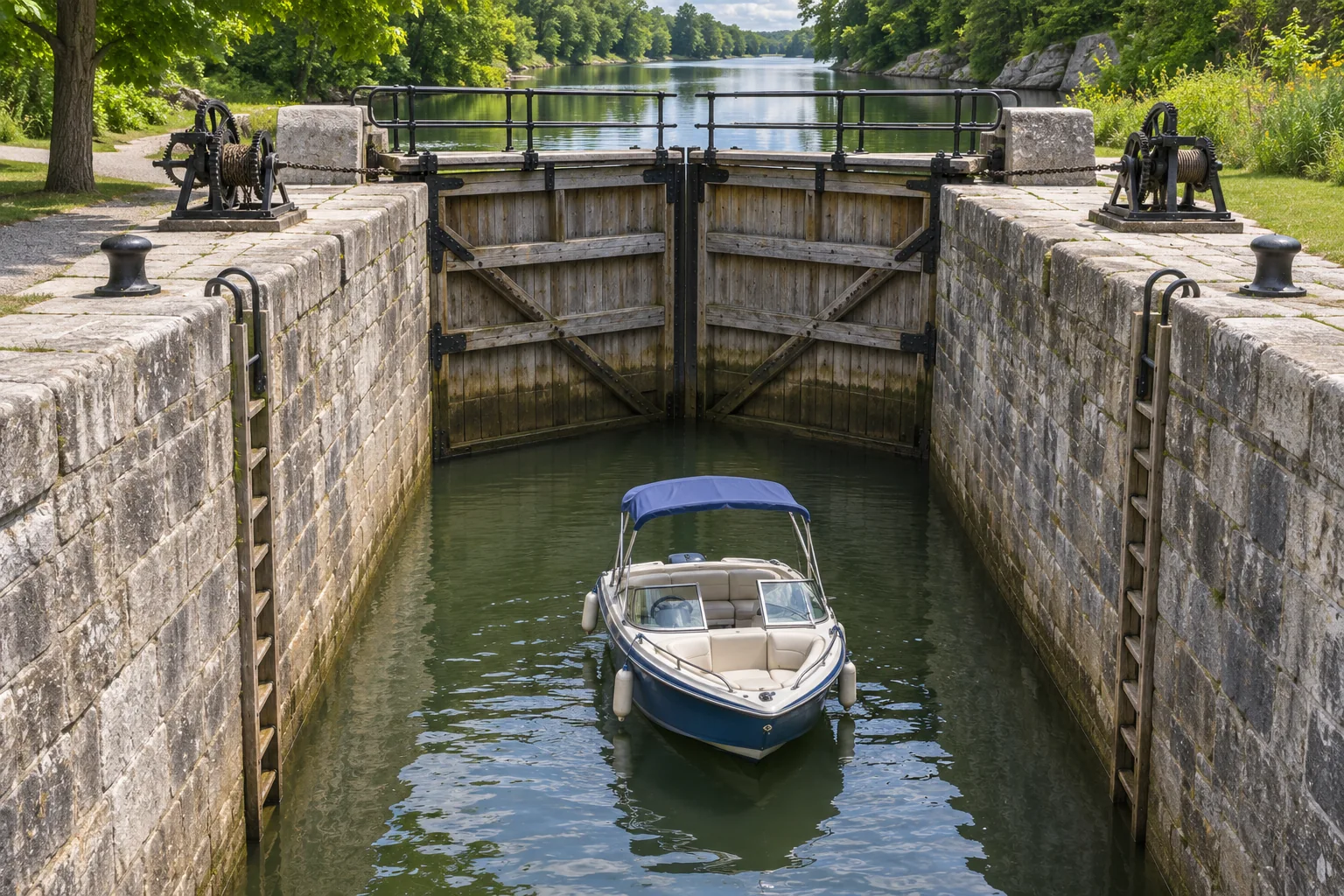
Watch a boat come up through a canal lock and keep an eye on a single stone in the chamber wall. At first the stone may be above the cabin roof. A few minutes later it is below the waterline. The chamber floor has stayed put. Water admitted from the higher stretch of canal has raised the surface, and the floating boat has risen with it. The gates at either end make this possible by letting the chamber match one water level at a time. [1, 2]
The two levels on either side of the gate
Imagine two stretches of quiet canal, one three metres higher than the other. Open a wide channel between them and the higher water rushes downhill. A boat would face a strong current and a drop. A lock breaks that connection into stages. Its chamber has a gate at each end, with smaller passages whose valves control the exchange of water. A closed gate holds the difference in level while the opposite end is open to boats. [1, 2]
The word “empty” can be misleading when you hear someone say that a lock is emptying. In normal operation an emptied chamber still contains water, and it must be deep enough at the lower level for the boat to float over the entrance sill. Filling means bringing the chamber up to the higher navigation level. Emptying means bringing it down to the lower one. The working volume is the difference between those two states.
One uphill passage, seen from the bank
Start with the chamber at the lower water level. The lower gates open, the boat enters, and the gates close behind it. With the route to the lower channel shut, the operator opens the filling valves. Water enters from the upper side. As the surface rises, the boat continues to displace its own weight in water. Its position relative to the chamber wall changes, while the distance between the waterline and the top of its hull stays much the same. [1, 3]
The inflow slows as the difference in level decreases. When the chamber reaches the upstream level, the gates at that end can open and the vessel leaves on the upper waterway. For a downhill passage the sequence reverses. A boat enters a chamber already at the upper level. Water then drains into the lower reach until the boat can float out through the lower gates. The familiar hand-operated locks on Canada’s Rideau Canal put each part of this sequence in plain sight. [1, 3]
Someone standing on deck experiences a vertical journey without the sensation of being hoisted by a cable. Weight acts down and buoyancy acts up throughout the passage. As the water rises under the hull, it briefly immerses a little more of it. The increased buoyancy brings the boat up with the surface. Under a gently changing level, the difference from ordinary floating equilibrium is too small for a person watching from shore to notice.
Why gates and valves do different jobs
At a pair of traditional mitre gates, the two leaves meet at a shallow angle in plan. The point faces the higher water. Pressure from that side helps press the leaves together when they are closed. Trying to swing a gate against a substantial difference in water level would mean working against an enormous force across its face. A smaller valve gives the operator a manageable way to change levels before moving the gate that a whole vessel must pass through. [1, 2]
Where the water enters matters to the people on deck. At Panama’s original locks, large culverts run along the chambers and feed smaller passages below the floor. Numerous floor openings distribute the inflow. On the Rideau, Parks Canada describes opening the filling sluices gradually to limit turbulence. One system spreads the delivery across many outlets. The other example shows why the speed of opening a valve also matters. A gentle average rise can still conceal a strong local jet. [1, 2]
How much water makes one lift?
For a simple rectangular chamber, multiply the surface area by the change in level. Suppose a chamber 40 metres long and 8 metres wide raises its surface by 3 metres. The difference is 960 cubic metres, or roughly the volume of 960,000 one-litre bottles. This idealized calculation ignores leaks and details of the walls. It shows why a modest-looking lift can move so much water when the chamber is long enough to take several boats.
Does the calculation change if a boat is present? Compare the low and high states with the same freely floating boat inside. It displaces about the same volume at each level. Subtract that hull volume from both states and it cancels in the difference. The water needed to raise the level in this example is therefore about the same whether one small boat or several boats make the rise together. Over a whole canal, the sequence of passages, gate leakage and the way locks share water also affect the total supply required.
Where the water goes after the boat leaves
Gravity can transfer water from the high reach to the chamber, then from the chamber to the low reach. It cannot return that water uphill for the next boat. A lock flight divides a large change in elevation into several steps, but it still needs a supply of water at the top. Water management becomes particularly visible on a busy route where many lockages draw on the same reservoir. [2, 4]
One way to reduce that demand is to save some of the water at intermediate elevations. The expanded Panama Canal locks have side basins that receive water as a chamber drains and return it during a later fill. The Panama Canal Authority describes a design that can reuse about 60 percent of the water per lockage. A basin can supply a chamber while its own water stands higher than the chamber and accept water while it stands lower. The order of those transfers is what makes the stored water useful. [4]
Back at the wall, the best clue that the lift has finished comes just before the gates move. When the surfaces on either side have settled to the same height, the upstream gate has finished its job as a dam for that passage. It can now become a doorway.
Keep exploring
Compare how a submarine changes its buoyancy and how a brake system uses pressure to transmit a force.
Sources and further reading
The Rideau and Panama sources describe two specific lock designs. The volume calculation uses a hypothetical rectangular chamber.
- Parks Canada — How a lock works on the Rideau Canal
- Panama Canal Authority — Design of the original locks
- Parks Canada — Locking through on the Rideau Canal
- Panama Canal Authority — Water-saving basins at the expanded locks
Keep exploring.
One remarkable idea at a time—nature, science, history and beyond.
Last updated November 18, 2026.

Barnakle Editorial Team
Barnakle Editorial Team is the collective byline used for Barnakle’s editorial articles. The contributor profile explains the team identity and links to the publication’s editorial policies.
More from the editorial team →